| The University of Connecticut School of Pharmacy and Pharmaceutical Sciences is accredited by the Accreditation Council for Pharmacy Education as a provider of continuing pharmacy education. Statements of credit for the online activity ACPE UAN 0009-0000-26-055-H04-P/T will be awarded when the post test and evaluation have been completed and passed with a 70% or better. Your CE credits will be uploaded to your CPE monitor profile within 2 weeks of completion of the program. |  |
Content
Learning Objectives
After completing this continuing education activity, pharmacists and pharmacy technicians will be able to
- DESCRIBE the origin of the modern health insurance system in the United States
- EXPLAIN how prescription drug coverage evolved into a component of modern health insurance plans
- DESCRIBE common cost-sharing strategies used by prescription drug plans
- IDENTIFY ways that pharmacy staff can help patients experiencing insurance-related difficulties at the pharmacy
INTRODUCTION
Daphney is a new pharmacy technician at Mystery Incorporated Pharmacy, and insurance issues are quickly becoming the most challenging part of her job. Between claim rejections, prior authorizations, and figuring out when to bill Medicare Part B, the world of pharmacy insurance feels like a spider web to her. This continuing education activity follows Daphney through a series of real-world situations she encounters during her first week in the pharmacy.
MONDAY: Daphney is processing prescriptions for a patient, Mr. Shaggy, when he wonders aloud how health insurance came to exist in the first place. Daphney has often wondered about this, too. She realizes that to become a more effective pharmacy technician, she must understand the importance of the historical foundation of health insurance in the United States (U.S.).
Brief History of the U.S. Health Insurance System.
In the early days of American health care, there was no formal health insurance system.1 If patients needed medical care, they usually paid out-of-pocket. The earliest health coverage came in the form of mutual aid societies, in which workers pooled money together to help cover burial costs and support families who lost a breadwinner. Over time, some of these societies became insurance companies, while others became labor unions.
As medicine advanced, treatment increasingly shifted from the home to physicians’ offices and hospitals, especially for more serious conditions. As a result, a family could spend 8% to 13% of its annual income on health care. The increasing cost of medical care contributed to growing interest in mechanisms for financing and spreading the risk of health care expenses.1
The Baylor Model and the Rise of Blue Cross Blue Shield
In 1929, Dallas schoolteachers approached Baylor University Hospital with a simple request.2 They wanted a predictable, affordable way to pay for hospital care. The hospital designed a plan: each teacher paid $6 a year. In return, the hospital covered up to three weeks of hospitalization. The plan attracted more than 1,500 enrollees and became an early model for prepaid hospital coverage.
This arrangement became the blueprint for what we know now as Blue Cross. In 1939, the American Hospital Association officially gave these hospital plans the Blue Cross name and logo. Around the same time, physicians created their own version, and by 1946, physician-run prepaid plans had united to form private insurance.2
Introduction of Employer-Based Health Insurance
Even with the popularity of private insurers, most employers did not directly provide health insurance to their employees.1 A major shift occurred during World War II as the federal government sought to control inflation. Congress passed the Stabilization Act of 1942, which authorized the federal government to stabilize prices, wages, and salaries. This law limited how much employers could raise workers' wages. Employers then began offering health insurance to attract employees instead of raising wages.1
In 1943, the Internal Revenue Service ruled that employer-paid group health insurance premiums were not taxable income to employees.1
When employer-sponsored health insurance first became common, many plans covered physician and hospital services but did not cover outpatient prescription drugs.2 Patients who wanted prescription coverage could purchase a prescription drug rider, an optional addition to their health insurance policy that provided drug benefits for an additional cost. As prescription medications became central to treating chronic disease, prescription coverage gradually evolved from an optional rider into a standard benefit offered by most health plans.2
TUESDAY: Daphney is about to process a prescription for Ms. Velma when she notices that the insurer rejects the claim with the message, “Non-formulary drug, prior authorization required.” Ms. Velma is confused and asks Daphney to clarify those terms. Like Daphney, pharmacy technicians are often among the first points of contact for patients in the pharmacy and may be asked to answer questions about prescription drug coverage. Understanding basic insurance terms is an important first step in helping patients navigate coverage problems.
KEY DEFINITIONS AND INSURANCE BASICS
Cost sharing divides the cost of health care services between patients and health insurance plans.3 Rather than covering the full cost of a service, the health plan requires the patient to pay part of the allowed amount.3 Common cost-sharing mechanisms include:
Deductible: the amount a patient must pay out-of-pocket each year before the health plan begins paying for covered services or medications subject to the deductible.4
- At the Pickup Counter: Patients may be responsible for some or all of the plan's allowed cost for a medication subject to the deductible.
Copays and Coinsurance: Once the patients meet their deductible, they may need to share the cost using these two methods. A copay is a fixed dollar amount the patient pays for each prescription or service. This flat fee is the same throughout the coverage period, regardless of the drug's cost. On the other hand, coinsurance is a percentage of the allowed cost of the service or medication.4
- At the Pickup Counter: The patient may have to pay the co-insurance or copay at pickup.
PAUSE AND PONDER: A frustrated patient presents a manufacturer's copay card for an expensive medication. He is confused about why his out-of-pocket costs have increased, even though he has used the copay card for the last few months. He believes he should have met his deductible by now. How would you explain this situation to him?
Copay maximizers and copay accumulators5: Insurers use these strategies to control costs at the point of sale by limiting the use of external price reduction techniques (discussed below). External price reduction techniques lower the patient’s costs at the counter each month; however, they do not help the patient make progress toward their deductible or out-of-pocket maximum over time.
- With copay accumulators, patients can use a manufacturer's copay card to help pay their cost-sharing obligation each month. These cards often have a limited amount of money on them. Once patients expend all available funds on the copay card, patients become responsible for the applicable cost-sharing amount until they meet their deductibles; the copay card does not count toward their deductible.
- With copay maximizers, the insurance plan takes the full yearly value of the manufacturer's copay card and divides it evenly across 12 months, rather than letting it run out after just a few months. This can make the patient's monthly costs more predictable. However, no matter how it's spread out, this copay assistance still does not count toward the patient's deductible. For example, George's medication has an allowed cost of $6,000 per month. Under the copay-maximizer program, the plan adjusts George's monthly cost-sharing obligation to $1,250—the monthly portion of the manufacturer program's $15,000 annual benefit. Manufacturer assistance pays that $1,250. The medication's remaining allowed cost is handled according to the plan's benefit design; George does not automatically owe the remaining $4,750. However, the manufacturer's payment generally does not count toward George's deductible or annual out-of-pocket maximum.
Copay-maximizer programs vary considerably, so pharmacy staff should verify the patient’s benefit structure and the manufacturer program’s terms rather than promising that the patient will owe nothing throughout the year.
- At the Pickup Counter5:
- With copay accumulators, patients may experience an increase in out-of-pocket costs once the manufacturer's copay card runs out.
- With copay maximizers, the insurer applies the manufacturer’s copay card throughout the year, but the patient’s deductible remains unmet.
Formulary: A formulary is the list of prescription medications a health plan covers. Health plans update formularies as medications enter or leave the market, shortages occur, and prices change.6 The primary purpose is to encourage the use of safe, effective, and affordable medications. Many insurance companies operate with tiered systems that determine the amount patients will pay for their medications. Insurers generally place the most cost-effective medications, usually generic drugs, in lower tiers, which means patients pay less out-of-pocket for them.7 They place medications that are more expensive, such as many brand-name or specialty drugs, in higher tiers, which results in higher out-of-pocket costs for the patient.7
- At the Pickup Counter: A “drug not covered” rejection usually means the medication is not on the patient's formulary. The patient may need to pay out-of-pocket, request an appeal, or ask the pharmacist and prescriber whether the plan covers an appropriate therapeutic alternative.
Prior authorization: Anyone who has worked in a pharmacy for as little as a week will be familiar with this additional step that most insurance companies require before pharmacy staff can dispense certain drugs. Prior authorization allows the health plan to evaluate whether the requested medication meets specified coverage criteria.8 Under Medicare Part D, the plan's decision on a prior authorization request is one type of coverage determination.
Some categories of drugs are more likely to require prior authorization:
- Brand-name medications for which a covered generic or other preferred alternative is available
- Medications only intended for a certain age group or medical condition
- Medications primarily used for cosmetic purposes
- Medications that are neither preventive nor used to treat life-threatening conditions
- Medications that providers consider medically necessary when no other options are available.8
- At the Pickup Counter: The insurer may reject the prescription claim indicating the need for prior authorization. Usually, the pharmacy communicates the rejection to the prescriber, and the prescriber submits the clinical information. The technician should follow the pharmacy’s process and refer clinical questions to the pharmacist.
Step therapy: This is another checkpoint set up by insurance companies before a pharmacy can fill certain prescriptions.9 It requires patients to try one or more lower-cost or preferred medications before insurance will cover specific prescribed drugs. Some people call it “fail first” therapy, meaning patients must either receive no relief from or be intolerant to cost-effective alternative medications before receiving coverage for the more expensive prescribed medication. Different insurance companies have their own guidelines and protocols for step therapy.9 For instance, one state plan requires step therapy for certain drugs that
- Have dangerous adverse effects or potential to be harmful when combined with other drugs
- Should only be used for certain health conditions
- Can be misused or abused
- Are prescribed when preferred drugs that are equally effective or lower in cost are available
- At the Pickup Counter: An insurer may reject a claim stating, “step therapy is required,” meaning a preferred medication must be tried first. Technicians need to escalate this situation to the pharmacist.
Now that Daphney has a clearer understanding of these key insurance terms, she can better explain the claim rejection to Ms. Velma. With this information, Ms. Velma proceeds to contact both the insurance plan and the prescriber to initiate the appropriate next steps.
WEDNESDAY: It is now the third day of the week, and Daphney’s confidence in navigating insurance-related issues is growing. A patient, Mr. Fred, arrives at the pharmacy to receive his annual influenza vaccine. Daphney reviews the prescription coverage information in his pharmacy profile and submits the vaccine claim to his Part D plan; the plan rejects it. A coworker then explains to Daphney that vaccine billing under Medicare has different coverage rules.
Breaking down Medicare and Medicaid
Medicare was established in 1965. More than 69 million Americans are enrolled in Medicare, and almost 90% of beneficiaries are 65 years or older.10 Despite its current use among older Americans, Medicare was originally created to be national insurance for everyone regardless of age and income. However, political objections and opposition limited this health insurance to elderly Americans. The government’s reasoning was that healthcare bills for the elderly were roughly three times higher than those of younger Americans, but they were unable to access employer-based insurance once they retired. Additionally, the elderly were an attractive political group because they voted reliably and consistently showed up to the polls.10 Now coverage is eligible for people11
- 65 years of age or older
- People under 65 with certain disabilities
- People of any age with end-stage renal disease (ESRD) or amyotrophic lateral sclerosis (ALS)
Medicare coverage has distinct parts:
- Part A—Hospital Insurance: Part A helps cover inpatient care in hospitals, nursing facility care, hospice care, and home healthcare. It covers the drugs used during an inpatient hospital stay or at skilled nursing facilities.
- Part B—Medical Insurance: Part B covers some services from healthcare providers, outpatient care, home healthcare, and durable medical equipment (e.g., wheelchairs, walkers, hospital beds, and other equipment). Part B also covers certain diabetes testing supplies, qualifying continuous glucose monitors (CGMs) and related supplies, and medically necessary nebulizers used at home.12,13,14 It covers drugs that the provider supplies and administers. Part B also covers a limited number of outpatient prescription drugs, including certain oral cancer medications and select vaccines such as influenza, hepatitis, and pneumococcal vaccines.
- Part D—Drug Coverage: Part D helps cover the cost a wide range of prescription drugs. It is often run by private insurance companies that follow rules set by Medicare. Aside from medications, Part D coverage also includes self-administered insulin, syringes, gauze, and alcohol swabs. Medicare Part D includes an annual out-of-pocket limit for covered medications. The limit is $2,100 in 2026. Patients can receive Medicare drug coverage in one of two ways11:
- Stand-alone prescription drug plans (PDPs): These are separate insurance plans that help cover prescription medication costs. These plans are used with Original Medicare and some other Medicare plan types that do not automatically include drug coverage. To join a stand-alone Medicare drug plan, the patient must first be enrolled in Medicare Part A and Part B. Patients who want prescription coverage must enroll in a Part D plan in addition to their medical coverage. Available Part D plans, participating pharmacy networks, and costs vary by service area and plan.
- Medicare Advantage Plans (Part C) and other Medicare health plans: These are bundled plans that include Part A, Part B, and usually Part D coverage.15 Patients who want to enroll in a Medicare health plan can search for available plans in their area through the Medicare website or contact their local State Health Insurance Assistance Program (SHIP). SHIP counselors are independent and not affiliated with any insurance company or health plan, allowing them to provide unbiased guidance when comparing coverage options.15
Each Medicare drug plan maintains its own formulary. Although formularies may change during the year, Medicare limits when plans may remove a covered drug, move it to a less favorable tier, or impose new coverage restrictions. Plans generally must provide advance notice to affected beneficiaries when such changes are permitted. Patients’ costs may also change when a drug’s negotiated price changes or when they enter a different phase of their Part D benefit. Pharmacy staff should encourage patients who are affected by a formulary change to contact the plan and discuss covered alternatives with the pharmacist and prescriber.
Part B vs Part D billing
Whether a drug is covered under Medicare Part B or Part D depends on how the medication is used and how it is administered. Billing the drug under the incorrect part can lead to claim denials. Table 116 outlines selected drugs, supplies, and equipment that Medicare Part B covers.
Table 1. Selected Part B-Covered Drugs, Supplies, and Equipment and Their Coverage Requirements
| Drug, supply, or equipment | Indications for Part B coverage. |
| Antigens | Administered by a doctor or self-administered |
| Erythropoietin | ESRD diagnosis or medication is needed to treat anemia related to certain conditions |
| Blood clotting factors | Hemophilia Diagnosis |
| Immunosuppressant drugs |
|
| Infusion drugs | Administered by an external infusion pump used at home |
| Nebulizer medications | If used at home and administered with a Part B-covered nebulizer.14 |
| Blood glucose monitors and testing supplies | If ordered for home use and Medicare coverage requirements are met.12 |
| Continuous glucose monitors (CGMs) and related supplies | If ordered for an eligible patient who takes insulin or has a history of problematic hypoglycemia and the patient or caregiver has received adequate training.13 |
| Nebulizers | If medically necessary, ordered by a Medicare-enrolled practitioner, and used in the home.14 |
| Pre-exposure Prophylaxis( PrEP ) medication and related services | If obtained from a Part B enrolled pharmacy |
| Vaccinations |
|
| Injectable osteoporosis drugs | A woman that meets the following conditions
|
| Enteral and Parenteral nutrition | If unable to absorb nutrition through the intestinal tract or take food by mouth |
| Intravenous Immune Globulin (IVIG) | If the following conditions are met
|
| Oral anti-cancer drugs | If the same drug is available in an injectable form or is a prodrug of the injectable drug and is used for cancer |
| Oral anti-nausea drugs |
|
| Self-administered drugs in hospital settings | If needed for the hospital outpatient services been received |
Medicaid
This joint federal and state program provides free or low-cost health coverage to eligible low-income adults, families and children, pregnant women, the elderly, and people with disabilities.
Eligibility Requirements
Federal law requires that all states provide Medicaid coverage to certain groups. These include low-income families, qualified pregnant women and children, and individuals receiving Supplemental Security Income (SSI). States can also extend eligibility to additional groups. Because each state administers its own Medicaid program, eligibility requirements vary among states. However, all states require that the beneficiaries be residents of the state in which they receive Medicaid. Applicants generally must be U.S. citizens or have a qualifying lawful immigration status and meet their state's residency requirements.
Some states also offer a program for the medically needy.18 These individuals earn too much to qualify for regular Medicaid but still have significant health needs. Through a process known as “spend down,” patients pay their own medical expenses out-of-pocket until those costs bring their income down to the state's medically needy income limit. For example: if a person earns $200 more per month than their state limit, they must spend $200 in uninsured medical expenses before Medicaid eligibility is triggered for that period.18
Medicaid Mandatory Benefits
While each state has the flexibility to determine the type of services it offers, states are required to provide certain benefits. Table 2 outlines these mandatory benefits19:
| Table 2. Medicaid Mandatory Benefits19 | ||
| Transportation to medical care | Federally qualified health center services | Family planning services |
| Inpatient hospital services | Laboratory and X-ray services | Tobacco cessation counseling for pregnant women |
| Outpatient hospital services | Nursing facility services | Physician services |
| Rural Health Clinic services | Early and Periodic screening, Diagnostic and Treatment services (EPSDT) | Home health services |
| Nurse Midwife services | Certified and family nurse practitioner services | Freestanding birth center services when licensed or otherwise recognized by the state |
| Medication Assisted Treatment (MAT) | Routine patient costs of items and services for beneficiaries enrolled in qualifying clinical trials | Concurrent care for children receiving hospice |
Dealing with Patients with Dual Enrolment in Medicare and Medicaid
Some patients are covered by both Medicare and Medicaid. These patients are called dual eligibles.20 Medicare covers adults 65 and older, and some younger people with disabilities. But Medicare does not cover everything. Medicaid can step in to help fill those gaps. This includes
- Nursing home stays that go beyond Medicare's 100-day limit
- Some prescription drugs
- Eyeglasses
- Hearing aids
When a patient has both Medicare and Medicaid, Medicare always pays first. Medicaid then covers the rest of the costs up to the limit set by the state. This is called coordination of benefits.
Some low-income Medicare beneficiaries qualify for Medicare Savings Programs (MSPs), which can help pay Medicare premiums and other cost-sharing expenses. One example is the Qualified Medicare Beneficiary (QMB) program.20
Later that afternoon, a patient hands Daphney two insurance cards and says, "Use whichever one is cheaper." The pharmacist explains that pharmacies cannot choose which insurance to bill first. Instead, insurance plans use coordination-of-benefits rules to determine which plan is primary and which is secondary.
Coordination of Benefits (COB): Some patients have more than one health insurance plan.4,21 For example, a patient may have insurance through their employer and also be covered under a spouse's employer-sponsored plan. When patients have multiple plans, insurers use coordination of benefits (COB) rules to determine which plan pays first (the primary plan) and which pays second (the secondary plan). The primary plan processes the claim first according to its benefits. The secondary plan may then pay some or all of the remaining covered costs, but the combined payments cannot exceed the allowable expense.21
The primary insurer processes the claim first.21 If a balance remains, the pharmacy may submit the claim to the secondary insurer for additional payment. Each insurance plan has its own rules for determining whether it serves as the primary or secondary payer.21
At the Pickup Counter: When a patient has more than one insurance plan, technicians need to make sure both plans are entered correctly in the pharmacy system. If a claim rejects because of a coordination-of-benefits issue, the pharmacist or an experienced technician may need to verify which insurance should be billed first before the prescription can be processed.
Pharmacy technicians should avoid guessing which insurance is primary. Instead, they should follow their pharmacy's procedures or ask the pharmacist whenever there is uncertainty.
Pharmacies and Medicaid
All 50 states offer prescription drug coverage through Medicaid, even though federal law does not require them to. This means most Medicaid patients can have their prescriptions filled at a pharmacy. Federal law limits the out-of-pocket costs that states may charge Medicaid beneficiaries. But some patients don't have to pay anything at all:
- Children under 18 (some states extend this to age 21)
- Patients living in a nursing home or other institution who use almost all of their income to pay for their care
- Patients receiving hospice care
- Native Americans receiving care through the Indian Health Service, a Tribal Organization, or Urban Indian Organization
For everyone else, copays are still limited by law:
- Income at or below 150% of the Federal Poverty Level: Copays must be kept very low
- Income above 150% of the Federal Poverty Level: Copays for non-preferred drugs can be up to 20% of the drug's cost
Pharmacies cannot turn patients away just because they cannot pay their copay. Each state has its own guidelines on how this applies to pharmacies. Talk to your pharmacist manager about your pharmacy's policy so you know what to do if this happens.
Daphney now understands why the influenza vaccine claim was rejected. She follows the pharmacy's billing procedures and submits the claim under the appropriate Medicare benefit, Part B.
THURSDAY: Today, the pharmacy is noticeably less busy. However, Daphney notices several patients expressing frustration about increases in their medication costs. At the same time, she overhears the pharmacy manager discussing the increasing number of pharmacy closures. Daphney knows that pharmacy benefit managers (PBMs) contribute to both issues, but she does not yet fully understand how their activities affect patients and pharmacies.
THE EVOLUTION OF PRESCRIPTION DRUG COVERAGE
Many people are surprised to learn that Medicare did not cover outpatient prescription drugs until 2003. For nearly four decades after Medicare was established in 1965, beneficiaries had no prescription drug coverage benefit. This gap was due to political concerns rather than oversight as policymakers worried that adding prescription drug coverage would create unpredictable costs.22
Before Medicare Part D was implemented, beneficiaries obtained prescription drug coverage through employer-sponsored plans, Medigap policies with drug benefits, Medicaid for those who qualified, or by paying out-of-pocket. As employers, unions, and private insurers expanded prescription drug benefits, they faced the growing burdens of processing prescription drug claims, negotiating with pharmacies, and managing drug benefits. This need for specialized administration led to the creation of pharmacy benefit managers (PBMs), which assumed responsibility for managing these responsibilities.22
Pharmacy Benefits Managers
In the pharmacy, staff often assume the insurance company alone decides prior authorizations. However, there is another player behind the scenes: the pharmacy benefit manager (PBM).23 PBMs are the middlemen of the pharmacy world. They work between the organizations that provide prescription drug benefits (such as employers, private health plans, and insurance companies), the pharmacies that dispense medications, and the manufacturers that produce them. They administer benefits. In other words, insurers hire them to oversee their pharmacy benefit programs. PBMs manage many aspects of the prescription drug benefit, including
- Designing the formulary: PBMs develop the list of covered medications, known as the formulary. They work with their clients (the actual plan sponsors) to decide which drugs are preferred, which require higher copays, and which may not be covered. Plan sponsors retain varying levels of authority.
- Utilization management: PBMs determine which medications require prior authorization, step therapy, or quantity limits to help manage medication use and costs.
- Price negotiations with manufacturers: PBMs negotiate rebates and discounts with drug manufacturers to lower the cost of medications for health plans. However, these negotiated savings do not always translate into lower out-of-pocket costs for patients.
- Pharmacy network management: PBMs establish networks of pharmacies that beneficiaries can use and negotiate reimbursement rates with those pharmacies. Plans may designate preferred and nonpreferred pharmacies, and patient cost sharing may differ between them.
- Mail-order pharmacy services: Many PBMs operate or contract with mail-order pharmacies, allowing patients to receive maintenance medications by mail, often with extended-day supplies.23
Three PBMs currently dominate nearly 80% of the market. They are OptumRx by United Healthcare (IRX), CVS Caremark (CMK), and Express Scripts by Cigna (ESI).
FRIDAY: It's finally Friday, and Daphney is looking forward to the weekend. Her goal today is to strengthen the insurance knowledge she has built throughout the week. A patient approaches the counter with a new insurance card, and as Daphney looks it over, she realizes she is not sure which information is important for processing a prescription claim.
How to Read Insurance Cards
At the counter, pharmacy technicians handle a variety of insurance cards. It's important to know the general ways to read these cards as they often come in varying formats from different insurers. Most health plans have one health insurance card that provides information for both medical expenses and prescription coverage. However, some patients have a separate insurance and prescription card.
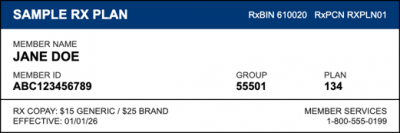
Five elements of an insurance card (See Figure 1) are particularly important when billing a prescription claim:
- Member Name: The patient's name and other identifying information entered in the pharmacy system must match the plan's enrollment information exactly, including any middle initial or suffix the plan requires. The subscriber or primary insured person may be someone else, such as a parent or spouse. Technicians should use the patient-specific information required by the plan and verify any discrepancies before submitting the claim.
- Member ID/Subscriber ID: This is the patient's unique identifier within the insurance plan. Many plans include a three-letter prefix followed by numbers.
- Group Number: This links the patient's coverage to their employer or organization's plan. It helps the processor apply the correct benefit rules, such as copays and covered drug lists. Not every card has one. Medicare, Medicaid, and individually purchased plans often don't use a group number at all.
- Bank Identification Number (BIN): This six-digit number directs the claim to the correct insurance processor. It's labeled as "RX BIN" or just "BIN" on the front of the card. Without the correct BIN, the claim will be rejected.
- Rx Processor Control Number (PCN): The agents in charge of processing insurance claims use the PCN alongside the BIN to direct the claim to the correct processing system. It may not always be labeled clearly, so technicians need to pay attention to where it appears on the card. A blank or missing PCN is common and usually isn't an error as some plans don't use one.24
Figure 1. A Typical Insurance Card
PAUSE AND PONDER: A patient was recently diagnosed with type 2 diabetes and was prescribed empagliflozin (Jardiance). He just lost his job, is now uninsured, and is struggling to afford his medication. What's the best option for him?
Strategies to Afford Medication
Switching to the generic alternative: Generic medications have the same active ingredient as their brand-name alternatives but are typically available at a lower cost. Pharmacists can often substitute a generic drug or an interchangeable biologic product (IBP) when the following conditions are met (and it’s critical to note that substitution requirements vary by state, and the pharmacist—not the technician—makes and documents the substitution decision):
- The generic drug/IBP to be substituted exists in the same strength, dose, dosage form and is dispensed in the same quantity
- The generic drug/IBP is therapeutically equivalent
- A cost savings will be passed on to the patient
Medication or patient assistance programs (PAPs): Pharmaceutical companies offer PAPs to provide some (not all) branded medications at a discounted cost to eligible patients. These programs are intended for individuals who need medication but cannot afford it. Eligibility criteria vary by manufacturer and typically require proof of income and provider involvement. Pharmacists can often identify eligible patients, and technicians can help with the application process.
Manufacturer coupon cards: Coupon cards reduce out-of-pocket costs for patients with private insurance who are prescribed brand-name medications. They are often available through the medication’s official website. Although coupon cards may significantly reduce copays, they generally cannot be used by patients enrolled in Medicare, Medicaid, TRICARE, Veterans Affairs, or other state or federal health care programs.25
Discount Cards: Discount cards are programs that negotiate reduced prices for prescription medications. Patients present the card instead of using insurance to receive a lower cash price. Discount cards do not count toward insurance deductibles or out-of-pocket maximums. Programs such as GoodRx, SingleCare, and ArrayRx (see Table 3) negotiate discounted cash prices for prescription medications. Patients use these cards instead of insurance to reduce out-of-pocket costs. Discount cards are used outside of insurance. Pharmacies are not required to accept every discount card, and a pharmacy's own cash price may sometimes be lower than the card price.
| Table 3. Comparison of Selected Discount Drug Programs26,27,28 | |||||
|
GoodRx | SingleCare | ArrayRx | ||
| Type of program |
|
Private prescription discount card | State-sponsored prescription discount program | ||
| Insurance required? | No | No | No | ||
| Can it be used with insurance? | No. Used instead of insurance. | No. Used instead of insurance. | No. Used instead of insurance. | ||
| Best use | Generic drugs, uninsured patients, or when the cash price is lower than the insurance copay | Generic drugs, uninsured patients, or when the cash price is lower than the insurance copay | Arizona, Connecticut, Nevada, Oregon, and Washington state residents seeking discounted cash prices on prescriptions* | ||
| Counts toward insurance deductible or out-of-pocket maximum? | No | No | No | ||
| Eligibility | Anyone | Anyone | Residents of participating states | ||
| *As of August 1, 2026 | |||||
Cash-price pharmacies: Some online pharmacies sell generic medications directly to consumers using transparent cash pricing rather than insurance. One example is Cost Plus Drugs, which prices medications using the manufacturer's acquisition cost plus a fixed markup, pharmacy fee, and shipping charge. Because these pharmacies do not bill insurance, purchases do not count toward insurance deductibles or out-of-pocket maximums. For some uninsured patients—or insured patients whose copays exceed the cash price—these pharmacies may provide substantial savings.
- At the Pickup Counter: If a patient cannot afford a generic medication even after insurance or discount cards are considered, the pharmacist may suggest comparing prices with a reputable cash-price pharmacy such as Cost Plus Drugs.
Rx Outreach: This is a nonprofit mail-order pharmacy that provides medications by mail for patients who are uninsured or face barriers to accessing a traditional pharmacy (e.g., transportation, location). It primarily offers generic medications. A limited number of medications may be available at no cost, while others are offered at reduced prices compared to retail pharmacies.
SATURDAY: Daphney is becoming much more confident in all things pharmacy insurance. A patient, Mr. Scrappy, arrives to pick up a prescription for sumatriptan tablets to treat migraine headaches. When Daphney submits the claim, the insurer rejects it with the message:
REJECT: QUANTITY LIMIT EXCEEDED
Mr. Scrappy sighs and yells, "My doctor prescribed it! Why won't the insurance pay for it?" Daphney isn't sure how to answer. The pharmacist explains that insurance companies often limit the amount of certain medications they will cover during a specific period. Understanding quantity limits helps pharmacy staff explain the situation to patients and identify the appropriate next step.
A quantity limit is a utilization management tool that restricts the amount of medication an insurance plan will cover during a specified period (for example, 9 tablets every 30 days). Quantity limits help promote safe medication use, encourage proper prescribing, and control healthcare costs. Insurance plans commonly apply quantity limits to medications that
- have significant safety concerns if overused
- have recommended maximum doses
- are expensive
- have a high potential for misuse or waste
Common medications with quantity limits
Examples include:
- Migraine medications (e.g., sumatriptan)
- Continuous glucose monitor (CGM) sensors
- Insulin and diabetes supplies
- Opioids
- High-cost specialty medications
The claim may reject with a message such as Quantity Limit Exceeded, Exceeds Plan Maximum, Maximum Daily Dose Exceeded, or Plan Limit Exceeded. Figure 2 describes the steps technicians can take to try to resolve the issue.
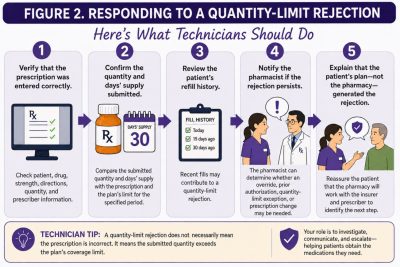
What should the technician do?
Depending on the situation, the pharmacist or prescriber may
- request a quantity limit exception
- submit a prior authorization
- change the prescription to meet the plan's limit
- contact the insurer to decide available options
SUNDAY: Just when Daphney thought she'd survived her first week, the pharmacy manager called. "Can you work today? Someone called out sick." Her first patient, Ms. Coco, approaches the counter. She's leaving for a two-week trip next week and wants to know if she can pick up her blood pressure medication early, so she doesn't run out while she's away. Daphney isn't sure whether this is something she can just process or whether it needs special handling.
Vacation Overrides and Early Refills
When a patient needs their medication sooner because they’ll be away from their usual pharmacy, the plan may grant an exception known as a vacation override, also called a “refill too soon” override. This override bypasses the plan's normal refill timing so the patient can get their medication before leaving. Coverage rules vary by plan, but several general principles apply:
- Non-controlled medications are generally easier to override. Pharmacy staff may need to contact the plan's pharmacy help desk, obtain an override code, and document the override according to pharmacy policy.
- Overrides are limited. Most insurers cap how many vacation overrides a patient can use in a year. For example, one Blue Cross & Blue Shield of Rhode Island policy limits vacation overrides to two per medication per benefit year.29 Patients should confirm the specific limit under their own policy, since coverage varies by plan.
CONCLUSION
Medications are a significant part of people's lives, and pharmacy technicians are well positioned to contribute to positive patient outcomes by understanding prescription drug coverage and insurance processes. Pharmacists and pharmacy technicians who have a clear understanding of how insurance works and who is responsible for each step can improve workflow efficiency. Learning these nuances is a career-long process, and specific workflows vary among organizations, but a general grasp of insurance remains essential. With that foundation, pharmacy technicians can help patients navigate coverage challenges, avoid unnecessary delays, and identify opportunities to make medications more affordable.