
| The University of Connecticut School of Pharmacy and Pharmaceutical Sciences is accredited by the Accreditation Council for Pharmacy Education as a provider of continuing pharmacy education. Statements of credit for the online activity ACPE UAN 0009-0000-26-041-H01-P/T will be awarded when the post test and evaluation have been completed and passed with a 70% or better. Your CE credits will be uploaded to your CPE monitor profile within 2 weeks of completion of the program. |  |
Content
INTRODUCTION
On a busy July afternoon, Jillian, a woman in her mid-40s, approaches the pharmacy counter looking tired and jittery. She glances toward the back of the store, as though making sure she knows where the restroom is. When the pharmacist asks how she can help, she says quietly, "I started having diarrhea more than a week ago." At first, she assumed she had a stomach virus and expected it to resolve in a day or two. Instead, the diarrhea has become more frequent. "It's explosive," she says. "When I have to go, I have to go right now. I haven't been more than a few minutes from a bathroom in days."
She reports having six to eight episodes of watery diarrhea each day, accompanied by cramping, bloating, nausea, and profound fatigue. She has missed three days of work because she is afraid she won't make it to a bathroom in time. She has been drinking plenty of fluids, but feels weak and has little appetite.
She has tried bismuth subsalicylate without relief and wonders whether a stronger over-the-counter medication might finally stop the diarrhea. As the pharmacist asks additional questions, she mentions that she and her husband have been trying to eat healthier. Over the past two weeks, they have eaten several prepackaged salad kits, fresh berries, and homemade smoothies made with fresh basil from a neighborhood farm stand.
The pharmacist considers this history. Acute viral gastroenteritis usually resolves within a few days. Persistent, profuse watery diarrhea during the summer months suggests another possibility.
PAUSE and PONDER: What additional questions should the pharmacy team ask? Which features of this patient's illness warrant referral for medical evaluation?
Seasonal Spotlight: Cyclosporiasis
Cyclosporiasis is a seasonal intestinal infection caused by the microscopic parasite Cyclospora cayetanensis.1,2 (Table 1 explains how parasites differ from bacteria or viruses.) Although cases occur every year, infections increase during the spring and summer when contaminated fresh produce enters the food supply.3 In 2026, the United States (U.S.) is experiencing a substantial multistate increase in reported cases, prompting investigations by the Centers for Disease Control and Prevention (CDC), the U.S. Food and Drug Administration (FDA), and multiple state health departments.2-6 The SIDEBAR lists facts every pharmacy employee needs to know.
| Table 1. Microbiology Minute: What's the Difference?8
Foodborne illnesses can be caused by viruses, bacteria, or parasites, but these organisms behave differently |
||
| Type | Examples | Key characteristics |
| Viruses | Norovirus, rotavirus | Require living cells to reproduce. Illness is often abrupt and resolves within a few days to a week. Antibiotics are ineffective. |
| Bacteria | Salmonella, Campylobacter, Escherichia coli | Organisms that multiply on their own. Some infections respond to antibiotics, while others do not. |
| Parasites | Cyclospora cayetanensis, Giardia duodenalis, Cryptosporidium parvum | Organisms that live in a host’s intestine and often have complex life cycles (with oocyst/cyst stages). Often require antiparasitic medications. Symptoms persist for weeks if untreated. |
SIDEBAR: Fast Facts about Cyclosporiasis1,7-9
- Cause: Infection with the protozoan parasite Cyclospora cayetanensis.
- Transmission: Consumption of food or water contaminated with Cyclospora oocysts—most often in the US via fresh produce.
- Person-to-person spread: Unlike many diarrheal illnesses, freshly shed Cyclospora oocysts require days to weeks in the environment before they become infectious, making direct transmission unlikely.
- Incubation period: Typically about one week (range, two days to two weeks).
- Hallmark symptom: Profuse, watery diarrhea that is often described as explosive.
- Other symptoms: Abdominal cramping, bloating, nausea, fatigue, loss of appetite, weight loss, and low-grade fever. Symptoms may persist for weeks or relapse if untreated.
- Diagnosis: Stool testing specifically ordered to detect Cyclospora. Most commercial laboratories have this as part of their multiplex PCR testing. Additionally, up to three days of testing is recommended after negative tests, as oocysts shed inconsistently.
- Treatment: Trimethoprim-sulfamethoxazole (TMP-SMX) for 7 to 10 days is the first line treatment. Supportive care includes aggressive fluid replacement. Patients with sulfonamide allergy require alternative management because no highly effective substitute has been established.
This Outbreak Is Different
As of early July 2026, the CDC confirmed domestically acquired cases in at least 37 states, while several affected states reported substantially larger numbers through their own surveillance systems. Michigan has experienced an especially large outbreak, and investigations to identify the contaminated food source remain ongoing. No single food item had been implicated as of July 11, 2026.7 Many cyclosporiasis outbreaks are never linked to a single food source because traceback investigations and testing of fresh produce are often difficult.
Although the source of the current outbreak has not been identified, previous U.S. outbreaks have been associated with fresh produce, including10-12
- Bagged salad mixes
- Cilantro
- Fresh basil
- Raspberries and blackberries
- Romaine and mesclun lettuce
- Snow peas
Identifying Possible Cyclospora Infection
Patients often mistake cyclosporiasis for viral gastroenteritis. The difference is time.1 Most cases of norovirus, the most common form of viral gastroenteritis, improve within 24 to 72 hours. In contrast, patients with cyclosporiasis often report that their diarrhea has persisted for a week or longer and may even improve briefly before returning. Why? Cyclospora cayetanensis has an unusual life cycle, described in Figure 1, that explains many of the infection's clinical characteristics and public health challenges.
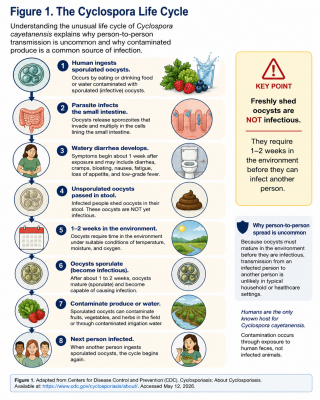
Although first recognized in humans in 1977, scientists spent more than a decade debating this parasite’s identity.13-15 At various times, the organism was referred to as "coccidia-like bodies," reflecting its resemblance to coccidial parasites, or "cyanobacterium-like bodies," and some investigators even suspected it was a blue-green alga before it was formally identified as Cyclospora cayetanensis in 1993. Large multistate outbreaks linked to imported Guatemalan raspberries in 1996 transformed Cyclospora from an obscure tropical parasite into a major foodborne pathogen of international public health importance.13-15
PAUSE and PONDER: Why is person-to-person transmission of Cyclospora cayetanensis not possible?
People become infected by swallowing sporulated oocysts—the environmentally mature form of the parasite—on contaminated food or in contaminated water.16,17 After ingestion, the parasite infects cells lining the small intestine, where it multiplies and causes inflammation that leads to watery diarrhea and other gastrointestinal symptoms. Infected individuals shed unsporulated (immature) oocysts in the stool.16,17 Freshly passed oocysts are not immediately infectious. Instead, they must remain in the environment for one to two weeks under favorable conditions before they mature (sporulate) and become capable of infecting another person.3,16
This delay explains two important features of cyclosporiasis1,3:
- Person-to-person transmission is uncommon because freshly shed oocysts cannot immediately infect another individual.
- Fresh produce is a common vehicle for infection because fruits, vegetables, and herbs can become contaminated in the field or during irrigation, allowing oocysts time to mature before the food is harvested and consumed.
Jillian seems relieved to have a possible diagnosis and a plan to see her primary care provider. Suddenly, she looks worried again. She says, “I feed some raw fruits and vegetables to my dogs! Will they get this?”
Here’s a not-so-fun fact: humans are the only known host for Cyclospora cayetanensis.16 Jillian’s dogs will not become ill from Cyclospora cayetanensis. Contamination of food or water occurs through exposure to human feces rather than infected animals.16 How does human fecal contamination get onto produce? See the SIDEBAR.
SIDEBAR: How Does Human Fecal Material End Up on Fresh Produce?5,6
Most people picture an obvious sanitation failure, but contamination is usually much less dramatic.6,18 Fresh produce can become contaminated when irrigation or wash water is contaminated with sewage, when an infected worker harvests or packs produce without adequate hand hygiene, or when toilet or handwashing facilities are unavailable or improperly maintained. Contamination may also occur during harvesting, packing, or processing if proper hygiene and sanitation practices are not followed.6,18 Food safety is ultimately about human behavior and infrastructure, not just microorganisms.
Because humans are the only known host for Cyclospora cayetanensis, preventing contamination depends on worker health and hygiene, safe water sources, proper sewage disposal, and field sanitation.6,18 The FDA's Produce Safety Rule requires covered farms to provide toilet facilities, handwashing stations, employee hygiene training, and procedures designed to prevent produce contamination.6,18
Recognizing Cyclosporiasis: Symptoms and Patient Clues
Jillian’s case is classic. Cyclosporiasis’s hallmark symptom is profuse, watery diarrhea, often described as explosive.8,19 Patients frequently report an overwhelming urgency to reach a restroom and may avoid work, social activities, or travel because they cannot predict when another episode will occur. Other symptoms commonly include abdominal cramping, bloating, nausea, loss of appetite, fatigue, low-grade fever, and weight loss. Vomiting is less common than diarrhea.8,19
The illness’s prolonged nature places patients—particularly older adults and individuals with underlying medical conditions—at risk for dehydration and electrolyte abnormalities. Although healthy adults usually recover without long-term complications, prolonged diarrhea can lead to dehydration, electrolyte disturbances, and weight loss, particularly in older adults, young children, and individuals who are immunocompromised.8,19
When a patient asks for help finding an antidiarrheal, ask a few simple questions:
- How long have the symptoms lasted?
- How many episodes do you experience each day?
- Is the diarrhea watery or bloody?
- Have over-the-counter medications helped?
- Have you recently eaten fresh berries, salad, herbs, or other raw produce?
- Have you traveled recently or attended a large gathering where food was served?
A patient like Jillian who says, "I thought it was a stomach bug, but it's been over a week and I'm still having explosive diarrhea," should be referred for medical evaluation.
Pharmacy personnel should encourage patients to seek prompt medical evaluation if they experience
- Watery diarrhea lasting more than 3 to 5 days
- Severe or persistent diarrhea accompanied by dehydration
- Inability to maintain adequate fluid intake
- Fever, bloody stools, or severe abdominal pain
- Significant weight loss
- Symptoms in an immunocompromised patient or other individual at high risk for complications
Diagnosis and Treatment
Diagnosing cyclosporiasis can be challenging because routine bacterial stool cultures do not detect Cyclospora cayetanensis, and many commonly ordered gastrointestinal multiplex PCR panels do not include this parasite. Healthcare providers should ensure that the selected diagnostic test specifically includes Cyclospora when the infection is suspected.1,8,20 Patients with persistent diarrhea should inform their healthcare provider about the duration of symptoms, recent travel, and consumption of fresh produce. If they don’t, healthcare providers need to ask.
Diagnosis may be made by identifying the characteristic round Cyclospora oocysts (which are round and a size equivalent to one-tenth the width of a human hair) in stool specimens or, more commonly, by using molecular methods such as PCR when the selected test panel includes Cyclospora. Because infected individuals may shed relatively few oocysts—and may not shed them consistently—a single negative stool specimen does not rule out infection. Sometimes, symptomatic patients do not shed a sufficient quantity of oocysts in their stool; these patients, called low level shedders, might need to submit several specimens collected on different days.5,20 When clinical suspicion remains high, healthcare providers may request stool samples collected on multiple days.
PAUSE and PONDER: A patient fills a prescription for TMP-SMX and says the prescriber told him to use “supportive care.” He doesn’t really know what that means. What would you say?
Treatment
The treatment of choice is trimethoprim-sulfamethoxazole (TMP-SMX).8,9 For immunocompetent adults, the recommended adult regimen is one double-strength tablet (TMP 160 mg/SMX 800 mg) orally twice daily for seven to 10 days. The pediatric dose for children older than two months is 8 to 10 mg/kg TMP and 40 to 50 mg/kg SMX per day, orally, in two divided doses for seven to 10 days. Both Bactrim and ciprofloxacin work similarly on the protozoan parasite as they do on bacteria. Bactrim inhibits its ability for folate synthesis it needs for survival, while ciprofloxacin inhibits its DNA replication. Importantly, it needs a functional immune system for cure; those with immunocompromise, it may result in stasis and secondary prophylaxis is generally recommended.8,9
Fluid replacement is an essential component of treatment because prolonged watery diarrhea can lead to dehydration and electrolyte imbalances. The pharmacy team should encourage patients to8
- Drink small, frequent amounts of fluid rather than large volumes at one time if nausea is present.
- Use an oral rehydration solution (ORS) (e.g., Pedialyte or other commercially available ORS) when diarrhea is moderate to severe or prolonged. ORS products contain an appropriate balance of water, sugar, and electrolytes to promote intestinal absorption.
- Consume clear fluids such as water, broth, or diluted sports drinks if an ORS is unavailable. (ORS remains the preferred option.)
Some beverages may worsen diarrhea or contribute to dehydration and should be avoided, including21-23
- Alcohol
- Excessive caffeine (coffee, energy drinks)
- Sugar-sweetened beverages such as regular soda or undiluted fruit juice, which can increase osmotic diarrhea
- Sugar-free beverages containing poorly absorbed sugar alcohols (e.g., sorbitol or mannitol), which may also worsen osmotic diarrhea
- Patients should be recommended to have ORS available at home.
Patients who are unable to keep fluids down, experience dizziness or fainting, produce very little urine, or develop signs of severe dehydration should seek immediate medical attention. Pediatric patients with any level of dehydration should seek medical attention. Patients with diabetes should monitor blood glucose more frequently during diarrheal illness because dehydration and changes in food intake may affect glycemic control. Patients who continue to have diarrhea after completing treatment—or whose symptoms recur—should contact their healthcare provider.3 Relapses are part of the disease.12
Over-the-counter antidiarrheal medications, may provide temporary symptomatic relief in otherwise healthy adults but do not eradicate Cyclospora cayetanensis.20 (And note that Cyclospora typically does not cause bloody diarrhea; if a patient has bloody stools or high fever, they may have an invasive bacterial infection rather than cyclosporiasis.) Patients with persistent watery diarrhea lasting more than several days should be referred for medical evaluation rather than repeatedly self-treating with over-the-counter products.20 Antidiarrheals should be avoided in patients with bloody diarrhea or high fever unless directed by a healthcare provider.8,20
Management becomes more complicated in patients with sulfonamide allergies. Research has yet to identify a highly effective alternative to TMP-SMX.8 Depending on the severity of the illness and the nature of the allergy, clinicians may recommend symptomatic treatment, consider an alternative antimicrobial such as ciprofloxacin, supported by limited evidence, or pursue TMP-SMX desensitization in carefully selected patients.+
Food Safety and Prevention
Fresh produce is the most common source of infection because people often eat it raw. Previous U.S. outbreaks have been linked to cilantro, basil, raspberries, blackberries, and leafy greens.10-12 However, any fresh fruit or vegetable exposed to contaminated irrigation water or poor sanitation practices may become contaminated. The 1996 raspberry outbreak was so large that it fundamentally changed how public health agencies investigate produce-associated outbreaks. Before then, most people associated foodborne illness with meat, eggs, or dairy—not fresh berries.13-15
Rinsing produce under running water is recommended because it removes dirt and may reduce contamination, but it cannot be relied upon to remove or eliminate all Cyclospora oocysts.6 The parasite's hardy outer shell allows it to survive under environmental conditions that would eliminate many bacteria and viruses. Experts don’t recommend soap, bleach, or commercial produce washes because they have not been shown to eliminate Cyclospora and may leave harmful residues on food. Refrigeration does not kill the parasite. Freezing may reduce viability but should not be relied upon to prevent infection.6
PAUSE and PONDER: If washing doesn't work, why bother?
In short, washing reduces contamination, even though it doesn't guarantee safety.
Jillian listens to the information about washing vegetables, and she sighs, “We were eating better. Now we can’t even have a salad.” The pharmacist says, "I understand why you feel that way," and continues, "But I don't want this experience to keep you from eating healthy foods. The answer isn't to avoid salads forever. It's to pay attention to food recalls and practice good food safety." He also tells her, “In otherwise healthy individuals this is not fun, but it is important to continue eating healthy foods.”
Reducing Infection Risk
Although no method completely eliminates the risk of cyclosporiasis, patients can reduce their risk by24
- Washing hands with soap and water before preparing or eating food.
- Rinsing fresh fruits and vegetables under running water before eating, cutting, or cooking them.
- Scrubbing firm produce (e.g., melons, cucumbers, potatoes) with a clean produce brush.
- Refrigerating perishable produce promptly.
- Separating fresh produce from raw meat, poultry, seafood, and their juices to prevent cross-contamination.
- Following FDA recalls and public health advisories during foodborne illness outbreaks.
For most healthy adults, cyclosporiasis is unpleasant but rarely life-threatening. The health benefits of eating fresh fruits and vegetables continue to outweigh the relatively low risk of infection. Patients should follow recommended food safety practices, remain aware of food recalls, and seek medical evaluation promptly if persistent watery diarrhea develops. Individuals who are severely immunocompromised should discuss additional food safety precautions—including avoiding raw produce—with their healthcare providers.
CONCLUSION
Remember Jillian? She didn't come to the pharmacy looking for an antiparasitic medication. She came looking for an antidiarrheal. The pharmacy team's greatest contribution wasn't recommending a product—it was recognizing that her symptoms didn't fit the pattern of a routine stomach virus and ensuring she received appropriate medical evaluation. Tackling outbreaks of this parasitic diarrhea is about recognizing patterns, asking the right questions, and understanding that food safety begins long before food reaches the pharmacy—or the patient.