Archives

Load-Bearing Walls: Getting Cardiovascular Therapy Right the First Time -RECORDED WEBINAR

About this Course

This course is a recorded (home study version) of the Arthur E. Schwarting Symposium on April 17, 2026 . The theme was "Measure Twice, Cut Once: A Carpentry Approach to Pharmacy."


Learning Objectives

Upon completion of this application based CE Activity, a pharmacist will be able to:

  • Identify high-risk cardiovascular medications that are most commonly associated with preventable adverse drug events amid transitions of care
  • Describe evidence-based principles for precise cardiovascular medication dosing, including clinically relevant pharmacokinetic considerations that influence drug and dose selection
  • Explain the benefits and limitations of clinical decision support tools in cardiovascular pharmacotherapy
  • Recognize common system-level and cognitive factors contributing to cardiovascular medication near misses and adverse effects

Release and Expiration Dates

Released:  April 17, 2026
Expires:  April 17, 2029

Course Fee

$10 Pharmacist

ACPE UAN

0009-0000-26-009-H01-P

Session Code

26RS09-RHA98

Accreditation Hours

1 hour of CE (0.1 CEUs)

Additional Information


How to Complete Evaluation:  When you are ready to submit posttest answers, go to the BLUE take test/evaluation button. Use the session code from your confirmation email or from the box above, not from the end of the video!

Accreditation Statement

The University of Connecticut School of Pharmacy and Pharmaceutical Sciences is accredited by the Accreditation Council for Pharmacy Education as a provider of continuing pharmacy education.

Pharmacists and Pharmacy Technicians are eligible to participate in this knowledge-based activity and will receive up to 1 CE Hours (or 0.1 CEUs)  for completing the activity ACPE UAN 0009-0000-26-009-H01-P, passing the quiz with a grade of 70% or better, and completing an online evaluation. Statements of credit are available via the CPE Monitor online system and your participation will be recorded with CPE Monitor within 72 hours of submission.

Grant Funding

There is no grant funding for this activity.

Faculty

Katelyn Galli, PharmD, BCCP

Assistant Clinical Professor

University of Connecticut School of Pharmacy and Pharmaceutical Sciences

Storrs, CT

Faculty Disclosure

In accordance with the Accreditation Council for Pharmacy Education (ACPE) Criteria for Quality and Interpretive Guidelines, The University of Connecticut School of Pharmacy and Pharmaceutical Sciences requires that faculty disclose any relationship that the faculty may have with commercial entities whose products or services may be mentioned in the activity.

  • Katelyn Galli has no relationships with ineligible companies

Disclaimer

The material presented here does not necessarily reflect the views of The University of Connecticut School of Pharmacy and Pharmaceutical Sciences or its co-sponsor affiliates. These materials may discuss uses and dosages for therapeutic products, processes, procedures and inferred diagnoses that have not been approved by the United States Food and Drug Administration. A qualified health care professional should be consulted before using any therapeutic product discussed. All readers and continuing education participants should verify all information and data before treating patients or employing any therapies described in this continuing education activity.

CONTENT

Posttest

1. Which of the following medications would be considered high risk for error during the medication reconciliation process? 

  1. Apixaban
  2. Citalopram
  3. Fexofenadine

2. Upon daily chart review, you identify that Jack has an AKI and review his medications for necessary adjustments. Which of the following is most appropriate regarding his apixaban?

  1. Continue to hold anticoagulation given increased bleeding risk
  2. Stop apixaban and start rivaroxaban 15mg daily instead
  3. Consider transitioning to heparin via aPTT measurement until AKI resolves

3. The team decides to start Jack on oral amiodarone 400mg TID x 3 days, 200 mg TID x 3 days, then 200 mg daily. Which of the following is most important for the pharmacist to ensure at discharge?

  1. Ensure the prescription is sent to the patient's home pharmacy for easy refills
  2. Confirm that thyroid function tests are ordered and assessed before starting the amiodarone
  3. Suggest starting sotalol instead for better rate control

4. Which strategy can optimize clinical decision support for high-risk cardiac medications? 

  1. Prevent ordering of any anticoagulant except apixaban to ensure standardization
  2. Integrate most recent SCr values and dosing recommendations into sotalol orders
  3. Block order entry of amiodarone by prescribers if all baseline labs are not checked

5. The Epic medical record has the advantage of having access from outside health systems. The VAMC has a secure medical record that cannot be accessed. Jack gets most of his care and his medications at the VA. Which of the following factors increases his risk for experiencing medication errors?

  1. Fragmented medical records
  2. Use of a single pharmacy
  3. Poor insurance coverage

6. Jack's SCr is stable but remains elevated. Following diuresis, he is found to be cachectic and euvolemic with a “dry" weight of 58 kg. You recommend decreasing his apixaban to 2.5 mg BID but receive pushback from the provider as "this was his home dose." What kind of bias does this reflect?

  1. Anchoring bias
  2. Automation bias
  3. Availability bias


    VIDEO

    LAW: Behind the Counter Crimes: Fraud and Diversion in Pharmacy

    Learning Objectives

    After completing this continuing education activity, pharmacists and pharmacy technicians will be able to

    • Define fraud, waste, and abuse in healthcare
    • Explain key federal laws and regulations that govern fraud and diversion
    • Identify medications at increased risk for medication diversion and red flags associated with diversion
    • Apply fraud and diversion prevention and reporting strategies

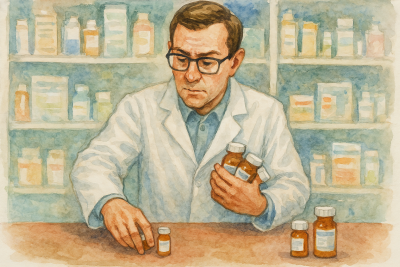
        A pharmacist is sorting different size pill bottles on the counter, holding three of them close to his chest

         Release Date

        Release Date: April 15, 2026

        Expiration Date: April 15, 2029

        Course Fee

        Pharmacists   $7

        Pharmacy Technicians   $4

        There is no funding for this CE.

        ACPE UANs

        Pharmacist: 0009-0000-26-021-H03-P

        Pharmacy Technician: 0009-0000-26-021-H03-T

        Session Codes

        Pharmacist: 26YC21-VEX87

        Pharmacy Technician: 26YC21-XVE78

        Accreditation Hours

        2.0 hours of CE

        Accreditation Statements

        The University of Connecticut School of Pharmacy is accredited by the Accreditation Council for Pharmacy Education as a provider of continuing pharmacy education.  Statements of credit for the online activity ACPE UAN 0009-0000-26-021-H03-P/T will be awarded when the post test and evaluation have been completed and passed with a 70% or better. Your CE credits will be uploaded to your CPE monitor profile within 2 weeks of completion of the program.


        Disclosure of Discussions of Off-label and Investigational Drug Use

        The material presented here does not necessarily reflect the views of The University of Connecticut School of Pharmacy or its co-sponsor affiliates. These materials may discuss uses and dosages for therapeutic products, processes, procedures and inferred diagnoses that have not been approved by the United States Food and Drug Administration. A qualified health care professional should be consulted before using any therapeutic product discussed. All readers and continuing education participants should verify all information and data before treating patients or employing any therapies described in this continuing education activity.

        Faculty

        Monica Holmberg, PharmD, BCPS

        Recent graduate of the UConn Medical Writing Certificate Program

        Phoenix, AZ

        Faculty Disclosure

        In accordance with the Accreditation Council for Pharmacy Education (ACPE) Criteria for Quality and Interpretive Guidelines, The University of Connecticut School of Pharmacy requires that faculty disclose any relationship that the faculty may have with commercial entities whose products or services may be mentioned in the activity.

        Monica Holmberg has no relationships with ineligible companies.


        ABSTRACT

        Healthcare fraud places an enormous strain on the healthcare system, with loss estimates ranging in the hundreds of billions of dollars. Federal laws and regulations exist to prevent and address fraud in healthcare. Pharmacy team members must understand healthcare regulations to maintain accurate, legal, and ethical practice and to identify and address suspected fraud. Medication diversion poses substantial risk to patients, healthcare workers, and healthcare facilities. It can carry significant financial and legal consequences. Although diversion has traditionally been associated with controlled medications, the incidence of non-controlled diversion has been rising. These medications may be desirable due to their potential for resale, physiological effects, or role in opioid use disorder. Identifying red flags, implementing preventive practices, and reporting suspected diversion appropriately can help to minimize diversion and prevent potential harm.

        CONTENT

        Content

        INTRODUCTION

        Meet Charlie. Charlie is a newly licensed pharmacist who is excited to start his new job at a busy community pharmacy. During his training, a more experienced coworker, Hazel, instructs Charlie to override insurance claim rejections. She shows him the prior authorization override code to submit claims. She tells him, “You don’t actually need to contact the prescriber and have them obtain prior authorization for it to work. It’s just a workaround everyone does.”


        The next day, the insurance program rejects a prescription for Reimbursitol because it requires prior authorization. Its cash price is more than $1,000, and Charlie dreads informing the patient. Hazel tells Charlie to enter the override code, even though they have not contacted the provider and the insurer has not approved the prior authorization. The claim goes through, and the pharmacy receives payment for Reimbursitol. Charlie is eager to fit in and lacks experience, and this workaround streamlines his workflow, so he follows this process for several prescriptions over the next few weeks.


        Healthcare fraud imposes an enormous burden on the healthcare system. Experts estimate that fraud accounts for 3% to 10% of healthcare expenses annually, resulting in billions of dollars lost each year.1 In 2024, the United States (U.S.) spent $5.3 trillion on healthcare, or about $15,474 per person. A large share of this spending was divided among the following2

        • Medicare: $1.118 billion (21%)
        • Medicaid: $932 billion (18%)
        • Private health insurance: $1.645 billion (31%)
        • Out-of-pocket spending: $557 billion (11%)


        Based on these figures, fraud could account for losses of $159 billion to $530 billion in just one year.


        Not only does fraud affect healthcare on a national level, but it directly impacts pharmacies. For example, in 2019, an independent pharmacy chain allegedly submitted false claims to Medicare and Medicaid for prescription medications by switching from a lower cost to a higher cost product without a medical need or prescription. Investigators allege that pharmacy staff switched patients from an inexpensive to an expensive medication and billed federal healthcare programs for reimbursement of the high-cost item. This change in therapy inflated the complexity of the product dispensed, which was not medically necessary and resulted in larger reimbursement payments, In some cases, the pharmacy dispensed the expensive item and billed federal payors without a valid prescription. The case resolved in 2022 with the pharmacy paying $2.05 million and implementing training programs regarding fraud and compliance.3,4


        The water can sometimes seem muddy when it comes to billing practices and legal regulations. Understanding the laws and regulations that govern healthcare can enable pharmacy team members to identify, report, and prevent fraud and abuse, rather than falling victim to unsavory practices.


        FRAUD, ABUSE, AND WASTE: WHAT'S THE DIFFERENCE?

        Although fraud, waste, and abuse are often grouped together, each carries a distinct definition, intent standard, and regulatory implication.


        Fraud is an intentional deception or misrepresentation that could result in an unauthorized benefit. It is intentionally wrongful and considered criminal.5,6 An example of fraud is billing for services that were not provided.7


        Abuse is provider practices that are inconsistent with accepted practices, resulting in an unnecessary cost to the health care system. There is usually not criminal intent, but it still leads to financial loss by the payor.5,6 An example of abuse is billing for medically unnecessary services.7


        Waste is misuse or inappropriate use of resources that results in unnecessary costs to the healthcare system. It is not associated with deceptive intentions.6 An example of waste is ordering excessive or unnecessary tests or services.


        See the SIDEBAR for a quick overview of additional law terminology.


        SIDEBAR: A (Very) Brief Law Terminology Refresher8,9

        Law: A broad term for all rules that govern conduct, such as statutes, ordinances, and regulations. For example, the Controlled Substance Act is a federal law regulating agents with potential for abuse.


        Act or statute: Both refer to a specific type of law. An act is a formal, written law passed by a legislative body, such as Congress or state legislature. A statute refers to the written law itself, typically as it is codified in the U.S. Code. For example, the False Claims Act began as a bill in January 1863. When President Lincoln signed it in March 1863, it became law. It is currently published in the official U.S. federal code as 31 U.S.C. §§ 3729–3733.


        Ordinance: A local law in place to ensure public safety, health, and general welfare. Ordinances often regulate fire and safety regulations, housing standards, parking regulations, snow removal, littering, public streets and sidewalks, and zoning. Examples of ordinances pertaining to pharmacy include zoning, signage, and operating hours.


        Regulation: A rule issued by administrative agencies that have legislative authority over a specific area to enforce rules or statutes. For example, the state board of pharmacy may regulate how many CE hours pharmacists and technicians must complete each year, or for how many years documentation must remain on the pharmacy premises.


        Table 1 offers a brief side-by-side look at civil versus criminal law.


        Table 1. Overview of Criminal Law vs. Civil Law10-12

        Criminal Law Civil Law
        Objective Punish wrongdoing and protect society Settle disputes between individuals or entities
        Initiating party State/federal government (prosecutor) Private party (plaintiff)
        Burden of proof* Very high: beyond a reasonable doubt Lower standard: Preponderance of the evidence (must be proven more than 50% likely that plaintiff’s claims are true)
        Potential penalties Jail/prison, fines Financial compensation
        Examples Theft, assault, arson, murder Breach of contract, personal injury, property disputes
        Pop Culture Example (TV) Law & Order Judge Judy

        *Burden of proof is the responsibility to present enough evidence to win the case and meet the applicable legal standard. It usually lies with the party initiating the case. In other words, the prosecutor or plaintiff must find the defendant guilty rather than the defendant proving their innocence.


        COMPLIANCE IN ACTION: FEDERAL LAWS AND REGULATIONS

        Several federal laws and regulations are in place to prevent and address fraud. The False Claims Act (FCA), Anti-Kickback Statute (AKS), Physician Self-Referral Law (Stark Law), and HIPAA establish important compliance requirements for healthcare.


        False Claims Act (FCA)

        The False Claims Act (FCA; 31 U.S.C. §§ 3729–3733) is a civil federal statute dating back to 1863 in response to contractor fraud during the American Civil War.13 Still in effect today, the FCA allows the federal government to recover losses through civil lawsuits for false or fraudulent claims, seek financial penalties, and pursue criminal charges for that conduct.14


        Knowingly submitting false claims or conspiring to submit false claims violates the FCA.13 In the healthcare setting, the FCA applies whenever a federal payor is involved, such as Medicare or Medicaid. Examples of healthcare-related FCA violations include submitting false or fraudulent claims for payment, billing for services not rendered, and upcoding (billing for a more expensive service than was actually obtained by the patient).15


        Civil liability under the FCA does not require a specific intent to defraud. In its definition, the FCA uses the term “knowingly” to include individuals who knew the claim was false, deliberately ignored that it was false, or ignored signs that it was false. Violations carrying civil liability consist of recklessness or deliberate ignorance and do not require intent. In other words, an individual who “looks the other way” or “should have known” may be violating the FCA.16


        Civil penalties under the FCA are up to three times the government’s loss plus inflation-related fines ($11,000 for Medicare or Medicaid fraud) per claim. Because each item or service billed counts as a claim, losses and fines can accumulate quickly.16 The FCA includes a whistleblower provision (“qui tam”), which allows private citizens to submit a claim on the government's behalf for a share of recoveries, usually between 15% to 30%.3 Whistleblowers can be business partners (current or former), hospital or office staff, patients, or competitors.13,16


        In addition to seeking civil penalties under the FCA, the government may also bring criminal charges where appropriate. More severe cases—those with intentional fraud—may face criminal prosecution. Criminal penalties include imprisonment and criminal fines.16


        Anti-Kickback Statute (AKS)

        The Anti-Kickback Statute (AKS; 42 U.S.C. § 1320a-7b(b)) ensures that healthcare providers make clinical decisions objectively and appropriately based on patient need, not financial incentive. This federal criminal law prohibits knowingly and willfully offering, paying, soliciting, or receiving remuneration to entice or reward referrals. It also prohibits creating federal healthcare business involving items or services that are reimbursable by programs like Medicare, Medicaid, or other federal health programs. Remuneration is considered anything of value, and in this instance, it covers a wide range. Examples include–but are not limited to–free rent, hotel stays, meals, bribes, rebates, and excessive compensation.16


        The AKS applies to both the party offering the kickback and the party receiving it. This means that it is illegal to accept payment for referring patients, and it is illegal to pay to have patients referred.16


        AKS violations carry both criminal and civil penalties that can be extensive and overlapping. Violations of the AKS are classified as felony crimes under federal law and can result in jail time.16 Criminal penalties can include fines up to $25,000 per violation and/or up to a 5-year prison term. Civil penalties fall under the Civil Monetary Penalties Law and carry penalties of up to $50,000 per kickback plus up to three times the remuneration value.


        Furthermore, AKS violations may also create liability under the FCA and incur the penalties associated with FCA violations. In addition to the criminal and civil penalties, AKS violations can result in ineligibility to participate in federal health care programs.14,16


        Physician Self-Referral Law (Stark Law)

        The Physician Self-Referral Law (42 U.S.C. § 1395nn), often called the Stark Law, is a civil law that prohibits physicians from referring Medicare or Medicaid patients for designated health services (DHS) to parties with which the physician or an immediate family member has a financial relationship, unless an exception applies. Simply put, physicians should not profit by referring patients to services in which they have a financial stake.16 See Table 2 for a list of DHS.


        Table 2. Stark Law Designated Health Services (DHS)17

        1. Clinical laboratory services
        2. Physical therapy
        3. Occupational therapy
        4. Outpatient speech-language pathology
        5. Radiology and certain other imaging
        6. Radiation therapy
        7. Durable medical equipment and supplies
        8. Parenteral and enteral nutrients, equipment, and supplies
        9. Prosthetics, orthotics, and prosthetic devices and supplies
        10. Home health services
        11. Outpatient prescription drugs
        12. Inpatient and outpatient hospital services


        The Stark Law is a strict liability statute, meaning that a violation can exist even without specific intent to break the law. Any violation—even an accidental one—is a violation of the Stark Law.16


        Civil penalties include fines and ineligibility to participate in federal healthcare programs.16 Although the Stark Law addresses physician referrals, pharmacists and technicians may be indirectly affected. For example, if a physical refers Medicare or Medicaid patients to a pharmacy which he or she has a financial interest, it may violate the Stark Law, unless an exception applies. A complete list of regulatory exceptions to the Stark Law is beyond the scope of this activity; however, exceptions that may apply to a pharmacy setting include the in-office ancillary services exception, bona fide employment relationships, and fair market value compensation arrangements.18,19 Pharmacy team members can contact their legal or compliance departments if concern exists regarding Stark Law and/or its exceptions.


        Health Insurance Portability and Accountability Act (HIPAA)

        While HIPAA is often perceived as primarily protecting patient privacy, it includes fraud provisions. It is a crime to knowingly use, obtain, or disclose protected health information (PHI). Criminal penalties for HIPAA violations, addressed under 42 U.S.C. § 1320d–6, can be substantial and vary depending on the nature and extent of the violation. A basic violation can result in fines up to $50,000 and/or up to 1 year in prison. When committed under false pretenses, the fines increase to no more than $100,000 and/or up to 5 years in prison. The intent to sell, transfer, or use PHI for personal gain increases the fines even further to a maximum of $250,000 and/or 10 years in prison.20,21


        Understanding the functions of key regulatory bodies can illustrate the many moving parts involved in governing healthcare. The SIDEBAR summarizes these organizations briefly.


        SIDEBAR: Regulatory and Enforcement Agencies 7,22-27

        The U.S. Department of Justice (DOJ) is the federal agency responsible for ensuring justice. It enforces federal laws, prosecutes cases, oversees federal law enforcement agencies such as the Federal Bureau of Investigation (FBI) and Drug Enforcement Agency (DEA), and manages prisons. The DOJ is headed by the Attorney General.


        The Federal Bureau of Investigation (FBI) reports to the DOJ. It enforces federal criminal law and conducts investigations, and can investigate corruption, fraud, and organized crime.


        The U.S. Drug Enforcement Administration (DEA) enforces controlled substance laws and regulations, including the manufacture and distribution of controlled prescription drugs.


        The Office of the Inspector General (OIG) is a federal agency that aims to counteract fraud, abuse, and waste while maximizing efficiency and accountability in the Department of Health and Human Services programs. The OIG can audit, investigate, and inspect federal programs, especially Medicare and Medicaid programs, which comprise a large portion of the federal budget.


        The Centers for Medicare and Medicaid Services (CMS) is a federal agency within the U.S. Department of Health and Human Services. CMS oversees and regulates federal healthcare programs such as Medicare, Medicaid, and State Children’s Health Insurance Program (SCHIP). CMS collaborates with individuals, groups, and law enforcement organizations to prevent and determine fraud and abuse.


        State boards regulate healthcare professions by overseeing licensing and renewals, enforcing professional standards, and inspecting facilities. They may also take disciplinary action when standards are not met. There are many state healthcare boards, but only the following disciplines have prescribing authority or direct access to medications: pharmacy, nursing, medical, osteopathic, dentistry, optometry, podiatry, and veterinary.


        From Laws to Practice: Examples of Pharmacy Fraud and Abuse 

        Remember Charlie? A month into his new job, he takes this CE program, reviews the earlier claims, and realizes that he entered override codes even though prior approval was never obtained. Charlie becomes worried that he might have followed bad advice.


        PAUSE AND PONDER: Did Charlie knowingly commit fraud, or did he make a mistake after receiving misleading guidance? What responsibilities does Charlie have to correct past claims or disclose potential issues?


        Fraud in healthcare can be committed by an individual, group, or organization.7 In the pharmacy setting, fraudulent activity often involves improper billing or reimbursement practices.


        Pharmacy Billing and Reimbursement Fraud

        Several types of billing fraud can occur in the pharmacy, such as billing for prescriptions that were never dispensed (“phantom claims”), dispensing a different quantity than prescribed without documentation, or refilling prescriptions without authorization. Additional fraudulent billing practices include billing for a brand-name drug while dispensing a generic (or billing for a more expensive generic than what was dispensed), adding medications to prescriptions without dispensing them, and submitting claims without an invoice to document purchase.28


        What does this look like in pharmacy practice? Here are two real-life examples involving mismatched quantities coming in versus quantities going out: A pharmacy did not have documentation supporting the medication quantities billed to Medicaid as compared to the quantities purchased from vendors over four years. The case settled for $1,333,660. Another pharmacy had similar documentation gaps; the case settled for $42,521.28


        See the SIDEBAR for more real-world examples of fraudulent healthcare schemes and consequences.


        SIDEBAR: From the Headlines: Health Care Fraud Cases Involving Pharmacists29-36

        Between 2017 and 2022, a pharmacist submitted fraudulent claims to Medicare for medications that were never dispensed in violation of the FCA. He created fake patient profiles and fraudulent prescription entries, resulting in more than $1 million in Medicare payments to the pharmacy. In 2023, the pharmacist plead guilty to one count of healthcare fraud and was sentenced to 2 years in federal prison (after facing a maximum of 10 years). He was also ordered to pay $1.138 million in fines and restitution, and the state board of pharmacy ordered that he surrender his license.


        From June 2014 to June 2020, a pharmacist defrauded Medicare and Kentucky Medicaid by billing for prescriptions that patients never received in violation of the FCA. The pharmacist also submitted inflated reimbursement claims by billing for expensive diabetic test strips while dispensing a less expensive item. The pharmacy collected $627,614 from the healthcare payors for the fraudulent prescriptions and $102,441 for the fraudulent test strip claims. She was sentenced to 20 months in prison with 2 years’ probation after release. She was also ordered to pay $730,056 in restitution, and she surrendered her license.


        A pharmacist who owned a pharmacy and served as the pharmacist-in-charge coordinated a healthcare fraud scheme with two co-schemers, resulting in more than $300 million in fraudulent Medi-Cal (California’s version of Medicaid) claims. In early 2022, Medi-Cal suspended its prior authorization requirements while transitioning to a new payment system. From May 2022 to March 2023, the pharmacy billed Medi-Cal $306,521,392 for high-reimbursement, non-contracted generic drugs that normally would have required prior authorization and received approximately $204,032,151 in payments. Investigators allege that these medications were not medically indicated, often weren’t dispensed, and involved kickbacks to the two co-schemers. The co-schemers allegedly received more than $36 million in kickbacks, which the pharmacist referred to as “consulting services.” One co-schemer was a nurse practitioner who received kickbacks for writing the fraudulent prescriptions without evaluating patients, medical records, or medical necessity. The state charged her with two counts of healthcare fraud. The other co-schemer was involved in laundering money from the fraudulent payments and has been charged with one count of healthcare fraud. In August 2024, the pharmacist pleaded guilty to two counts of healthcare fraud. At the time of this writing, he is awaiting sentencing and facing a maximum of 10 years in jail for each count of healthcare fraud. This conduct not only violated the FCA by submitting claims for services not performed but also violated the AKS.


        Medical Provider Healthcare Fraud

        Healthcare providers may also commit fraud. Examples can include double billing (submitting multiple claims for the same service), phantom billing (billing for a service, visit, or supplies that was never received), unbundling (billing components of a service separately), or upcoding.22


        Patient or Individual Fraud

        Although not the focus of this activity, pharmacy staff should be aware of fraudulent schemes involving patients or individuals. Examples include forged or altered prescriptions, doctor shopping (seeing multiple providers to obtain prescriptions for controlled substances), diversion (selling one’s prescription medication), health care provider impersonation (billing for services or supplies without a license to do so), and benefit card abuse (using someone else’s health care card or allowing someone else to use it).22 Awareness of these patterns may help pharmacy staff recognize fraudulent activities.


        Speak Up! Don’t Look Away: Addressing Fraud and Abuse

        Prompt reporting of suspected fraud is critical to maintain compliance with laws and regulations, and to maintain the financial viability of the healthcare system. There are several ways to report suspected fraud or abuse.7


        In some cases, self-reporting may result in less severe penalties.28 If one realizes the billing process was questionable, the very first step is to stop submitting problematic claims. Next, individuals should consider obtaining legal counsel specializing in healthcare fraud to evaluate legal practices or risks. Individuals should determine how much money was collected in error and return overpayments. If an investment or suspicious relationship is involved, end it! If appropriate, individuals should consider self-disclosure to CMS or OIG.7


        So, what does Charlie do? He reports his concern to the pharmacy manager, who audits the claims and corrects the errors. Charlie and the pharmacy team receive additional training to prevent future mistakes. Hazel’s intent and the extent of her use of override codes—and those she influenced—were evaluated during the internal audit. No legal action is taken because the issue was caught early, reported internally, and corrected. Additionally, there was not intent to defraud—it appears to be negligent error.


        The pharmacy manager uses the incident as a choose-your-own misadventure learning example. She discusses the following potential outcomes with Charlie:

        • If Charlie had continued billing incorrectly even though he knew or suspected it was wrong, he could have been subject to consequences including criminal charges, civil charges, or license suspension/revocation.
        • If the manager ignored Charlie’s concerns, the pharmacy and/or manager could have faced a federal investigation and penalties. Charlie could have been protected by whistleblower protection laws if he chose to file a file a qui tam case.
        • If the miscoding practices were discovered during a third-party audit, consequences could have included civil penalties and a criminal investigation (to determine intent) for the individuals involved and the pharmacy.
        • If Charlie had recognized and reported the miscoding right away, it would have triggered an internal investigation with possible disciplinary action for Hazel. It also would have eliminated Charlie’s liability.


        Contact Information: How to Report Suspected Fraud or Abuse

        If a beneficiary (patient) wants to report:

        CMS Hotline: 1-800-MEDICARE (1-800-633-4227)

        OIG Hotline: 1-800-HHS-TIPS (1-800-447-8477)

        https://oig.hhs.gov/fraud/report-fraud/index.asp

        U.S. Department of Health and Human Services

        Office of Inspector General

        ATTN: OIG Hotline Operations

        PO Box 23489

        Washington, DC 20026

        Complaints specific to Medicare Part C or Part D: 1-877-7SafeRx (1-877-772-3379)


        If a Medicare or Medicaid provider wants to report:

        OIG Hotline: 1-800-HHS-TIPS (1-800-447-8477)

        https://oig.hhs.gov/fraud/report-fraud/index.asp

        U.S. Department of Health and Human Services

        Office of Inspector General

        ATTN: OIG Hotline Operations

        PO Box 23489

        Washington, DC 20026

        Contact MAC (Medicare Administrative Claiming) (https://www.cms.gov/mac-info) or Medicaid State Agency

        MAC can also address billing procedures, errors, or questionable practices


        The OIG hotline is anonymous; however, providing contact information is preferred so that follow up can occur.7


        DIVERSION AWARENESS FOR PHARMACY STAFF

        Diversion is the unauthorized acquisition, use, or distribution of drugs.38  It can occur with medications that fall under the Controlled Substance Act, such as opioids, benzodiazepines, and/or stimulants, and non-controlled medications.39 Diversion can happen at any point in the supply chain and by either healthcare workers or patients.40 This activity will focus on diversion by healthcare workers.


        Diversion of Controlled Substances

        Addiction often drives controlled substance diversion in healthcare environments, with opioids identified as the most frequently diverted medications.38 Table 3 lists commonly diverted controlled substances. Diversion of controlled substances can cause significant harm to the patient, healthcare worker, and healthcare facility.


        Table 3. Commonly Diverted Controlled Substances38,40

        Drug class Examples
        Opioids codeine, fentanyl, hydromorphone, meperidine, morphine, oxycodone, methadone, hydrocodone combinations
        Benzodiazepines alprazolam, clonazepam, lorazepam
        Stimulants amphetamines, methylphenidate


        Diversion of controlled medications by a healthcare worker can result in patient harm in several ways. Consider a hypothetical situation in which a healthcare worker tampers with a vial of an injectable controlled substance. The worker removes half of the contents for her own use and replaces the remainder with another clear liquid, which may or may not be sterile, using a technique that is definitely not sterile. Patient harm can result due to41-43

        • An inadequate control of pain or anxiety from a subtherapeutic dose.
        • Risk of infection if the product administered is contaminated due to the addition of a nonsterile diluent or needle sharing. For example, two outbreaks occurred in 2018 due to contamination:
          • An emergency department nurse in Washington diverted a medication and it resulted in 12 cases of hepatitis C
          • A cancer center nurse diverted medication in New York leading to 6 cases of Sphingomonas paucimobilis bacteremia.
        • Risk of allergy or intolerance if the patient receives a drug other than the one prescribed due to diversion of the prescribed agent.
        • Potential for adverse outcomes, such as errors and complications, if a patient receives direct care from a healthcare worker who is actively and acutely impaired, as this impairment will significantly compromise clinical judgement.


        Diversion also poses personal and professional harm to the healthcare worker, including the risk of overdose. Diversion and administration of injectable agents present the potential for infection due to unsterile or unsanitary self-injection techniques or contamination, along with transmission of bloodborne illnesses. Professional risks include felony prosecution, civil charges, and license suspension or revocation. The worker is also liable for fraudulent documentation in the medical record and fraudulent billing if the patient or insurance provider was billed for a medication that the patient did not receive.42


        Additionally, the risks associated with the diversion of controlled substances extend to the employer or healthcare organization. Regulatory and legal consequences include the ramifications of fraudulent billing, liability for damages, and diminished community confidence in the healthcare system.41


        Behavioral patterns of healthcare workers may be associated with potential medication diversion. Red flags include38,44

        • Unexpected absences or late arrivals
        • Disappearance from the worksite (frequent extended bathroom breaks or excessive time in the medication storeroom)
        • Extra time at work (appearance on scheduled days off, seeking overtime, early arrivals, staying late)
        • Consistently removing controlled substances towards the end of a shift
        • Erratic productivity
        • Errors with insufficient explanation
        • Poor relationships with colleagues, including isolation or avoidance
        • Insistence upon personal administration of injected medications to patients
        • Trends with waste: too much or too little, delaying waste documentation procedures until the end of shift, or documenting waste with a variety of healthcare colleagues
        • Trends with work areas: offering to work in non-assigned areas, preferring patients with controlled medications, or prioritizing work alongside new employees or orientees
        • Creating false orders or “prefill” orders


          Diversion of Non-Controlled Substances

          Let’s check in on Charlie. A few weeks go by, and Charlie is settling into his job. He has become more comfortable with the skills and responsibilities required in his position and is adapting to the workplace culture. He notices that Hazel likes to do things her way and on her own. When Charlie tries to unpack the refrigerated delivery one morning, she takes over, telling him “I always do this. It’s too hot to leave the refrigerated items out, and I’m the fastest at putting them away.” He also notices that she’s frequently on the closing shift. When he offers to stay late so she can go home on time, Hazel says “I’ve got it. My roommate borrowed my car and is picking me up late anyway, so I might as well be the one who stays.”


          Recently, Charlie has had trouble filling prescriptions for a popular injectable GLP-1 receptor agonist medication. It seems that the pharmacy can’t keep it in stock, even though the ordering system shows several recent deliveries. Hazel often tells patients the medication is on backorder.


          When reviewing two GLP-1 receptor agonist prescriptions marked as “returned to stock,” Charlie can’t find the product in the refrigerator. Hazel says they were restocked earlier, adding that she will adjust the inventory herself. Charlie also notices documentation that two additional boxes were “damaged due to temperature excursion,” but he doesn’t remember a recent refrigerator breakdown.


          PAUSE AND PONDER: Does Hazel’s behavior demonstrate red flags? Why are discrepancies with non-controlled, high-cost medications concerning?


          The incidence of non-controlled diversion has been rising. Because non-controlled medications may not be as tightly regulated as controlled medications, they may be easier to acquire through illegal means. Individuals may divert non-controlled medications, especially high-cost products, for their own use, resale, or to supply friends or family members who can’t afford the cost.39


          High-cost medications that are commonly diverted include antiretrovirals and oncology medications. Other agents often diverted are performance-enhancing agents (such as erythropoietin) and psychoactive medications (such as cyclobenzaprine, quetiapine, and trazodone).39 The sedative and anxiolytic effects of atypical antipsychotics have increased their desirability for misuse or diversion. These medications can be used alone for insomnia or anxiety or in combination with other illicit substances for either calming or enhancing effects.45


          Another potential area for diversion involves medications used in the management of opioid use disorder, including diphenhydramine (for histamine-induced pruritus), ondansetron (for withdrawal-related nausea and vomiting), and naloxone (for overdose reversal).39


          Picking up the Pieces: Prevention and Reporting

          In a perfect world, medications would make their way to patients without illegal interception by an intermediary. But this world—the real world—isn’t a perfect one, and diversion happens. How should the pharmacy team handle it?


          At the end of the month, Charlie is reviewing a routine inventory variance report for high-cost medications. When he completes a physical count of the items in stock, Charlie finds that the pharmacy is short four boxes of the GLP-1 receptor agonist medication. The system shows two prescriptions that were billed and later reversed to “never picked up,” and two boxes that were documented as “temperature excursion — product damaged.” However, the refrigerator logs do not show temperature fluctuations for that time.


          PAUSE AND PONDER: How should Charlie address this discrepancy?


          The strongest defense is a good offense. Some strategies for preventing and detecting diversion include38

          • Establishing a diversion program. This is a big task, and it can be challenging to find the time, energy, and resources when it is simply tacked on as an additional responsibility to an existing job description. Ideally, a position (or positions) would be dedicated solely to this role.
          • Establishing to whom the program reports internally—compliance, risk management, legal, pharmacy, nursing, and so on. This will vary depending on the size and structure of the organization.
          • If appropriate, including members across all disciplines in the organization, such as pharmacy, nursing, anesthesiology, medical directors, security, risk management, compliance, legal, human resources, occupational health, and employee assistance programs. Organizations can consider creating a subset Response Team for initial investigations.
          • Having policies for diversion monitoring, investigation, and events.
          • Conducting audits to identify and investigate discrepancies sooner rather than later. Early action may minimize risk to patients, employees, and the organization.


          Monitoring for diversion of non-controlled medications may require a more nuanced strategy. Because these medications aren’t regulated as stringently as their controlled counterparts, they may be more easily diverted. The above recommendations apply for assessing non-controlled diversion, along with a few additional points39

          • Identify non-controlled medications at risk for diversion and consider storing them like controls—locked and routinely inventoried.
          • Monitor inventory, especially noting excessive restocking and unexpected unavailability.
          • If appropriate and/or feasible, utilize diversion analytics software programs to identify access, dispensing, and behavior patterns.
          • For facilities with automated dispensing cabinets, review reports for overrides (who and what), canceled transactions, inventories, and discrepancies. Investigate any outliers.
          • Establish a confidential reporting system for employees.
          • Investigate and respond to all suspicious findings.
          • Educate employees about commonly diverted non-controlled medications and the steps provided by the facility to prevent, identify, and report suspected diversion.
          • Use staff feedback and facility data to evaluate and adjust the process as needed.


          Charlie brings the discrepancy to the pharmacy manager, who begins an official internal audit. The audit shows that the claim reversals and inventory adjustments for the missing GLP-1 receptor agonist medications were completed with Hazel’s credentials. Security footage from two closing shifts shows Hazel placing small, boxed items from the refrigerator into her personal bag after other staff had left during times that correspond with the claim reversal.


          PAUSE AND PONDER: How does reporting differ for controlled versus non-controlled discrepancies? What consequences could one expect for Hazel’s actions?


          Controlled diversion requires reporting at local, state, and federal levels. Local law enforcement should be contacted, and the appropriate state licensing boards should be notified.38,40,46 The state health department should be notified if patient risk occurs, such as tampering or product contamination.43 If the diversion occurred after the prescription was filled and dispensed, it should be reported to the state Medicaid agency–even if it was filled using private insurance or cash. Incidents with diversion are often linked to other acts of fraud, waste, or abuse involving Medicaid, and reporting each occurrence may help to identify other activities.40


          Under federal regulations, DEA registrants (such as pharmacies) must notify the appropriate DEA field division office within one business day after discovery of significant loss of a controlled substance, and DEA Form 106 must be filed within 45 days.47 Additionally, the FDA Office of Criminal Investigations (FDA-OCI) holds federal jurisdiction and can assist facilities when drug tampering of a controlled substance is involved.38


          Although controlled diversion carries stricter federal regulations, noncontrolled diversion is unethical, unprofessional, and can lead to significant legal and financial consequences, including license suspension. Incidents of non-controlled diversion usually are addressed by an internal investigation and documentation, state board notification, and local law enforcement notification.46 Staff should correct insurance claims if applicable. Notification to the DEA is not required for non-controlled diversion.


          How is the loss addressed at Charlie’s pharmacy? The pharmacy manager places Hazel on administrative leave and begins an investigation. Law enforcement is contacted regarding suspected internal theft of prescription medications. The compliance and legal departments are notified, the loss is documented, and the affected insurance claims are reviewed.


          CONCLUSION

          Where does this leave Charlie?


          The next Saturday night, Charlie closes the pharmacy and meets with his new friend, Harry, who also works at the pharmacy.


          “Well, this has been…” Charlie pauses to find the right words.


          “Interesting,” volunteers Harry.


          The two colleagues reflect on the past several weeks. They agree that they have both learned a lot in a short amount of time. They now understand the importance of accurate billing practices and prompt reporting of miscoding errors, and they appreciate that management implemented training to prevent future errors. They are also aware of medications with potential for diversion, along with behavioral red flags that may suggest suspicious activity. Charlie has even volunteered to spearhead a diversion program that encompasses both controlled and non-controlled products, including inventory assessment and staff education.


          Together, they can look forward to stronger pharmacy practices related to billing accuracy, diversion prevention, and regulatory compliance.

          Pharmacist Post Test (for viewing only)

          Behind the Counter Crimes: Fraud and Diversion in Pharmacy
          26-021 Pharmacist Post-test

          After completing this continuing education activity, pharmacists will be able to
          • Define fraud, waste, and abuse in healthcare
          • Explain key federal laws and regulations that govern fraud and diversion
          • Identify medications at increased risk for medication diversion and red flags associated with diversion
          • Apply fraud and diversion prevention and reporting strategies

          1. Which of the following is an example of healthcare fraud?
          A. Billing for services not provided
          B. Billing for medically unnecessary services
          C. Ordering excessive or unnecessary services

          *

          2. What is the purpose of the FCA?
          A. To ensure that healthcare providers make clinical decisions objectively based on patient need rather than financial incentive
          B. To prohibit physicians from referring federally insured patients for designated health services with which the physician or an immediate family member has a financial relationship
          C. To allow the federal government to recover losses and penalize fraud for false claims

          *

          3. To whom does the Anti-Kickback Statute (AKS) apply?
          A. Only the party offering the kickback
          B. Only the party accepting the kickback
          C. The parties offering and accepting the kickback

          *

          4. What is “phantom billing”?
          A. Submitting multiple claims for the same service
          B. Billing for a service, visit, or supplies patients never received
          C. Billing components of a service separately

          *

          5. Which class of controlled medications is most frequently diverted?
          A. Opioids
          B. Benzodiazepines
          C. Stimulants

          *

          6. Which of the following is a behavioral red flag for diversion by a healthcare worker?
          A. Consistent productivity when present (but frequent absences)
          B. Extra, unnecessary time at work (i.e., arriving early or staying late)
          C. Strong team relationships with co-workers

          *

          7. Jordan is initiating a diversion control program for both controlled and non-controlled medications. What are strategies he should include?
          A. Keep the program secret so he can catch potential diverters without warning.
          B. Leave existing storage and inventory procedures unchanged for non-controlled medications.
          C. Develop policies, conduct audits, monitor inventory and investigate any outliers.

          *

          8. To maximize pharmacist productivity while generating extra income, a busy community pharmacy’s management team instructs its staff skip patient counseling but to bill insurance for Medication Therapy Management sessions. Which of the following is TRUE?
          A. The pharmacy is engaging in fraudulent billing because it is submitting claims for services not provided.
          B. The pharmacy is not engaging in fraudulent billing because staff is following the directions issued by the management team.
          C. The pharmacy is not engaging in fraudulent billing because none of the staff are personally benefitting from financial gain from the billing practices.

          *

          9. Continuing from the case in question 8: A staff pharmacist grows concerned that these billing practices may be illegal. What should she do next?
          A. Stop billing suspicious claims, obtain counsel, report to CMS or OIG, consider initiating a whistleblower case
          B. Continue billing suspicious claims, document that she is following instructions from management
          C. Continue billing suspicious claims, ask management for a “raise” since she is generating extra income for the business

          *

          10. Trixie is a pharmacist in a busy community pharmacy. On September 1, she completes a routine inventory the controlled substances and discovers a discrepancy of 30 tablets of oxycodone. This is considered a significant loss. By what day must the pharmacy file DEA Form 106?
          A. September 2
          B. September 8
          C. October 15

          Pharmacy Technician Post Test (for viewing only)

          Behind the Counter Crimes: Fraud and Diversion in Pharmacy
          26-021 Pharmacy Technician Post-test

          After completing this continuing education activity, pharmacy technicians will be able to
          • Define fraud, waste, and abuse in healthcare
          • Explain key federal laws and regulations that govern fraud and diversion
          • Identify medications at increased risk for medication diversion and red flags associated with diversion
          • Apply fraud and diversion prevention and reporting strategies

          1. Which of the following is an example of healthcare waste?
          A. Billing for services not provided
          B. Billing for medically unnecessary services
          C. Ordering excessive or unnecessary services

          *

          2. In which document would you find the whistleblower provision (“qui tam”), which allows private citizens to bring a claim on the government's behalf for a share of recoveries?
          A. The Anti-Kickback Statute (AKS)
          B. The False Claims Act (FCA)
          C. Stark Law

          *

          3. What does the Anti-Kickback Statute do?
          A. Ensures that healthcare providers make clinical decisions objectively based on patient need, rather than financial incentive
          B. Prohibits physicians from referring federally insured patients for designated health services which the physician or an immediate family member has a financial relationship
          C. Allows the federal government to recover losses and penalize fraud for false claims

          *

          4. What is “double billing”?
          A. Submitting multiple claims for the same service
          B. Billing for a service, visit, or supplies that was never received
          C. Billing components of a service separately

          *

          5. Which of the following is a controlled medication that is frequently diverted?
          A. Oxycodone
          B. Naproxen
          C. Quetiapine

          *

          6. Which of the following is a behavioral red flag for medication diversion by a healthcare worker?
          A. Reliable attendance at work
          B. Errors with insufficient explanation
          C. Consistent productivity

          *

          7. Tina is a pharmacy technician at a busy community pharmacy. Lately the pharmacy has been dispensing expensive brand-name prescriptions, even when inexpensive generic equivalents are available. There is no documented medical need requiring the brand item. The pharmacy bills Medicare for the more expensive brand medication and receives a significantly higher reimbursement than it would for the generic. Which of the following best describes this billing practice?
          A. The pharmacy is engaging in fraudulent billing practices because the pharmacy is intentionally billing for a more expensive product that is not medically necessary.
          B. The pharmacy is not engaging in fraudulent billing practices because none of the staff are receiving kickbacks for this practice.
          C. The pharmacy is not engaging in fraudulent billing practices because the brand and generic are interchangeable products.

          *

          8. Continuing from question 7: When Tina asks her supervisor about this, she is told that Medicare reimburses more for brand items, so the pharmacy profits more by this billing practice. Tina suspects this isn’t legal. What should she do?
          A. Nothing. This is a management decision; she is just following directions.
          B. Quietly ask other coworkers if they think this practice is legal.
          C. Report the suspicious activity to her supervisor’s supervisor, CMS or OIG.

          *

          9. Tootsie is a pharmacy technician whose primary responsibility is inventory management. She cannot account for more than $37,000 in stock over the last four months. She lists the product for which more than 10% of inventory has disappeared and notifies her supervisor that several high-cost medications may be being diverted. Which of the following is the BEST strategy for this pharmacy team to use to prevent medication diversion?
          A. Perform quarterly inventory when an employee reports suspicious activity
          B. Continue to store medications at high risk for diversion in an unsecured location
          C. Monitor the inventory of medications at high risk for diversion at least weekly

          *

          10. Faith is the pharmacy technician who has been designated the “controlled substances custodian.” She inventories all controlled substances weekly and prepares the orders to replenish stock. On September 1, she returns from a week off. She determines that the wholesaler delivered three bottles of oxycodone on August 25 but they are not in the safe. She realizes this meets the definition of a significant loss. She notifies her supervisor, who says they must file DEA Form 106. On which of the following days would it be TOO LATE file a DEA Form 106?
          A. It’s already too late! The form must be filed by September 1.
          B. They can file Form 106 on December 31; it is due by year’s end.
          C. They need to file the form before October 15.

          References

          Full List of References

          1. National Healthcare Anti-Fraud Association. The Challenge of Health Care Fraud. Accessed January 21, 2026. https://www.nhcaa.org/tools-insights/about-health-care-fraud/the-challenge-of-health-care-fraud/
          2. Centers for Medicare and Medicaid Services. National Health and Expenditure Data. Accessed January 21, 2026. https://www.cms.gov/data-research/statistics-trends-and-reports/national-health-expenditure-data/nhe-fact-sheet
          3. U.S. Department of Justice, Office of Public Affairs. False Claims Act Settlements and Judgments Exceed $2 Billion in Fiscal Year 2022. Published February 7, 2023. Accessed January 19, 2026. https://www.justice.gov/archives/opa/pr/false-claims-act-settlements-and-judgments-exceed-2-billion-fiscal-year-2022
          4. U.S. Department of Justice, United States Attorney’s Office, Eastern District of Wisconsin. Milwaukee Pharmacy Chain to Pay Over $2 Million to Resolve Allegations It Violated the False Claims Act. January 28, 2022. Accessed March 6, 2026. https://www.justice.gov/usao-edwi/pr/milwaukee-pharmacy-chain-pay-over-2-million-resolve-allegations-it-violated-false
          5. Centers for Medicare and Medicaid Services. Common types of healthcare fraud. Accessed January 20, 2026. https://www.cms.gov/files/document/overviewfwacommonfraudtypesfactsheet072616pdf
          6. Office of Inspector General. What is considered fraud, waste, or abuse? Accessed January 21, 2026. https://oig.usaid.gov/node/221
          7. Centers for Medicare and Medicaid Services. Medicare Fraud and Abuse: Prevent, Detect, Report. Accessed January 19, 2026. https://www.cms.gov/Outreach-and-Education/Medicare-Learning-Network-MLN/MLNProducts/Downloads/Fraud-Abuse-MLN4649244.pdf
          8. News from New Hampshire and NPR. Ask Civics 101: What Are The Differences Between Laws, Regulations, Ordinances, And Statutes. Published August 6, 2021. Accessed February 10, 2026. https://www.nhpr.org/nh-news/2021-08-06/ask-civics-101-what-are-the-differences-between-laws-regulations-ordinances-and-statutes
          9. Abogados Gold. Difference Between Statute and Act: Key Distinctions Explained. Accessed March 16, 2026. https://abogadosgold.com/statute/statute-vs-act/#google_vignette
          10. United States Courts. Glossary of Legal Terms. Accessed February 12, 2026. https://www.uscourts.gov/glossary
          11. American Bar Association. Glossary. Accessed February 12, 2026. https://www.americanbar.org/groups/legal_services/flh-home/flh-glossary/
          12. Grand Canyon University. Understanding the Differences Between Civil and Criminal Law. Published on Jan 5, 2026. Accessed February 12, 2026. https://www.gcu.edu/blog/criminal-justice-government-and-public-administration/civil-criminal-law
          13. U.S. Department of Justice, Civil Division. The False Claims Act. Updated January 15, 2025. Accessed January 19, 2026. https://www.justice.gov/civil/false-claims-act
          14. U.S. Department of Health and Human Services, Office of Inspector General. Federal Anti-kickback Statute. Published December 12, 2011. Accessed January 22, 2026. https://oig.hhs.gov/newsroom/oig-podcasts/federal-anti-kickback-statute/
          15. U.S. Department of Health and Human Services, Office of Inspector General. False Claims Act. Published December 19, 2011. Accessed January 20, 2026. https://oig.hhs.gov/newsroom/oig-podcasts/false-claims-act/
          16. U.S. Department of Health and Human Services, Office of Inspector General. Fraud & Abuse Laws. Accessed January 20, 2026. https://oig.hhs.gov/compliance/physician-education/fraud-abuse-laws/#:~:text=As%20you%20begin%20your%20career,fines%20can%20add%20up%20quickly.
          17. Centers for Medicare and Medicaid Services. Physician Self-Referral. Accessed January 25, 2026. https://www.cms.gov/medicare/regulations-guidance/physician-self-referral?redirect=/physicianselfreferral/
          18. Cornell Law School Legal Information Institute. 42 CFR § 411.357 - Exceptions to the referral prohibition related to compensation arrangements. Accessed March 14, 2026. https://www.law.cornell.edu/cfr/text/42/411.357#:~:text=There%20are%20several%20exceptions%20to%20the%20referral,in%20writing%20and%20signed%20by%20both%20parties
          19. Cornell Law School Legal Information Institute. 42 CFR § 411.355 - General exceptions to the referral prohibition related to both ownership/investment and compensation. Accessed March 14, 2026. https://www.law.cornell.edu/cfr/text/42/411.355
          20. Cornell Law School Legal Information Institute. 42 U.S. Code § 1320d-6 - Wrongful disclosure of individually identifiable health information. Accessed January 26, 2026. https://www.law.cornell.edu/uscode/text/42/1320d-6
          21. U.S. Department of Justice. Scope of Criminal Enforcement Under 42 U.S.C. § 1320d-6. Published June 1, 2005. Accessed March 7, 2026. https://www.justice.gov/sites/default/files/olc/opinions/attachments/2014/11/17/hipaa_final.htm#:~:text=(3)%20discloses%20individually%20identifiable%20health,6(b)(3).
          22. Federal Bureau of Investigation. Health Care Fraud. Accessed January 20, 2026. https://www.fbi.gov/investigate/white-collar-crime/health-care-fraud
          23. U.S. Department of Health and Human Services, Office of Inspector General. About OIG. Accessed February 2, 2026. https://oig.hhs.gov/about-oig/
          24. United States Drug Enforcement Administration. What we do. Accessed February 2, 2026. https://www.dea.gov/what-we-do
          25. U.S. Department of Justice. Organization, Mission and Functions Manual. Accessed March 3, 2026. https://www.justice.gov/doj/organization-mission-and-functions-manual#:~:text=The%20Department%20of%20Justice%20(DOJ)%20has%20a,Treating%20everyone%20with%20fairness%2C%20dignity%2C%20and%20compassion
          26. FBI. Federal Bureau of Investigation. Mission and Priorities. Accessed March 5, 2026. https://www.fbi.gov/about/mission
          27. Arizona State Board of Pharmacy. About Our Mission. Accessed March 8, 2026. https://pharmacy.az.gov/about
          28. Office of the Inspector General. Texas Health and Human Services. OIG identifies common pharmacy violations. March 7, 2023. Accessed February 4, 2026. https://oig.hhs.texas.gov/about-us/news/oig-identifies-common-pharmacy-violations#:~:text=The%20OIG%20often%20sees%20similar%20errors%20repeated,documentation%20of%20an%20invoice%20supporting%20the%20purchase
          29. U. S. Department of Justice. Pharmacy Owner Sentenced for $1M Health Care Fraud Scheme. Published June 12, 2024. Accessed March 10, 2026. https://www.justice.gov/archives/opa/pr/pharmacy-owner-sentenced-1m-health-care-fraud-scheme
          30. U. S. Department of Justice. Pharmacist Pleads Guilty to Medicare Fraud Scheme.
          Published April 5,2023. Accessed March 10, 2026. https://www.justice.gov/archives/opa/pr/pharmacy-owner-sentenced-1m-health-care-fraud-scheme
          31. California State Board of Pharmacy. Before the Board of Pharmacy. Accessed March 10, 2026. https://www.pharmacy.ca.gov/enforcement/fy2223/ac227573#:~:text=same%20as%20revocation.-,2.,of%20the%20Decision%20and%20Order.
          32. My News LA. Former LA Pharmacist Sentenced to Prison for Medicare Fraud. Published June 12, 2024. Accessed March 11, 2026. https://mynewsla.com/crime/2024/06/12/former-la-county-pharmacist-sentenced-to-prison-for-medicare-fraud-2/
          33. U.S. Department of Justice. Former Eastern Kentucky Pharmacist Sentenced for Healthcare Fraud. Published Wednesday, October 23, 2024. Accessed March 10, 2026. https://www.justice.gov/usao-edky/pr/former-eastern-kentucky-pharamacist-sentenced-healthcare-fraud
          34. AOL. Former Kentucky pharmacist gets prison time in Medicare fraud, must repay $730,055. Published October 23, 2024. Accessed March 10, 2026. https://www.aol.com/news/former-kentucky-pharmacist-gets-prison-155735871.html
          35. U.S. Department of Justice. Montclair Pharmacist Charged with Submitting Over $300 Million in Fraudulent Claims to Medi-Cal in Medication Reimbursement Scam. Published June 27, 2024. Accessed March 10, 2026. https://www.justice.gov/usao-cdca/pr/montclair-pharmacist-charged-submitting-over-300-million-fraudulent-claims-medi-cal
          36. U.S. Department of Justice. Orange County Man Charged in Federal Complaint Alleging He Helped $270 Million Medi-Cal Scam Involving Medication Reimbursement. Published June 30, 2025. Accessed March 11, 2026. https://www.justice.gov/usao-cdca/pr/orange-county-man-charged-federal-complaint-alleging-he-helped-270-million-medi-cal
          37. U.S. Department of Justice. Case Summaries. 2025 National Health Care Fraud Takedown. Patricia Anderson. Accessed March 11, 2026. https://www.justice.gov/criminal/criminal-fraud/health-care-fraud-unit/2025-national-hcf-case-summaries
          38. Colorado Department of Public Health and Environment. Drug diversion in health care settings. Accessed February 26, 2026. https://cdphe.colorado.gov/healthcare-associated-infections-hais/drug-diversion-in-health-care-settings
          39. Institute for Safe Medication Practices. Drug diversion prevention beyond controlled substance medications. ISMP Medication Safety Alert. 2024;29(5):1-4. Published March 7, 2024. Accessed February 17, 2026. https://www.ismp.org/sites/default/files/newsletter-issues/20240307.pdf
          40. Centers for Medicare and Medicaid Services. Prescription Drug Diversion Resource Guide. Published June 2014. Accessed February 27, 2026. https://www.cms.gov/files/document/wprescripdrugdiversionresguide062614fpdf
          41. American Society of Health-System Pharmacists. Diversion Prevention. Accessed February 26, 2026. https://www.ashp.org/pharmacy-practice/resource-centers/pain-management-and-moud-resource-center/diversion-prevention
          42. Berge KH, Dillon KR, Sikkink KM, Taylor TK, Lanier WL. Diversion of drugs within health care facilities, a multiple-victim crime: patterns of diversion, scope, consequences, detection, and prevention. Mayo Clin Proc. 2012;87(7):674-682. doi:10.1016/j.mayocp.2012.03.013
          43. Centers for Disease Control and Prevention. Clinician Brief: Drug Diversion. Published March 18, 2024. Accessed February 28, 2026. https://www.cdc.gov/injection-safety/hcp/clinical-overview/
          44. Institute for Safe Medication Practices. Drug diversion—A direct and indirect threat to patient safety. ISMP Medication Safety Alert! Community/Ambulatory Care Edition. 2022;21(10). Accessed March 7, 2026. https://www.ismp.org/sites/default/files/newsletter-issues/community202210.pdf
          45. Vanderbilt University Medical Center. Why do antipsychotic medications have street value? Published Feb 17, 2016. Accessed March 2, 2026. https://www.vumc.org/poison-control/toxicology-question-week/feb-17-2016-why-do-antipsychotic-medications-have-street-value
          46. National Association of Boards of Pharmacy. Drug distributor accreditation criteria. Accessed March 7, 2026. https://nabp.pharmacy/programs/accreditations/drug-distributor/criteria/#policies-and-procedures
          47. U.S. Department of Justice Drug Enforcement Administration. Theft/Loss Reporting. Accessed February 27, 2026. https://www.deadiversion.usdoj.gov/21cfr_reports/theft/theft-loss.html

          Pet Allergies

          Learning Objectives


          After completing this application-based continuing education activity, pharmacists will be able to

          ·       Outline the causes of pet allergies in dogs, cats, and other less common species
          ·       Differentiate between allergic sensitization, allergy, and cross sensitivity
          ·       Paraphrase facts that prove that currently, hypoallergenic dogs and cats are a myth
          ·       Compare nonpharmacologic, over the counter, and prescription treatments in terms of dosing, effectiveness, and cost

          After completing this application-based continuing education activity, pharmacy technicians will be able to

          ·       Outline the causes of pet allergies in dogs, cats, and other less common species
          ·       Differentiate between allergic sensitization, allergy, and cross sensitivity
          ·       Paraphrase facts that prove that currently, hypoallergenic dogs and cats are a myth
          ·       Identify patients whose complaints indicate they may need referral to a pharmacist

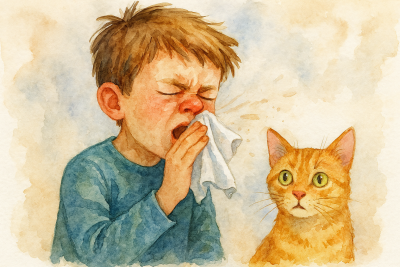
          watercolor of a boy holding a tissue up to his nose mid-sneeze while an orange cat looks on nearby


          Release Date: March 25, 2026

          Expiration Date: March 25, 2029

          Course Fee

          FREE

          There is no grant funding for this CE activity

          ACPE UANs

          Pharmacist: 0009-0000-26-020-H01-P

          Pharmacy Technician: 0009-0000-26-020-H01-T

          Session Codes

          Pharmacist:   23YC08-JKT44

          Pharmacist Technician:  23YC08-TKX48

          Accreditation Hours

          2.0 hours of CE

          Accreditation Statements

          The University of Connecticut School of Pharmacy is accredited by the Accreditation Council for Pharmacy Education as a provider of continuing pharmacy education.  Statements of credit for the online activity ACPE UAN 0009-0000-26-020-H01-P/T  will be awarded when the post test and evaluation have been completed and passed with a 70% or better. Your CE credits will be uploaded to your CPE monitor profile within 2 weeks of completion of the program.


          Disclosure of Discussions of Off-label and Investigational Drug Use

          The material presented here does not necessarily reflect the views of The University of Connecticut School of Pharmacy or its co-sponsor affiliates. These materials may discuss uses and dosages for therapeutic products, processes, procedures and inferred diagnoses that have not been approved by the United States Food and Drug Administration. A qualified health care professional should be consulted before using any therapeutic product discussed. All readers and continuing education participants should verify all information and data before treating patients or employing any therapies described in this continuing education activity.

          Faculty

          Yangzhou (Marina) Li, MS, PharmD
          Medical Writing Scientist
          Janssen of Pharmaceutical Companies of Johnson and Johnson,
          Boston, MA

          Dylan DeCandia, PharmD
          Freelance Medical Writer
          Franklyn's Pharmacy
          Ho-Ho-Kus, NJ


          Faculty Disclosure

          In accordance with the Accreditation Council for Pharmacy Education (ACPE) Criteria for Quality and Interpretive Guidelines, The University of Connecticut School of Pharmacy requires that faculty disclose any relationship that the faculty may have with commercial entities whose products or services may be mentioned in the activity.

          Dr. Li is a full time employee of Janssen Pharmaceutical of Johnson and Johnson and previously worked for Nest Bio and LegendBiotech. Dylan DeCandia does not have any relationships with ineligible companies and therefore has nothing to disclose.


          ABSTRACT

          Many American households have pets, and many others would like to have pets but family members have pet allergies. Allergies to cats and dogs are common (an estimated 15% to 30% of people are allergic to companion pets), and allergies to unusual or exotic pets have increased over the last decade. Pet allergy is an allergic reaction to proteins (allergens) found in animals’ skin cells (dander), saliva, urine, or sweat on their fur. Most animal allergens belong to one of three primary protein families. Pet allergies are currently incurable. The treatment goal is to control symptoms and improve patients’ functional status and well-being. Options include nonpharmacologic interventions like cleaning and bathing the pet and pharmacologic management with antihistamines, corticosteroids, anticholinergic nasal sprays, mast cell stabilizers, or leukotriene modifiers. Allergists will consider allergy-specific immunotherapy when medications and/or avoidance measures fail.

          CONTENT

          Content


          INTRODUCTION AND EPIDEMIOLOGY

          The American Pet Products Association (APPA) estimates that approximately 70% of Americans keep pets in their household, equating to 90.5 million homes. Dogs and cats are the most popular and live in around 69.0 and 45.3 million United States (U.S.) households, respectively, followed by 11.8 million households for freshwater fish, 9.9 million households for birds, and 3.5 million households for horses.1 Public, residential, leisure, and specific occupational environments (e.g., farms, laboratories, pet shops) have high concentrations of pet allergens because of the high prevalence of community pet-keeping and Americans’ tendency to live indoors. Allergic reactions to pets have been recognized for at least 100 years.2 Risk factors for developing asthma and rhinitis include allergies to furry animals, especially cats and dogs.3 Direct or second-hand pet exposure increases the likelihood of exacerbating disease in pet-sensitive people. However, evidence also shows that early childhood exposure to dogs or cats before one year of age may have protective effects in preventing allergic sensitization.4


          Notably, allergies to unusual or exotic pets have increased over the last decade.5 In many urban areas, apartment complexes prevent owning large pets or charge a fee for owning cats and dogs, leading to the choice of smaller, more unusual animals. Some examples of uncommon pets are rodents (mice, rats [which allegedly make very good pets], guinea pigs, and other mammals like ferrets, pigs), amphibians (axolotl [a Mexican salamander], dart frogs, and fire belly newts), and reptiles (snakes).6 The allergic signs and symptoms or diseases associated with uncommon pets are like those manifested in cat and dog allergies. In addition, patients may present with respiratory symptoms induced by bird allergens and gastrointestinal symptoms after consuming bird eggs; this is called a bird-egg syndrome.7


          Overall, the incidence of specific allergy to exotic or uncommon pets is unknown because literature only includes isolated cases or small series. In the U.S., an estimated 15% to 30% of people are allergic to their pets.8 Among people with pet allergies, a fraction is sensitized to more than one animal. Moreover, according to the Asthma and Allergy Foundation of America, cat allergies are reported twice as often as dog allergies. Animals are also recognized as the third leading cause of allergic asthma, after mites and pollens.8 Many people adopt ferrets or rabbits, believing they are hypoallergenic. They are not, and pharmacy staff should be aware of that fact.9,10 The most frequent allergic reactions result from inhalation, contact, or bites.


          This continuing education activity summarizes knowledge of pet allergens, including those from uncommon pets; the allergy reaction mechanism and its signs and symptoms; current advances in diagnosis and treatment methods such as immunotherapy; and recommendations for patient education and counseling.


          PAUSE AND PONDER: When patients ask about medication for pet allergies, what kinds of questions should you ask?


          PET ALLERGENS

          Allergy Mechanisms

          Compared with other conditions’ mechanisms, allergy mechanisms are simple and encompass three specific paths: allergic sensitization, allergy, and cross-reactivity.11

          • Allergic sensitization is the presence of immunoglobulin E (IgE) antibodies to an allergen.
          • Allergy is the occurrence of reproducible symptoms or signs initiated by exposure to a defined stimulus at a dose tolerated by nonallergic persons and mediated by specific immunologic mechanisms. If no symptoms develop, a person could be sensitizing to a particular allergen but not be allergic.
          • Cross-reactivity is the process of IgE antibodies (originally developed against a given allergen) binding to homologous molecules originating from a different allergen source.


          Characterizing Pet Allergens

          Allergies to pets are common. Pet allergy is an allergic reaction to proteins (allergens) found in animals’ skin cells (dander), saliva, urine, or sweat on their fur.5 Allergens within the same protein family can cause cross-reactivity. Most allergens are spread via airborne particles. Dander contains allergens formed in sebaceous gland secretions and saliva. Secretions containing allergens adhere to the hair and stratum corneum of the skin. When an animal sheds, tiny particles disperse into the air and remain buoyant for an extended period of time. After the particles slowly settle onto the floor, furniture, or other items, they can be easily re-dispersed into the air. As a result, pet-sensitive people could experience allergy symptoms in the nose, eyes, and respiratory tract even if the pet is not present.5 Additionally, people can carry pet allergens that settled onto their clothing or hair.


          For cats and dogs, the primary allergen sources are dander and saliva. Similarly, the primary allergen source in rabbits is saliva. In contrast, the primary allergen source is urine in rodents (mice and rats) and Mustelidae (ferrets and minks).


          Rodents are an interesting case study. Most research laboratories experience a very high rate of staff turnover because lab workers develop allergies to rodents. Children who are exposed to rodent urine can develop this allergy, too. Male rodents produce a larger quantity of and more condensed urine than female rodents. This explains why people who commonly come in contact with male rodents are more likely to develop allergic symptoms. Allergy to rodents acts as an occupational hazard for researchers. Mouse urine is the most concentrated of all urines—far more concentrated than any other species.12 One study showed that 30% of people exposed to mice and 13.7% of people exposed to rats suffered from allergy symptoms.12 Symptoms range from conjunctivitis to asthma to skin reactions, which makes working with these animals difficult.


          Most animal allergens belong to one of three primary protein families. Within the three families, lipocalin-like proteins and the serum albumin family are the two most widely studied. Other identified allergens are considered minor, including gelatins, immunoglobulins, and transferrins presented in secretions and dandruff. Knowledge of these allergens’ allergenicity and cross-activity is essential to improve treatment and prevent allergic reactions. Table 1 summarizes partially characterized pet allergens, including those generated by exotic pets, because not all allergens are fully characterized.5


          Table 1. Summary of Characterized Pet Allergens13-22

          Common Name of Animal Source Allergen Family
          Dog Dander, saliva, hair Can f 1 (major allergen)

          Can f 2

          Can f 4

          Can f 6

          Can f 3

          Can f 5

          Can f 7

          Can f 8

          Lipocalin

          Lipocalin

          Lipocalin

          Lipocalin

          Albumin

          Arginine esterase (kallikrein)

          Epididymal secretory protein E1 or Niemann Pick type C2 protein

          Cystatin

          Cat Sebaceous, anal, and salivary gland Fel d 1 (major allergen)

          Fel d 2

          Fel d 4

          Fel d 7

          Fel d 3

          Fel d 5w

          Fel d 8

          Fed d 6w

          Uteroglobin

          Albumin

          Lipocalin

          Von Ebner gland protein

          Cystatin

          Cat IgA

          Latherin-like

          IgM

          Horse Dander, sublingual, submaxillary salivary glands, and urine Equ c 1 (major allergen)

          Equ c 2

          Equ c 4

          Equ c 3

          Equ c 6

          Lipocalin

          Lipocalin

          Latherin

          Albumin

          Lysozyme

          Chinchilla Epithelia, saliva, urine Chi La

          Chi Lb

          Protein kinase inhibitor

          Lipocalin

          Guinea pig 


          Cav p 1 (major allergen)

          Cap p 2 (major allergen)

          Cap p 3

          Cap p 4

          Cap p 6

          Lipocalin

          Lipocalin

          Lipocalin

          Serum albumin

          Lipocalin

          Gerbil Epithelial, salvia, urine, sleep bed Mer un 23kDa

          Mer un 4

          Lipocalin

          Serum albumin

          Siberian hamster Epithelial, saliva, urine Phod s 1 Lipocalin
          Rat Rat n 1 (major allergen)

          Rat n 4

          Rat n 7

          Lipocalin; alpha-2u-glubulin

          Serum albumin

          Immunoglobulin

          Mouse Mus m 1 (major allergen)

          Mus m 2

          Mus m 4

          Mus m 7

          Lipocalin; urinary prealbumin

          Unknown

          Serum albumin

          Immunoglobulin

          Rabbit Ory c 1

          Ory c 2

          Ory c 3

          Ory c 4

          Lipocalin

          Lipocalin

          Secretoglobin

          Lipocalin

          Ferret Mus p 17

          Mus p 66

          Unknown

          Serum albumin

          Pig Meat Sus s 1

          Sus s 5

          Sus s 6

          Serum albumin

          Lipocalin

          Serum albumin


          Lipocalin Superfamily

          More than 50% of allergens identified from furry animals belong to the lipocalin superfamily and are found in animal dander, saliva, and urine.23 Lipocalins are large proteins and can induce IgE production in a large proportion of atopic individuals (people who have enhanced immune response to common allergens) who are exposed to the allergen source.24


          Serum Albumin Family

          Serum albumin is a globular protein prone to participation in IgE-mediated cross-reactions.24 Serum albumin is commonly found in pet dander and saliva and causes an allergic reaction by inhalation and ingestion.


          Secretoglobin Superfamily

          Secretoglobins are the most potent allergens in cats (e.g., Fel d 1) and other pets (e.g., rabbit; Ory c 3). Produced by the skin, salivary and lacrimal glands, these proteins have an unknown function. Dried saliva and dandruff are spread as airborne particles and cause sensitization in susceptible people.25


          SIGNS AND SYMPTOMS OF PET ALLERGIES

          The most frequently observed pet allergies result from inhalation, contact, and bites. The main allergic symptoms are similar across both common and uncommon pet types. They present as rhinitis, conjunctivitis, urticaria (red, itchy welts that result from a skin reaction), and lower and upper respiratory symptoms, which can be mild to severe and rarely cause anaphylactic shock.5


          Hypoallergenic Pets

          “Hypoallergenic” is defined as possessing decreased risk of causing an allergy in people, which means that hypoallergenic animals could still elicit allergies in humans.9 To make hypoallergenic animals, breeders or researchers combine breeds that produce less allergen (in dogs, breeders use breeds that shed less than other breeds, or have hair rather than fur). However, animals often have different mechanisms of allergenicity, so infrequent shedding does not solve all allergy problems.


          In a dog allergen study, homes that included hypoallergenic dogs had no statistically significant difference in dog allergen levels compared to homes that included non-hypoallergenic dogs. The common allergen in dogs, Can f 1, was reported at similar levels in all groups.25 The frequency of shedding varies in different dog breeds, but all dogs can elicit allergies in humans.


          The main allergen in cats, Fel d 1 protein, comes from their saliva and sweat glands. Because of its small size and adhesiveness, Fel d 1 floats around and sticks to everything, making it almost impossible to remove physically. In fact, Fel d 1 measures in at less than one-tenth the size of ribosome; it’s so small, it easily navigates its way deep into the lungs and can precipitate asthma.26 For this reason, making a completely hypoallergenic cat has proven impossible, however vaccines to decrease the production of Fel d 1 protein have been studied; one vaccine is a combination of recombinant Fel d 1, tetanus toxoid protein, and a snippet of the coat of a plant virus.27 Researchers are unsure as to the purpose of Fel d 1 in cats or why levels of Fel d 1 vary.


          Ferrets—which are related to otters, minks, and weasels—are considered hypoallergenic because they are less likely to cause an allergic reaction compared to other animals. However, they can still provoke allergies in people. Allergies to ferrets come from their hair, saliva, and urine. Ferret hair and saliva is usually easy to control because they shed infrequently and do not lick people like dogs and cats often do. However, urine is harder to control and can cause allergies when owners clean crates.9


          Rabbits produce allergens through dander, hair from shedding, and saliva. They tend to shed more often than ferrets, around every three months, so keeping up with cleaning may be difficult. Rabbit hair isn’t naturally allergenic, but when rabbits lick their fur, they transfer a saliva protein that is contaminated with the protein allergen.10


          DIAGNOSIS

          Skin Prick Test

          Allergists (allergy specialists) use skin prick tests together with medical history and physical examinations to rule out or confirm a suspected IgE-mediated animal allergy.28 Manufacturers prepare skin prick tests by extracting natural allergens from animal hair, dander, and urine. The doctor or nurse will prick the patient’s skin on the forearm or upper back and determine if an allergic reaction occurs within 15 minutes. If a patient develops a red, itchy bump where the pet allergen extract is pricked into the skin, the patient is allergic to that pet allergen. Diagnosticians should first use a skin prick test as it is inexpensive, easy to use, and quick to perform. However, allergen concentrations and components are inconsistent, varying among similar commercial tests from different manufacturers. Healthcare providers should be aware that patients’ test results may be inconsistent if they use different skin prick tests at different times.28


          Serum-specific IgE Test

          Allergists can use a serum-specific IgE (blood) test when patients’ symptoms and skin test results are contradictory or when patients’ skin conditions prevent a skin test. Serum-specific IgE tests can only determine if a patient is sensitized to a specific pet allergen, but it cannot determine if a patient is allergic to that allergen. Serum-specific IgE tests are highly sensitive, but prone to false-positive results. From this perspective, serum-specific IgE tests may be less accurate than skin prick tests.29


          Molecular Diagnosis

          Recent scientific advances have allowed molecular diagnosis to differentiate patients who are allergic to a single species or sensitized due to cross-reactivity. This method can aid targeted recommendations for avoidance and assess the choice and composition of immunotherapy.28


          PET ALLERGY MANAGEMENT

          Pet allergies cannot currently be cured. The treatment goal is to control symptoms and improve patients’ functional status and well-being.


          Nonpharmacologic Treatment – Avoid & Minimize Allergen Exposure

          Current recommendations for managing pet allergy symptoms start with exposure avoidance. Starting when animals are young, bathing them at least once weekly can reduce allergens and eliminate reactions in humans who are exposed to them (see SIDEBAR).30 Immediate removal of animals from the household will not alleviate symptoms if the owner has carpeting and other pieces of furniture/items that the pet slept or sat on. Mammalian allergens are stable and can persist in house dust for up to six months.32 Additionally, using high-efficiency particulate air (HEPA) filters and mattress encasement, vacuuming, and chemically treating carpet are alternative methods for reducing exposure to contaminated materials, but may not reduce disease severity.33


          PAUSE AND PONDER: When patients have pet allergies, which symptoms are best treated with antihistamines?


          SIDEBAR: To Bathe or Not to Bathe…26,31

          Bathing a cat or dog regularly appears to reduce the quantity of allergen harbored by the pet. To effectively lower Can f 1 concentrations, owners need to bathe the animal at least twice every week because Can f 1 concentrations rise rapidly, approaching baseline concentrations within three days after washing. Twice-weekly bathing can reduce the amount of recoverable Can f 1 on dogs by more than 80%, but researchers note that ideally, one would bathe the dog two to three times every week. Airborne Can f levels can fall by ruff-ly 40% but will quickly escalate.

          However, the beneficial effects of reducing allergen levels by regular bathing are more likely associated with dogs, because their allergen burden returns faster than that of cats. So, bathing animals reduces the amount of allergen far better than vacuuming.

          But should companion animals be bathed so often?

          Most cats are notoriously averse to bathing, although some breeds like water (i.e., the Bengal). Dogs vary in the response to bathing—some like it, others do not. People who plan to bathe their cats or dogs regularly should do three things:

          1. Check with a veterinarian or a breed advocacy group. The American Kennel Club indicates that how often an owner should bathe a dog depends on the dog’s coat type and presence or absence of an undercoat (in the latter case, frequent bathing can affect a dog’s temperature regulation). Bathing an animal is not just about a human’s allergies, the animal’s health and welfare should be a primary concern.
          2. Consider the labor and time involved in bathing a pet often, safely, and well.
          3. Start when the animal is young.


          An allergen reducing cat food (Pro Plan LiveClear) is now available, and its manufacturer indicates it reduces the number of allergens in cat hair and dander by 47% after three weeks of feeding.34 It is produced using eggs that contain an anti-Fel d1 antibody. When cats consume the food, the egg powder binds to and neutralizes Fel d1 in the cat’s saliva.34


          Pharmacologic Treatment

          When avoidance and reducing allergens are not enough, depending on the severity of signs, over the counter (OTC) medications like antihistamines or local/topical steroids may provide temporary relief of allergy symptoms.35 Those symptoms include runny/itchy nose or throat, sneezing, and itchy, red or watery eyes. Combination products that contain both an antihistamine and a decongestant or an analgesic are available but should be used with caution due to the increased risk of adverse effects. Other allergy medications, besides the ones mentioned, are used less often, including mast cell stabilizers and leukotriene antagonists. Table 2 summarizes common medications (both OTC and prescription) for treating mild to moderate allergy symptoms.35


          Table 2. Medications to Treat Allergy Symptoms36

          Medication Mechanism of Action Adverse Effects Notes
          Antihistamines
          1st generation (nonselective, more sedating):*

          diphenhydramine, chlorpheniramine, clemastine

          2nd generation (less sedating, less drowsiness):

          cetirizine,* desloratadine,* fexofenadine,* levocetirizine,* and loratadine*

          Azelastine has nasal spray* and eye drop formulations. Epinastine and olopatadine* are formulated as eye drops.

          Blocks histamine and its binding to receptors, prevents histamine-caused redness, swelling, itching, and changes in secretions during an allergic response ·       Drowsiness

          ·       Fatigue

          ·       Headache

          The 2nd generation antihistamines are preferred over 1st generation based on safety and efficacy data.


          Corticosteroids
          Available as tablets, liquids, nasal sprays, topical creams for skin allergies, topical eye drops for conjunctivitis.


          Some steroids include:

          beclomethasone, ciclesonide, fluticasone furoate,* mometasone, budesonide,* triamcinolone,* dexamethasone ophthalmic, prednisone, etc.

          Anti-inflammatory effect Short-term use:

          Weight gain, fluid retention, high blood pressure


          Long-term use:

          Growth suppression, diabetes, cataracts of the eye, osteoporosis, muscle weakness


          Side effects of inhaled steroids:

          Cough, hoarseness, fungal infection of the mouth


          Highly effective for allergies but must be taken regularly. It may take 1 to 2 weeks before the full effect.
          Decongestants
          Available as nasal sprays, eye drops, liquids, and tablets


          Some decongestants include:

          pseudoephedrine,* phenylephrine,* and oxymetazoline* nasal sprays


          Shrinks swollen nasal tissues and blood vessels to relieve the symptoms of nasal swelling, congestion, mucus secretion, and redness ·       Increased blood pressure

          ·       Insomnia

          ·       Anxiety, feeling nervous, restlessness

          Relieve congestion and are often prescribed with antihistamines for allergies.


          Contraindicated in patients with severe coronary artery disease, severe hypertension, and who concomitantly use monoamine oxidase inhibitors


          Short-term use only (~5 days). Long-term use can make symptoms worse.

          Combination Allergy Drugs
          Some combination drugs include:

          cetirizine/pseudoephedrine,* fexofenadine/ pseudoephedrine,* diphenhydramine/ pseudoephedrine,* loratadine/pseudoephedrine,* pseudoephedrine/triprolidine* for nasal allergies, and naphazoline/pheniramine* for allergic conjunctivitis


          Effects from each component Side effects from each component Use with caution due to increased risk of adverse effects
          Anticholinergic Nasal Spray
          Ipratropium bromide nasal spray to control nasal discharge Antisecretory properties in the nasal mucosa ·       Bitterness of the mouth

          ·       Dry nose, nosebleeds, or irritation

          ·       Dizziness

          ·       Headache

          ·       Sore throat

          ·       Respiratory tract infection

          Some patients may feel better right away. For others, it may take 1 to 2 weeks before the medicine helps. It is important for patients to continue use of this medication as instructed.
          Mast Cell Stabilizers
          Available as eye drops for allergic conjunctivitis and nasal sprays for nasal allergy symptoms


          Some mast cell stabilizers include cromolyn sodium,* iodoxamide-tromethamine, nedocromil, pemirolast, etc.

          Prevents histamine release from mast cells ·       Throat irritation, coughing, skin rashes

          ·       Eye drops may cause blurred vision, stinging, and burning

          For mild to moderate symptoms

          Not as effective as steroids

          Leukotriene Modifiers
          Montelukast:

          Indicated for adults and pediatric patients six months or older with perennial allergic rhinitis.

          May be less effective than loratadine or cetirizine for reducing daytime nasal symptoms

          Montelukast binds to leukotriene receptors in the human airway (smooth muscle cells and macrophages), preventing airway edema, smooth muscle contraction, and other respiratory inflammation ·       Stomach pain or upset

          ·       Headache

          ·       Stuffy nose

          ·       Cough

          ·       Fever

          ·       Rash

          ·       Irritability

          Warn patients to report behavior changes, including suicidal ideation or suicidal behavior

          Avoid concomitant use of aspirin or NSAIDs in aspirin-sensitive patients

          *Indicates over-the-counter (OTC) medication


          In general, for conditions eligible for self-care (e.g., allergic rhinitis) patients should start taking OTC allergy medications one week before they expect symptoms from a predictable exposure or as soon as possible before allergen exposure (for episodic exposure).35 Prescribers should tailor the pharmacologic therapy and length of treatment based on symptoms and severity. Usually, complete relief takes two to four weeks. Intranasal steroids control nasal symptoms more effectively than antihistamines, as they inhibit multiple cell types and mediators, and should be recommended for moderate or persistent allergic rhinitis. Decongestants are effective in nasal congestion but have little effect on other symptoms. Intranasal and ocular preparations are available for nasal and eye symptoms. Intranasal cromolyn is the preferred initial choice for pregnant or lactating patients, as the body does not absorb it based on the route of administration. As mentioned in the table, fluticasone and triamcinolone nasal sprays are available OTC.35


          If a patient has persistent allergies, allergy medication is more effective when taken regularly.35 For example, if a patient with moderate or severe persistent allergic rhinitis has completed two to four weeks of treatment with intranasal corticosteroids or oral antihistamines and achieved symptomatic control, healthcare providers can optimize the treatment’s effect by reducing the dose and continuing treatment for one additional month. If a patient’s symptoms are uncontrolled after two to four weeks of OTC treatment, pharmacists should assess the patient’s adherence and refer for prescription therapy if necessary.35


          PAUSE AND PONDER: Which providers in your area provide allergen-specific immunotherapy? What should patients expect if they take this route?


          Allergy Immunotherapy

          Allergen-specific immunotherapy has been used in pet allergies for years and has proven efficacy to help control symptoms and prevent disease progression. Allergists will consider allergy-specific immunotherapy when symptoms are uncontrolled by medications and/or avoidance measures, when adverse drug effects are intolerable, or when patients want to reduce long-term use of allergy medications.37


          The basis for allergen-specific immunotherapy is gradual reprogramming of the immune system to build a tolerance to allergens. The U.S. Food and Drug Administration (FDA) characterizes allergen-specific immunotherapies as biologics because they are produced from living cells, not synthesized by chemists, and regulated under the Center for Biologics Evaluation and Research (CBER).38 This class comes in three forms:

          • Sublingual allergy immunotherapy (SLIT) tablets
          • SLIT drops, and
          • subcutaneous allergy immunotherapy (SCIT)


          As of 2022, the FDA has approved four SLIT tablets to treat allergic rhinitis with or without allergic conjunctivitis caused by ragweed, northern pasture grasses, and dust mites in susceptible individuals; the FDA has not approved SLIT tablets for pet allergies.22


          SLIT drops are made from FDA-approved allergy extracts used to make SCIT shots. However, these extracts are only FDA-approved for injection use under the skin, and they are not approved for use under the tongue. Therefore, SLIT drops are not FDA-approved and are off-label in the U.S., and Medicare or Medicaid does not cover these treatments in most cases. Despite not having FDA approval, patients can still receive SLIT drops from some prescribers who prepare a custom-mixed formulation but must pay out of pocket. Research indicates SLIT is safe and effective.39


          The FDA has approved SCIT for cat allergies, but not for other pet allergies. Patients who receive SCIT usually call it “allergy shots.” One systemic review evaluated 88 trials that enrolled 3,459 asthmatic patients and exposed them to SCIT. One case of deterioration in asthma symptoms was avoided for every three patients treated with SCIT (95% CI, 3-5), and one patient would avoid increasing symptomatic medication use for every four patients treated (95% CI, 3-6).40 Another study found that SCIT can reduce the need for systemic steroids in allergic rhinitis patients.41 Usually, the patient receives a solution for injection with 10,000 bioequivalent allergy units (BAUs) per milliliter (standardized extract) of lyophilized cat hair and dander added to glycerol and human serum albumin (0.03%). A clinician administers one to two subcutaneous injections every week starting at low doses (1:10,000 dilution) and titrating up to a seemingly effective maintenance dose. Then, the prescriber extends the injection interval gradually to every 2 weeks to 4 weeks. For cat allergens, the effective maintenance dose usually falls within the 1,000 to 4,000 BAU range.42


          S'CIT sometimes can cause treatment-related systemic allergic reactions; however, near-fatal or severe reactions are rare, and most reactions are local and mild (swelling, pruritis, and redness at injection site).43 SCIT should not be recommended to patients who have severe uncontrolled heart problems or asthma if they take beta-blockers, which are associated with more frequent reactions, more severe reactions, and reactions that are refractory to epinephrine. Additionally, allergy shots should not be recommended for pregnant women unless discussed with their obstetricians.43


          Both SCIT and SLIT require gradual up-titration of dosages with ongoing and multiple treatments and may take three to five years to reach desensitization. Also, for SCIT, based on its route of administration (subcutaneous injections are invasive), patients will need to visit the doctor's office more frequently and may experience the treatment-associated side effects.


          SLIT has been increasingly recommended because of its ability to modify the immune system for the long term while reducing allergy symptoms. SLIT also showed a safer profile, only associated with mild mouth symptoms, and improved adherence compared to SCIT.44 When compared to traditional allergy treatments, SLIT tablets showed similar clinical efficacy to nasal corticosteroids and greater clinical efficacy than second-generation antihistamines and montelukast.45


          What About Cost?

          In adherent patients, SCIT and SLIT have proven to be an economically viable option. The annual cost of using SCIT depends on patients’ insurance: Medicare ($1021.70), Medicaid ($758.16), and the commercial average ($1722.24). Yearly treatment costs for SLIT are self-pay because treatment is not FDA approved and costs around $679.25.46 Because SLIT drops are administered at home by patients, they tend to be more affordable than the cost of SCIT. Patient preference might be for a once monthly administration, rather than taking oral antihistamines daily.


          OTC medications are less expensive than immunotherapy, but costs vary. In a comparison of second-generation antihistamines versus montelukast, levocetirizine (Xyzal) had the best efficacy per cost value. Generic fexofenadine (Allegra), although similar in efficacy, was more expensive than levocetirizine.44


          CONCLUSION

          Healthcare providers should counsel patients about reducing allergen exposure and help patients to choose OTC medications for self-care based on individual patient needs and conditions to optimize treatment effects. Pharmacy staff should refer patients to allergists when necessary to identify the cause of their allergy symptoms. If a patient's allergy does not allow him or her to have pets at home and the patient owns a pet, suggest that the patient ask family members or friends about placement before contacting the local animal shelters.

          Pharmacist Post Test (for viewing only)

          Pet Allergies
          Pharmacist Post-test
          After completing this continuing education activity, pharmacists will be able to
          1. Outline the causes of pet allergies in dogs, cats, and other less common species
          2. Differentiate between allergic sensitization, allergy, and cross sensitivity
          3. Paraphrase facts that prove that currently, hypoallergenic dogs and cats are a myth
          4. Compare nonpharmacologic, over the counter, and prescription treatments in terms of dosing, effectiveness, and cost

          1. What is the major allergen in dogs?
          A. Can f 3
          B. Can f 1
          C. Fel d 1

          2. When comparing allergy immunotherapies (SCIT, SLIT) and traditional allergy treatments, how do they differ?
          A. Traditional allergy treatments are more clinically efficacious, SCIT and SLIT therapies should not be considered in treatment
          B. Traditional allergy treatments are more effective, but with the recent FDA approval of SLIT, it should be considered more often
          C. Although not FDA approved, SLIT showed similar clinical efficacy to nasal corticosteroids and more clinical efficacy to second-generation antihistamines in trials

          3. What is the best way to define hypoallergenic animals?
          A. Animals that are less likely to cause allergies in humans.
          B. Animals that cannot cause allergies in humans
          C. Animals that do not cause conjunctivitis, but other common symptoms may still occur

          4. A mother brings her young son to the pharmacy and says that the allergist indicates he has an allergy to their cat. She asks what this means. What is the BEST answer?
          A. Her son has immunoglobulin G (IgG) antibodies to an allergen.
          B. Her son will experience reproducible symptoms when exposed to the cat.
          C. Her son will have symptoms when exposed to any furry animal.

          5. Lance, a college student who lives in a group house, comes in and says that he has tried several medications for allergic symptoms linked to his roommate’s three cats. The medications relieved the symptoms but caused so much drowsiness, he couldn’t study. His allergist is now recommending he start immunotherapy. What is the MOST LIKELY reason the allergist is making this recommendation?
          A. Lances’ symptoms are uncontrolled by medications
          B. Lance is experiencing intolerable adverse effects
          C. Lance want to reduce his use of allergy medications.

          6. Lance returns to the pharmacy to pick up his atenolol for hypertension and he said the allergist has asked him to decide if he wants to take SCIT or SLIT. He asks you which factors he should consider. What is the BEST answer?
          A. Advise him to consider cost, dosing frequency, and route of administration
          B. Advise him to consider cost and convenience alone as they are both effective
          C. Advise him to tell his allergist he is taking a beta blocker, so SLIT is preferred

          7. Emily and her mom come to the pharmacy and they are very excited. They are considering adopting a dog! Emily has asthma and multiple allergies, and the pediatrician has told them she is probably allergic to or will become allergic to dogs. As Mom chatters, she tells you that the 9-year-old dog, Raven, is an Alaskan Malamute (a breed that has a heavy undercoat) that weighs 95 pounds. She said that a friend told her that if she washes the dog two or three times a month, allergies will not be a problem. She says, “I think I can find time to wash a dog twice a month.” What is the MOST IMPORTANT FACT you should bring to her attention?
          A. Before adopting Raven, check with a veterinarian or a breed advocacy group to determine if bathing is a good idea.
          B. Bathing a pet two to three times a month is not frequent enough to reduce the allergen load—you have to bathe them two to three times a week.
          C. Look for a younger Alaskan Malamute—maybe a puppy—so the dog will get used to being bathed so often.

          8. Adele, who is 7 months pregnant, is experiencing an allergic reaction to a visiting ferret. She asks you to recommend an OTC product to reduce her nasal stuffiness and itchy eyes. Which is the BEST product to recommend?
          A. Intranasal cromolyn
          B. Oral levocetirizine
          C. Oral diphenhydramine

          9. Which of the following have similar effectiveness for pet allergies, but different cost effectiveness?
          A. Fluticasone and fexofenadine
          B. Montelukast and loratadine
          C. Levocetirizine and fexofenadine

          10. Which medication class should be used for no longer than five days at a time?
          A. Decongestants
          B. First generation antihistamines
          C. Nasal corticosteroids

          Pharmacy Technician Post Test (for viewing only)

          Pet Allergies

          Pharmacy Technician Post-test

          After completing this continuing education activity, pharmacy technicians will be able to
          • Outline the causes of pet allergies in dogs, cats, and other less common species
          • Differentiate between allergic sensitization, allergy, and cross sensitivity
          • Paraphrase facts that prove that currently, hypoallergenic dogs and cats are a myth
          • Identify patients whose complaints indicate they may need referral to a pharmacist

          1. What is the major allergen in dogs?
          A. Can f 3
          B. Can f 1
          C. Fel d 1

          2. When comparing allergy immunotherapies (SCIT, SLIT) and traditional allergy treatments, how do they differ?
          A. Traditional allergy treatments are more clinically efficacious, SCIT and SLIT therapies should not be considered in treatment
          B. Traditional allergy treatments are more effective, but with the recent FDA approval of SLIT, it should be considered more OFTEN?
          C. Although not FDA approved for pet allergies, SLIT showed similar efficacy to nasal corticosteroids and more clinical efficacy to second-generation antihistamines in trials

          3. What is the best way to define hypoallergenic animals?
          A. Animals that are less likely to cause allergies in humans.
          B. Animals that cannot cause allergies in humans
          C. Animals that do not cause conjunctivitis, but other common symptoms may still occur

          4. A mother brings her young son to the pharmacy and says that the allergist indicates he has an allergy to their cat. She asks what this means. What is the BEST answer?
          A. Her son has immunoglobulin G (IgG) antibodies to an allergen.
          B. Her son will experience reproducible symptoms when exposed to the cat.
          C. Her son will have symptoms when exposed to any furry animal.

          5. Lance, a college student who lives in a group house, comes in and says that he has tried several medications for allergic symptoms linked to his roommate’s three cats. The medications relieved the symptoms but caused so much drowsiness, he couldn’t study. His allergist is now recommending he start immunotherapy. What is the MOST LIKELY reason the allergist is making this recommendation?
          A. Lances’ symptoms are uncontrolled by medications
          B. Lance is experiencing intolerable adverse effects
          C. Lance want to reduce his use of allergy medications.
          Links to LO #4 Answer found on page 10

          6. Lance returns to the pharmacy to pick up his atenolol for hypertension and he said the allergist has asked him to decide if he wants to take SCIT or SLIT. He asks you which factors he should consider. What is the BEST answer?
          A. Advise him to consider cost, dosing frequency, and route of administration
          B. Advise him to consider cost and convenience alone as they are both effective
          C. Advise him to tell his allergist he is taking a beta blocker, so SLIT is preferred

          7. Emily and her mom come to the pharmacy, and they are very excited. They are considering adopting a dog! Emily has asthma and multiple allergies, and the pediatrician has told them she is probably allergic to or will become allergic to dogs. As Mom chatters, she tells you that the 9-year-old dog, Raven, is an Alaskan Malamute (a breed that has a heavy undercoat) that weighs 95 pounds. She said that a friend told her that if she washes the dog two or three times a month, allergies will not be a problem. She says, “I think I can find time to wash a dog twice a month.” What is the MOST IMPORTANT FACT should you bring to her attention?
          A. Before adopting Raven, check with a veterinarian or a breed advocacy group to determine if bathing is a good idea.
          B. Bathing a pet two to three times a month is not frequent enough to reduce the allergen load—you have to bathe them two to three times a week.
          C. Look for a younger Alaskan Malamute—maybe a puppy—so the dog will get used to being bathed all the time.

          8. Adele., who is 7 months pregnant, is experiencing an allergic reaction to a visiting ferret. She asks you to recommend an OTC product to reduce her nasal stuffiness and itchy eyes. Which is the BEST product to recommend?
          A. Intranasal cromolyn
          B. Oral levocetirizine
          C. Oral diphenhydramine

          9. Which of the following have similar effectiveness for pet allergies, but different cost effectiveness?
          A. Fluticasone and fexofenadine
          B. Montelukast and loratadine
          C. Levocetirizine and fexofenadine

          10. Which medication class should be used for no longer than five days at a time?
          A. Decongestants
          B. First generation antihistamines
          C. Nasal corticosteroids

          References

          Full List of References

          1. 2021-2022 APPA National Pet Owners Survey. Accessed January 17, 2022. https://www.americanpetproducts.org/press_industrytrends.asp
          2. Ownby D, Johnson C. Recent Understandings of Pet Allergies [version 1; peer review: 2 approved]. F1000Research. 2016;5(108)doi:10.12688/f1000research.7044.1
          3. Perzanowski MS, Rönmark E, Platts-Mills TA, Lundbäck B. Effect of cat and dog ownership on sensitization and development of asthma among preteenage children. Am J Respir Crit Care Med. 2002;166(5):696-702. doi:10.1164/rccm.2201035
          4. Ownby DR, Johnson CC, Peterson EL. Exposure to dogs and cats in the first year of life and risk of allergic sensitization at 6 to 7 years of age. JAMA. 2002;288(8):963-72. doi:10.1001/jama.288.8.963
          5. Díaz-Perales A, González-de-Olano D, Pérez-Gordo M, Pastor-Vargas C. Allergy to uncommon pets: new allergies but the same allergens. Front Immunol. 2013;4:492-492. doi:10.3389/fimmu.2013.00492
          6. Curin M, Hilger C. Allergy to pets and new allergies to uncommon pets. Allergol Select. 2017;1(2):214-221. Published 2017 Aug 4. doi:10.5414/ALX01842E
          7. Villas F, Compes E, Fernández-Nieto M, Muñoz MP, Bartolome B, de las Heras M. Bird-egg syndrome caused by Agapornis species (lovebird). J Investig Allergol Clin Immunol. 2009;19(1):71-2.
          8. Quirce S. Asthma in Alergológica-2005. J Investig Allergol Clin Immunol. 2009;19 Suppl 2:14-20.
          9. Ferret allergies: Are ferrets hypoallergenic animals? Accessed July 12, 2022. https://friendlyferret.com/ferret-hypoallergenic-allergies/
          10. Are rabbits hypoallergenic? All your questions answered. Hypoallergenic Home. Accessed July 12, 2022. https://hypoallergenichomes.com/hypoallergenic-pets/rabbits/
          11. Konradsen JR, Fujisawa T, van Hage M, et al. Allergy to furry animals: New insights, diagnostic approaches, and challenges. J Allergy Clin Immunol. Mar 2015;135(3):616-25. doi:10.1016/j.jaci.2014.08.026
          12. Kang SY, Won HK, Park SY, Lee SM, Lee SP. Prevalence and diagnostic values of laboratory animal allergy among research personnel [published online ahead of print, 2021 Jul 11]. Asian Pac J Allergy Immunol. 2021;10.12932/AP-220321-1094. doi:10.12932/AP-220321-1094
          13. Grönlund H, Saarne T, Gafvelin G, van Hage M. The major cat allergen, Fel d 1, in diagnosis and therapy. Int Arch Allergy Immunol. 2010;151(4):265-74. doi:10.1159/000250435
          14. Fernández-Parra B, Bisson C, Vatini S, Conti A, Cisteró Bahima A. Allergy to chinchilla. J Investig Allergol Clin Immunol. 2009;19(4):332-3.
          15. De las Heras M, Cuesta-Herranz J, Cases B, et al. Occupational asthma caused by gerbil: purification and partial characterization of a new gerbil allergen. Ann Allergy Asthma Immunol. 2010;104(6):540-542.
          16. De las Heras M, Cuesta J, De Miguel J, et al. Occupational rhinitis and asthma caused by gerbil. J Allergy Clin Immunol. 2002;109(1):S326.
          17. Hunskaar S, Fosse RT. Allergy to laboratory mice and rats: a review of the pathophysiology, epidemiology and clinical aspects. Lab Anim. 1990;24(4):358-379.
          18. Sathish JG, Sethu S, Bielsky M-C, et al. Challenges and approaches for the development of safer immunomodulatory biologics. Nat Rev Drug Discov. 2013;12(4):306-324.
          19. Phipatanakul W. Rodent allergens. Curr Allergy Asthma Rep. 2002;2(5):412-416.
          20. Gonzáles de Olano D, Pastor Vargas C, Cases Ortega B, et al. Identification of a novel 17-kDa protein as a ferret allergen. Ann Allergy Asthma Immunol.. 2009;103(2):177-178.
          21. Posthumus J, James HR, Lane CJ, et al. Initial description of pork-cat syndrome in the United States. J Allergy Clin Immunol.. 2013;131(3):923-925.
          22. FDA Allergen Extract Sublingual Tablet. Cited 21 February 2022 Accessed https://www.fda.gov/vaccines-blood-biologics/allergenics/allergen-extract-sublingual-tablets.
          23. Jesner S. (2022, June 28). Sublingual immunotherapy faqs. Sublingual Immunotherapy FAQs. Accessed July 8, 2022. https://www.hopkinsmedicine.org/otolaryngology/specialty_areas/sinus_center/sublingual_immunotherapy.html#:~:text=Immunotherapy%20treats%20the%20cause%20of,as%20drops%20under%20the%20tongue.
          24. Malandain H. IgE antibody in the serum--the main problem is cross-reactivity. Allergy. 2004;59(2):229-230. doi:10.1046/j.1398-9995.2003.00395.x
          25. Nicholas CE, Wegienka GR, Havstad SL, et al. Dog allergen levels in homes with hypoallergenic compared with nonhypoallergenic dogs. Am J Rhinol Allergy. 2011;25(4):252-6. doi: 10.2500/ajra.2011.25.3606
          26. Dance A. The race to deliver the hypoallergenic cat. Nature. 2020;588(7836):S7-S9. doi:10.1038/d41586-020-02779-3
          27. Hypoallergenic cats. Blue Cross. (n.d.). Accessed July 8, 2022. https://www.bluecross.org.uk/advice/cat/hypoallergenic cats#:~:text=Despite%20popular%20belief%2C%20hypoallergenic%20cats,how%20much%20protein%20they%20produce
          28. Skin prick tests. FoodAllergy.org. Accessed August 1, 2022. Skin Prick Tests - FoodAllergy.org
          29. de Vos G. Skin testing versus serum-specific IgE testing: which is better for diagnosing aeroallergen sensitization and predicting clinical allergy?. Curr Allergy Asthma Rep. 2014;14(5):430. doi:10.1007/s11882-014-0430-z
          30. Hodson T, Custovic A, Simpson A, Chapman M, Woodcock A, Green R. Washing the dog reduces dog allergen levels, but the dog needs to be washed twice a week. J Allergy Clin Immunol. Apr 1999;103(4):581-5. doi:10.1016/s0091-6749(99)70227-7
          31. Latz K. How Often Should You Bathe Your Dog? Accessed July 13, 2022. https://www.akc.org/expert-advice/health/how-often-should-you-wash-your-dog/
          32. Aalberse RC. Mammalian airborne allergens. Chem Immunol Allergy. 2014;100:243-247. doi:10.1159/000358862
          33. Wood RA, Johnson EF, Van Natta ML, Chen PH, Eggleston PA. A placebo-controlled trial of a HEPA air cleaner in the treatment of cat allergy. Am J Respir Crit Care Med. 1998;158(1):115-120. doi:10.1164/ajrccm.158.1.9712110
          34. Discover ProPlan LiveClear Allergen Reducing Cat Food. Purina. Accessed July 12, 2022. https://www.purina.com/pro-plan/cats/liveclear-cat-allergen-reducing-food
          35. Scolaro KL. Chapter 11: Colds and Allergy. Handbook of Nonprescription Drugs: An Interactive Approach to Self-Care, 20th Edition.
          36. Product Information: SINGULAIR(R) oral tablets, oral chewable tablets, oral granules, montelukast sodium oral tablets, oral chewable tablets, oral granules. Merck & Co (Per FDA); 2012.
          37. Clark J, White ND. Immunotherapy for Cat Allergies: A Potential Strategy to Scratch Back. Am J Lifestyle Med. 2017;11(4):310-313. doi:10.1177/1559827617701389
          38. Allergenics. U.S. Food and Drug Administration. Accessed July 29, 2022. https://www.fda.gov/vaccines-blood-biologics/allergenics
          39. Sublingual Immunotherapy. Johns Hopkins Medicine. Accessed July 13, 2022. https://www.hopkinsmedicine.org/otolaryngology/specialty_areas/sinus_center/sublingual_immunotherapy.html#:~:text=Immunotherapy%20treats%20the%20cause%20of,as%20drops%20under%20the%20tongue.
          40. Abramson MJ, Puy RM, Weiner JM. Injection allergen immunotherapy for asthma. Cochrane Database Syst Rev. 2010;(8):Cd001186. doi:10.1002/14651858.CD001186.pub2
          41. Aasbjerg K, Torp-Pedersen C, Backer V. Specific immunotherapy can greatly reduce the need for systemic steroids in allergic rhinitis. Allergy. 2012;67(11):1423-9. doi:10.1111/all.12023
          42. Ling M, Long AA. Pet dander and difficult-to-control asthma: therapeutic options. Allergy Asthma Proc. 2010;31:385-391.
          43. Cox L, Nelson H, Lockey R, et al. Allergen immunotherapy: a practice parameter third update. J Allergy Clin Immunol. 2011;127(1 Suppl):S1-55. doi:10.1016/j.jaci.2010.09.034
          44. Goodman MJ, Jhaveri M, Saverno K, Meyer K, Nightengale B. Cost-effectiveness of second-generation antihistamines and montelukast in relieving allergic rhinitis nasal symptoms. Am Health Drug Benefits. 2008;1(8):26-34.
          45. Aboshady OA, Elghanam KM. Sublingual immunotherapy in allergic rhinitis: efficacy, safety, adherence and guidelines. Clin Exp Otorhinolaryngol. 2014 Dec;7(4):241-9. doi: 10.3342/ceo.2014.7.4.241.
          46. Hardin FM, Eskander PN, Franzese C. Cost-effective Analysis of Subcutaneous vs Sublingual Immunotherapy From the Payor's Perspective. OTO Open. 2021 Oct 25;5(4):2473974X211052955. doi: 10.1177/2473974X211052955.

          Delving Beyond the Shelving Podcast Episode #2: Private Equity and PBMs

          Learning Objectives

          After completing this application-based continuing education activity, pharmacists and pharmacy technicians will be able to:

          ·       Recall outcomes of previous private equity investment
          ·       Discuss what factors led to the topple of the Walgreens empire
          ·       Dissect the effects of the current healthcare payor system on patients and pharmacies
          ·       Develop a plan for potential legislation change

              Cute cartoon pill bottles on shelves with the words Delving Beyond The Shelving

               Release Date

              Release Date: June 20, 2026

              Expiration Date: June 20, 2029

              Course Fee

              FREE

              There is no funding for this CE.

              ACPE UANs

              Pharmacist: 0009-0000-26-038-H04-P

              Pharmacy Technician: 0009-0000-26-038-H04-T

              Session Codes

              Pharmacist: 26POD38-MRQ75

              Pharmacy Technician: 26POD38-RQM57

              Accreditation Hours

              0.5 hours of CE

              Accreditation Statements

              The University of Connecticut School of Pharmacy and Pharmaceutical Sciences is accredited by the Accreditation Council for Pharmacy Education as a provider of continuing pharmacy education.  Statements of credit for the online activity ACPE UAN 0009-0000-26-038-H04-P/T will be awarded when the post test and evaluation have been completed and passed with a 70% or better. Your CE credits will be uploaded to your CPE monitor profile within 2 weeks of completion of the program.


              Disclosure of Discussions of Off-label and Investigational Drug Use

              The material presented here does not necessarily reflect the views of The University of Connecticut School of Pharmacy and Pharmaceutical Sciences or its co-sponsor affiliates. These materials may discuss uses and dosages for therapeutic products, processes, procedures and inferred diagnoses that have not been approved by the United States Food and Drug Administration. A qualified health care professional should be consulted before using any therapeutic product discussed. All readers and continuing education participants should verify all information and data before treating patients or employing any therapies described in this continuing education activity.

              Faculty

              Dylan Decandia PharmD

              Freelance Medical Writer, Franklyn’s Pharmacy

              Ho-Ho-Kus, NJ


              Faculty Disclosure

              In accordance with the Accreditation Council for Pharmacy Education (ACPE) Criteria for Quality and Interpretive Guidelines, The University of Connecticut School of Pharmacy and Pharmaceutical Sciences requires that faculty disclose any relationship that the faculty may have with commercial entities whose products or services may be mentioned in the activity.

              Dylan Decandia PharmD has no relationships with ineligible companies.


              Dylan Decandia, PharmD discusses topics in the pharmacy world with a new guest each episode. Catch the next episode on Spotify or Apple Podcasts.

              DELVING BEYOND THE SHELVING PODCAST EPISODE 2

              Pharmacist Post Test (for viewing only)

              Delving Beyond the Shelving Episode #2: Private Equity and PBMs
              Posttest 26-038
              Pharmacists and Pharmacy Technicians

              1. Which of the following companies has Sycamore Partners invested in?
              a. CVS Caremark
              b. Playa Bowls
              c. Abercrombie and Fitch

              *

              2. Public scrutiny for private equity firms is often associated with which of the following practices?
              a. Cutthroat business practices leading to strenuous and substandard working conditions
              b. Lack of funding leading to unsatisfactory hiring practices and poorly staffed retailers
              c. Private equity firms ignore SEC regulations leading to audits and employee-related lawsuits

              *

              3. Walgreens failed to invest in what type of business, leading to its downfall. What type of business was it?
              a. Primary care clinics
              b. Pharmacy benefit manager
              c. Pharmacy manufacturers

              *

              4. Walgreen’s investment in what company set them back billions of dollars?
              a. Caremark
              b. VillageMD
              c. Aetna

              *

              5. Which of the following is a consequence of the current pharmacy payor system?
              a. Mass pharmacy closures across the country
              b. Decreased drug pricing for patients
              c. Formulary incorporating most available medications

              *

              6. Which of the following is an example of potential positive reform to the pharmacy payor system?
              a. Keeping the current system and modeling successful pharmacies
              b. Developing reasonable dispensing and service reimbursement
              c. Lower reimbursement rates to save taxpayer money

              *

              7. What action can individual pharmacists perform to impact legislative changes?
              a. Make time at work to tell prescribers that things are not going well
              b. Contact local legislators and explain how PBMs affect your pharmacy
              c. Call PBM pharmacy service lines and provide example of corporate greed

              *

              8. Which statement is most closely related to current changes in pharmacy PBM legislation?
              a. Legislation is rapidly changing; the system will change for the better soon
              b. State governments are laying the groundwork to challenge PBMs
              c. The federal government is targeting some PBMs in Congressional hearings

              Pharmacy Technician Post Test (for viewing only)

              Delving Beyond the Shelving Episode #2: Private Equity and PBMs
              Posttest 26-038
              Pharmacists and Pharmacy Technicians

              1. Which of the following companies has Sycamore Partners invested in?
              a. CVS Caremark
              b. Playa Bowls
              c. Abercrombie and Fitch

              *

              2. Public scrutiny for private equity firms is often associated with which of the following practices?
              a. Cutthroat business practices leading to strenuous and substandard working conditions
              b. Lack of funding leading to unsatisfactory hiring practices and poorly staffed retailers
              c. Private equity firms ignore SEC regulations leading to audits and employee-related lawsuits

              *

              3. Walgreens failed to invest in what type of business, leading to its downfall. What type of business was it?
              a. Primary care clinics
              b. Pharmacy benefit manager
              c. Pharmacy manufacturers

              *

              4. Walgreen’s investment in what company set them back billions of dollars?
              a. Caremark
              b. VillageMD
              c. Aetna

              *

              5. Which of the following is a consequence of the current pharmacy payor system?
              a. Mass pharmacy closures across the country
              b. Decreased drug pricing for patients
              c. Formulary incorporating most available medications

              *

              6. Which of the following is an example of potential positive reform to the pharmacy payor system?
              a. Keeping the current system and modeling successful pharmacies
              b. Developing reasonable dispensing and service reimbursement
              c. Lower reimbursement rates to save taxpayer money

              *

              7. What action can individual pharmacists perform to impact legislative changes?
              a. Make time at work to tell prescribers that things are not going well
              b. Contact local legislators and explain how PBMs affect your pharmacy
              c. Call PBM pharmacy service lines and provide example of corporate greed

              *

              8. Which statement is most closely related to current changes in pharmacy PBM legislation?
              a. Legislation is rapidly changing; the system will change for the better soon
              b. State governments are laying the groundwork to challenge PBMs
              c. The federal government is targeting some PBMs in Congressional hearings

              References

              Full List of References

              1#. Walgreens Shareholders Approve $10 Billion Private Equity Buyout. Yahoo Finance. July 11, 2025. Accessed July 15, 2025.
              https://finance.yahoo.com/news/walgreens-private-10-billion-deal-225338615.html?guccounter=1

              2#. Sycamore Partners Acquires 51% Interest in Mast Global Fashions. Sycamore Partners. November 3, 2011. Accessed July 15, 2025. https://www.sycamorepartners.com/news/article/25

              3#. Private Equity Funds. United States Securities and Exchange Commission. Accessed July 16, 2025.
              https://www.investor.gov/introduction-investing/investing-basics/investment-products/private-investment-funds/private-equity

              4#. What Private Equity Firms Are and How They Operate. ProPublica. August 3, 2025. Accessed July 16, 2025. https://www.propublica.org/article/what-is-private-equity

              5#. 10 Top Private Equity Firms by Total Equity. Investopedia. Updated July 16, 2025. Accessed July 17, 2025. https://www.investopedia.com/articles/markets/011116/worlds-top-10-private-equity-firms-apo-bx.asp
              6#. Why Is Private Equity Gaining Popularity? Forbes. May 9, 2024. Accessed July 17, 2025.
              https://www.forbes.com/councils/forbesfinancecouncil/2024/05/09/why-is-private-equity-gaining-popularity/

              8#. Walgreens Boots Alliance, Inc. (WBA). Yahoo Finance. Accessed July 17, 2025. https://finance.yahoo.com/quote/WBA/

              9#. Walgreens Boots Alliance Enters into Definitive Agreement to Be Acquired by Sycamore Partners. Walgreens Boots Alliance. March 6, 2025. Accessed July 15, 2025.
              https://investor.walgreensbootsalliance.com/news-releases/news-release-details/walgreens-boots-alliance-enters-definitive-agreement-be-acquired

              10#. Walgreens Shareholders Approve $10 Billion Private Equity Buyout. Forbes. July 11, 2025. Accessed July 15, 2025.
              https://www.forbes.com/sites/brucejapsen/2025/07/11/walgreens-shareholders-approve-10-billion-private-equity-buyout/

              11#. Walgreens Boots Alliance Accelerates VillageMD Investment and Large-Scale Rollout of Primary Care Clinics. Walgreens Boot Alliance. Accessed July 18, 2025.
              https://www.walgreensbootsalliance.com/news-media/press-releases/2021/walgreens-boots-alliance-accelerates-villagemd-investment-and-large

              12#. How Walgreens went from pharmacy behemoth to distressed retailer. Reuters. March 7, 2025. Accessed July 15, 2025.
              https://www.reuters.com/business/healthcare-pharmaceuticals/walgreens-pharmacy-behemoth-distressed-retailer-2025-03-07/

              13#. Walgreens Net Worth 2010-2025 | WBA. Macrotrends. Accessed July 16, 2025.
              https://www.macrotrends.net/stocks/charts/WBA/walgreens/net-worth

              14#. Walgreens narrows profit outlook for 2024, takes $6B hit in Q2 from VillageMD investment. Fierce Healthcare. March 28, 2024. Accessed July 19, 2025.
              https://www.fiercehealthcare.com/retail/walgreens-takes-6b-hit-q2-villagemd-investment#:~:text=Walgreens'%20VillageMD%20bought%20the%20urgent,through%20over%207%2C400%20provider%20locations.

              15#. Private Equity Labor Scorecard. Private Equity Stakeholder Project. November 2023. Accessed July 17, 2025. https://pestakeholder.org/pe-labor-scorecard/

              16#. The risks of a private equity takeover of Walgreens. Private Equity Stakeholder Project. March 7, 2025. Accessed July 17, 2025. https://pestakeholder.org/news/the-risks-of-a-private-equity-takeover-of-walgreens/

              17#. Understanding Drug Tiers. Patient Advocate Foundation. Accessed July 18, 2025.

              Understanding Drug Tiers

              18#. What Pharmacy Benefit Managers Do, and How They Contribute to Drug Spending. The Commonwealth Fund. March 17, 2025. Accessed July 18, 2025.
              https://www.commonwealthfund.org/publications/explainer/2025/mar/what-pharmacy-benefit-managers-do-how-they-contribute-drug-spending

              19#. Trends in Retail Prices of Prescription Drugs Widely Used by Older Americans, 2006 to 2020. AARP. January 2024. Accessed July 18, 2025. https://www.aarp.org/content/dam/aarp/ppi/topics/health/prescription-drugs/trends-in-retail-prices-of-prescription-drugs-widely-used-by-older-americans-2006-to-2020.doi.10.26419-2fppi.00219.001.pdf

              20#. Anderer S. Nearly 1 in 3 US Pharmacies Have Closed Since 2010, Widening Access Gaps. JAMA. February 4, 2025. Accessed July 17, 2025. doi: 10.1001/jama.2024.26875.

              21#. The Powerful Companies Driving Local Drugstores Out of Business. The New York Times. October 19, 2024. Accessed July 18, 2025. https://www.nytimes.com/2024/10/19/business/drugstores-closing-pbm-pharmacy.html#:~:text=This%20has%20been%20happening%20all,dozens%20of%20patients%20and%20pharmacists.

              22#. Annual Report 2025. Walgreens Boot Alliance. Accessed July 15, 2025. https://investor.walgreensbootsalliance.com/static-files/1dda9c7b-8315-4527-b4b3-c8cc6b4d7e09

              23#. The Real Reason Walgreens Collapsed. The Big News Letter. March 13, 2025. Accessed July 20, 2025. https://www.thebignewsletter.com/p/the-real-reason-walgreens-collapsed

              24#. SF 383 – Regulation of Pharmacy Benefit Managers (LSB1492SV.3). Legislative Service Agency. June 6, 2025. Accessed July 20, 2025. https://www.legis.iowa.gov/docs/publications/FN/1528921.pdf

              #25 Kicker: What it is, How it Works, and Types. Investopedia. Updated April 26, 2022. Accessed August 6, 2025.

              Delving Beyond the Shelving Podcast: Episode #1: Decongesting Phenylephrine Rumors

              Learning Objectives

              After completing this application-based continuing education activity, pharmacists and pharmacy technicians will be able to:

              • RECALL the history of phenylephrine’s approval and the FDA’s over-the-counter (OTC) approval process
              • DESCRIBE the rise and fall of phenylephrine’s popularity
              • DIFFERENTIATE oral phenylephrine from other routes of administration and their importance in practice
              • DISTINGUISH alternative OTC congestion products to patients

                  Cute cartoon pill bottles on shelves with the words Delving Beyond The Shelving

                   Release Date

                  Release Date: March 20, 2026

                  Expiration Date: March 20, 2029

                  Course Fee

                  FREE

                  There is no funding for this CE.

                  ACPE UANs

                  Pharmacist: 0009-0000-26-019-H99-P

                  Pharmacy Technician: 0009-0000-26-019-H99-T

                  Session Codes

                  Pharmacist: 26POD19-YQX98

                  Pharmacy Technician: 26POD19-XYQ89

                  Accreditation Hours

                  0.5 hours of CE

                  Accreditation Statements

                  The University of Connecticut School of Pharmacy is accredited by the Accreditation Council for Pharmacy Education as a provider of continuing pharmacy education.  Statements of credit for the online activity ACPE UAN 0009-0000-26-019-H99-P/T will be awarded when the post test and evaluation have been completed and passed with a 70% or better. Your CE credits will be uploaded to your CPE monitor profile within 2 weeks of completion of the program.


                  Disclosure of Discussions of Off-label and Investigational Drug Use

                  The material presented here does not necessarily reflect the views of The University of Connecticut School of Pharmacy or its co-sponsor affiliates. These materials may discuss uses and dosages for therapeutic products, processes, procedures and inferred diagnoses that have not been approved by the United States Food and Drug Administration. A qualified health care professional should be consulted before using any therapeutic product discussed. All readers and continuing education participants should verify all information and data before treating patients or employing any therapies described in this continuing education activity.

                  Faculty

                  Dylan Decandia PharmD

                  Freelance Medical Writer, Franklyn’s Pharmacy

                  Ho-Ho-Kus, NJ


                  Faculty Disclosure

                  In accordance with the Accreditation Council for Pharmacy Education (ACPE) Criteria for Quality and Interpretive Guidelines, The University of Connecticut School of Pharmacy requires that faculty disclose any relationship that the faculty may have with commercial entities whose products or services may be mentioned in the activity.

                  Dylan Decandia PharmD has no relationships with ineligible companies.


                  Dylan Decandia, PharmD discusses topics in the pharmacy world with a new guest each episode. Catch the next episode on Spotify or Apple Podcasts.

                  DELVING BEYOND THE SHELVING PODCAST EPISODE 1

                  Pharmacist Post Test (for viewing only)

                  POST TEST QUESTIONS
                  Pharm Fresh podcast Episode 1: Decongesting Phenylephrine Rumors
                  26-019 P

                  1. What is the formal name of the FDA’s “recipe book” for approved over-the-counter products?
                  a. OTC Monograph
                  b. FDA Approved OTCs
                  c. Monograph of Federal Approvals

                  *

                  2. When was Hatton and Hendeles’ first Citizens Petition for phenylephrine?
                  a. 2007
                  b. 2009
                  c. 2015
                  *

                  3. What was Hatton and Hendeles goal in the first Citizens Petition?
                  a. The FDA should remove oral phenylephrine from the market due to safety issues
                  b. The FDA should increase the recommended daily dose of oral phenylephrine
                  c. The FDA should move oral phenylephrine behind the counter with pseudoephedrine

                  *

                  4. Which law enacted in the 2000s was believed to cause increases in phenylephrine sales?
                  a. Family Smoking Prevention and Tobacco Control Act of 2009
                  b. Food and Drug Administration Amendments Act of 2007
                  c. Combat Methamphetamine Act of 2005

                  *

                  5. All phenylephrine routes of administration are effective in current therapies EXCEPT:
                  a. Ophthalmic
                  b. Intranasal
                  c. Oral

                  *

                  6. Which disease state indicates an intranasal phenylephrine product over an oral decongestant such as pseudoephedrine?
                  a. Uncontrolled Hypertension
                  b. Nasal Polyps
                  c. Rhinitis Medicamentosa

                  *

                  7. Which condition limits some congestion self-treatments to 3 days or less?
                  a. Uncontrolled Hypertension
                  b. Nasal Polyps
                  c. Rhinitis Medicamentosa

                  *

                  8. A mother presents to the pharmacy with her 9-year-old child. She states the child is congested, despite using Flonase for the last 2 months for allergies. As the pharmacist, what do you recommend to this patient?
                  a. Flonase Sensimist. She has exhausted the regular Flonase product and continued use might irritate the child’s nasal passages
                  b. Neti Pot. The patient has exhausted all Flonase products and non-pharmacological treatment may benefit this patient.
                  c. Recommend the patient to see their pediatrician. Over-the-counter treatment is no longer indicated in this patient.

                  Pharmacy Technician Post Test (for viewing only)

                  POST TEST QUESTIONS
                  Pharm Fresh podcast Episode 1: Decongesting Phenylephrine Rumors
                  26-019 T

                  1. What is the formal name of the FDA’s “recipe book” for approved over-the-counter products?
                  a. OTC Monograph
                  b. FDA Approved OTCs
                  c. Monograph of Federal Approvals

                  *

                  2. When was Hatton and Hendeles’ first Citizens Petition for phenylephrine?
                  a. 2007
                  b. 2009
                  c. 2015
                  *

                  3. What was Hatton and Hendeles goal in the first Citizens Petition?
                  a. The FDA should remove oral phenylephrine from the market due to safety issues
                  b. The FDA should increase the recommended daily dose of oral phenylephrine
                  c. The FDA should move oral phenylephrine behind the counter with pseudoephedrine

                  *

                  4. Which law enacted in the 2000s was believed to cause increases in phenylephrine sales?
                  a. Family Smoking Prevention and Tobacco Control Act of 2009
                  b. Food and Drug Administration Amendments Act of 2007
                  c. Combat Methamphetamine Act of 2005

                  *

                  5. All phenylephrine routes of administration are effective in current therapies EXCEPT:
                  a. Ophthalmic
                  b. Intranasal
                  c. Oral

                  *

                  6. Which disease state indicates an intranasal phenylephrine product over an oral decongestant such as pseudoephedrine?
                  a. Uncontrolled Hypertension
                  b. Nasal Polyps
                  c. Rhinitis Medicamentosa

                  *

                  7. Which condition limits some congestion self-treatments to 3 days or less?
                  a. Uncontrolled Hypertension
                  b. Nasal Polyps
                  c. Rhinitis Medicamentosa

                  *

                  8. A mother presents to the pharmacy with her 9-year-old child. She states the child is congested, despite using Flonase for the last 2 months for allergies. As the pharmacist, what do you recommend to this patient?
                  a. Flonase Sensimist. She has exhausted the regular Flonase product and continued use might irritate the child’s nasal passages
                  b. Neti Pot. The patient has exhausted all Flonase products and non-pharmacological treatment may benefit this patient.
                  c. Recommend the patient to see their pediatrician. Over-the-counter treatment is no longer indicated in this patient.

                  References

                  Full List of References

                  P5#. FDA Proposes Ending Use of Oral Phenylephrine as OTC Monograph Nasal Decongestant Active Ingredient After Extensive Review. U.S. Food and Drug Administration. November 07, 2024. Accessed January 14, 2025. https://www.fda.gov/news-events/press-announcements/fda-proposes-ending-use-oral-phenylephrine-otc-monograph-nasal-decongestant-active-ingredient-after

                  P8#. Amending Over-the-Counter Monograph M012: Cold, Cough, Allergy, Bronchodilator, and Antiasthmatic Drug Products for Over-the-Counter Human Use. Federal Register. November 11, 2024. Accessed January 15, 2025. https://www.federalregister.gov/d/2024-25910

                  P35#. OTC Drug Review Process | OTC Drug Monographs. U.S. Food and Drug Administration. October 10, 2023. Accessed January 29, 2025. https://www.fda.gov/drugs/otc-drug-review-process-otc-drug-monographs

                  P36#. FAQs About the OTC Review. Consumer Healthcare Products Association. Accessed February 10, 2025. https://www.chpa.org/about-consumer-healthcare/faqs/faqs-about-otc-review#:~:text=Each%20panel%20was%20charged%20with,of%20Federal%20Regulations%20(CFR)

                  P9#. Cold, Cough, Allergy, Bronchodilator, and Antiasthmatic Drug Products for Over-the-Counter Human Use; Amendment of Monograph for OTC Nasal Decongestant Drug Products. Federal Register. August 1, 2006. Accessed January 15, 2025. https://www.federalregister.gov/d/E6-12265

                  P4#. Code of Federal Regulations Title 21. National Archives. Last amended June 3, 2025. Accessed May 5, 2025. https://www.ecfr.gov/current/title-21/chapter-I/subchapter-A/part-10/subpart-B/section-10.30

                  P7#. Hendeles L, Hatton R. Supplement to Oral Phenylephrine Citizen's Petition (FDA 2015-P-4131). May 2022. Accessed January 15, 2025. https://downloads.regulations.gov/FDA-2015-P-4131-0007/attachment_1.pdf

                  P3#. Legal Requirements for the Sale and Purchase of Drug Products Containing Pseudoephedrine, Ephedrine, and Phenylpropanolamine. U.S. Food and Drug Administration. July 14, 2025. Accessed January 12, 2025. https://www.fda.gov/drugs/information-drug-class/legal-requirements-sale-and-purchase-drug-products-containing-pseudoephedrine-ephedrine-and

                  P20#. Oral Phenylephrine as a Nasal Decongestant in the Cold, Cough, Allergy, Bronchodilator, and Antiasthmatic (CCABA) OTC Monograph. 2023 Nonprescription Drugs Advisory Committee Meeting. U.S. Food and Drug Administration. September 11-12, 2024. Accessed January 18, 2025. https://www.fda.gov/advisory-committees/advisory-committee-calendar/updated-september-11-12-2023-meeting-nonprescription-drugs-advisory-committee-meeting-announcement#event-materials.

                  P19#. Hendeles L, Hatton R. Citizen’s petition 2015-P-4131-0001 requesting a final rule removing oral phenylephrine from the final monograph for OTC nasal decongestant products. November 4, 2015. https://downloads.regulations.gov/FDA-2015-P-4131-0001/attachment_1.pdf. Accessed May 6, 2025.

                  P17#. FDA Response to 2015 Citizens Petition. U.S. Food and Drug Administration. November 8, 2024. Accessed January 22, 2025.

                  P33#. Interim Response FDA-2015-P-4131. U.S. Food and Drug Administration. May 6, 2016. Accessed January 20, 2025. https://downloads.regulations.gov/FDA-2015-P-4131-0004/attachment_1.pdf

                  P1#. Phenylephrine, a Common Decongestant, Is Ineffective, Say FDA Advisors. It’s Not Alone. October 05, 2023. Accessed January 10, 2025. https://medicine.yale.edu/news-article/phenylephrine-a-common-decongestant-is-ineffective-say-fda-advisors-its-not-alone/

                  P6#. Food and Drug Administration Center for Drug Evaluation and Research Final Summary Minutes of the Nonprescription Drugs Advisory Committee Meeting. October 2, 2023. Accessed January 14, 2025. https://www.fda.gov/media/172701/download

                  P32#. Anderson T, Suda K, Gellad W. Trends in Phenylephrine and Pseudoephedrine Sales in the US. March 5, 2024. DOI: 10.1001/jama.2023.27932.

                  P10#. CVS Health to no longer sell decongestants with phenylephrine as the only active ingredient. NBC News. October 19, 2023. Accessed January 15, 2025.
                  https://www.nbcnews.com/business/consumer/cvs-health-pull-decongestants-phenylephrine-shelves-rcna121310

                  P37#. FDA Requests Removal of All Ranitidine Products (Zantac) from the Market. U.S. Food and Drug Administration. April 1, 2020. Accessed February 8, 2025. https://www.fda.gov/news-events/press-announcements/fda-requests-removal-all-ranitidine-products-zantac-market

                  P11#. Phenylephrine Nasal Spray. MedlinePlus. November 15, 2016. Accessed January 16, 2025. https://medlineplus.gov/druginfo/meds/a616049.html#:~:text=Phenylephrine%20comes%20as%20a%200.125,to%2012%20years%20of%20age.

                  P16#. Phenylephrine (Topical). Memorial Sloan Kettering Cancer Center. December 12, 2022. Access January 17, 2025. https://www.mskcc.org/cancer-care/patient-education/medications/adult/phenylephrine-topical

                  P12#. Phenylephrine (ophthalmic route). Mayo Clinic. Accessed January 16, 2025.
                  https://www.mayoclinic.org/drugs-supplements/phenylephrine-ophthalmic-route/description/drg-20067902

                  P13#. Phenylephrine (intravenous route). Mayo Clinic. Accessed January 16, 2025.
                  https://www.mayoclinic.org/drugs-supplements/phenylephrine-intravenous-route/description/drg-20110237

                  P14#. Morelli A, Ertmer C, Rehberg S, Lange M. Phenylephrine versus norepinephrine for initial hemodynamic support of patients with septic shock: a randomized, controlled trial. November 18, 2008. Accessed January 16. 2025. https://ccforum.biomedcentral.com/articles/10.1186/cc7121.

                  P15#. Cooper B. Review and update on inotropes and vasopressors. January 2008. Accessed January 17, 2025. DOI: 10.1097/01.AACN.0000310743.32298.1d

                  P24#. Johnson D, Hricik J. The pharmacology of Alpha-Adrenergic Decongestants. Pharmacotherapy. November-December 1993. Accessed January 20, 2025. https://pubmed.ncbi.nlm.nih.gov/7507588/

                  P25#. Guideline for the Prevention, Detection, Evaluation, and Management of High Blood Pressure in Adults: A Report of the American College of Cardiology/American Heart Association Task Force on Clinical Practice Guidelines. American Heart Association. November 13, 2017. Accessed January 20, 2025. https://www.ahajournals.org/doi/10.1161/hyp.0000000000000065

                  P26#. Label: SUDAFED SINUS CONGESTION 24 HOUR- pseudoephedrine hydrochloride tablet, film coated, extended release. DailyMed. Last updated March 20, 2023. Accessed January 20, 2025. https://dailymed.nlm.nih.gov/dailymed/drugInfo.cfm?setid=d389347d-eaa3-4571-9b84-21e662db622d

                  P27#. Is Rinsing Your Sinuses With Neti Pots Safe? U.S. Food and Drug Administration. Last updated April 28, 2025. Accessed March 5, 2025.
                  https://www.fda.gov/consumers/consumer-updates/rinsing-your-sinuses-neti-pots-safe#:~:text=Some%20children%20are%20diagnosed%20with,might%20not%20tolerate%20the%20procedure

                  P28#. Rhinocort (budesonide) Nasal Spray Label. U.S. Food and Drug Administration. December 28, 2010. Accessed March 5, 2025. https://www.accessdata.fda.gov/drugsatfda_docs/label/2010/020746s026lbl.pdf

                  P23#. Pseudoephedrine Capsules and Tablets. Cleveland Clinic. Last reviewed February 2024. Accessed January 20, 2025.
                  https://my.clevelandclinic.org/health/drugs/20768-pseudoephedrine-capsules-and-tablets

                  P29#. Label: NASACORT ALLERGY 24HR- triamcinolone acetonide spray, metered. DailyMed. Last updated July 1, 2024. Accessed March 5, 2025. https://dailymed.nlm.nih.gov/dailymed/drugInfo.cfm?setid=4bff57a5-cce0-401c-a0fe-23c65c1b7ddc

                  P30#. FLONASE (fluticasone propionate) nasal spray label. U.S. Food and Drug Administration. December 28, 2010. Accessed March 5, 2025.
                  https://www.accessdata.fda.gov/drugsatfda_docs/label/2019/020121s045lbl.pdf

                  P31#. Label: FLONASE SENSIMIST ALLERGY RELIEF- fluticasone furoate spray, metered. Updated December 19, 2024. Accessed March 5, 2025. https://dailymed.nlm.nih.gov/dailymed/drugInfo.cfm?setid=107100af-7ca2-44e8-b067-c0ab0a19a6dc

                  P21#. Hermelingmeier K, Weber R, Hellmich M. Nasal irrigation as an adjunctive treatment in allergic rhinitis: A systematic review and meta-analysis. September-October 2012. Accessed May 5, 2025. https://pmc.ncbi.nlm.nih.gov/articles/PMC3904042/

                  P22#. Reinikainen L, Jaakkola J. Significance of humidity and temperature on skin and upper airway symptoms. December 13, 2003. DOI: 10.1111/j.1600-0668.2003.00155.x.

                  P34#. Hatton R, Hendeles L. What we have learned from trying to remove oral phenylephrine from the market. January 29, 2025. Accessed March 5, 2025. https://doi.org/10.1002/jac5.2080
                  P35# Amending Over-the-Counter Monograph M012: Cold, Cough, Allergy, Bronchodilator, and Antiasthmatic Drug Products for Overthe-Counter Human Use. November 7, 2024. Accessed August 3, 2025. https://www.regulations.gov/document/FDA-2024-N-4734-0001.

                  Delving Beyond the Shelving Podcast Episode #3: History, Recommendations, and Acetaminophen Controversy: A Pregnancy Review

                  Learning Objectives

                  After completing this application-based continuing education activity, pharmacists and pharmacy technicians will be able to:

                  ·      EXPLAIN how historical events shaped the evaluation and labeling of medications used during pregnancy
                  ·      IDENTIFY preconception interventions that may improve pregnancy outcomes
                  ·      APPLY current evidence when counseling patients about medication use during pregnancy

                      Cute cartoon pill bottles on shelves with the words Delving Beyond The Shelving

                       Release Date

                      Release Date: September 20, 2026

                      Expiration Date: September 20, 2029

                      Course Fee

                      FREE

                      There is no funding for this CE.

                      ACPE UANs

                      Pharmacist: 0009-0000-26-050-H01-P

                      Pharmacy Technician: 0009-0000-26-050-H01-T

                      Session Codes

                      Pharmacist: 26POD45-PTX39

                      Pharmacy Technician: 26POD45-XPT93

                      Accreditation Hours

                      0.5 hours of CE

                      Accreditation Statements

                      The University of Connecticut School of Pharmacy and Pharmaceutical Sciences is accredited by the Accreditation Council for Pharmacy Education as a provider of continuing pharmacy education.  Statements of credit for the online activity ACPE UAN 0009-0000-26-050-H01-P/T will be awarded when the post test and evaluation have been completed and passed with a 70% or better. Your CE credits will be uploaded to your CPE monitor profile within 2 weeks of completion of the program.


                      Disclosure of Discussions of Off-label and Investigational Drug Use

                      The material presented here does not necessarily reflect the views of The University of Connecticut School of Pharmacy and Pharmaceutical Sciences or its co-sponsor affiliates. These materials may discuss uses and dosages for therapeutic products, processes, procedures and inferred diagnoses that have not been approved by the United States Food and Drug Administration. A qualified health care professional should be consulted before using any therapeutic product discussed. All readers and continuing education participants should verify all information and data before treating patients or employing any therapies described in this continuing education activity.

                      Faculty

                      Dylan Decandia PharmD

                      Freelance Medical Writer, Franklyn’s Pharmacy

                      Ho-Ho-Kus, NJ


                      Faculty Disclosure

                      In accordance with the Accreditation Council for Pharmacy Education (ACPE) Criteria for Quality and Interpretive Guidelines, The University of Connecticut School of Pharmacy and Pharmaceutical Sciences requires that faculty disclose any relationship that the faculty may have with commercial entities whose products or services may be mentioned in the activity.

                      Dylan Decandia PharmD has no relationships with ineligible companies.


                      Dylan Decandia, PharmD discusses topics in the pharmacy world with a new guest each episode. Catch the next episode on Spotify or Apple Podcasts.

                      DELVING BEYOND THE SHELVING PODCAST EPISODE 3

                      Listen on an App


                      logo for Spotify is a green circle with three curved lines shaped like a speaker Listen on Spotify


                      Listen on ApplePodcasts COMING SOON

                      Pharmacist Post Test (for viewing only)

                      Delving Beyond the Shelving: Episode #3: History, Recommendations, and Acetaminophen Controversy: A Pregnancy Review

                      26-050 Pharmacist post-test


                      After completing this continuing education activity, pharmacists will be able to

                      ·       EXPLAIN how historical events shaped the evaluation and labeling of medications used during pregnancy
                      ·       IDENTIFY preconception interventions that may improve pregnancy outcomes
                      ·       APPLY current evidence when counseling patients about medication use during pregnancy


                      1. What drug, originally used as a non-barbiturate sedative, caused fetal abnormalities in over 10,000 newborns across Europe in the 1950s?

                      A. Thalidomide

                      B. Folate

                      C. Warfarin


                      *


                      2. What is the name of the newly hired medical officer at the FDA, who helped prevent tragedy in newborns in the United States?

                      A. Dr William McBride

                      B. Dr Widukind Lenz

                      C. Dr Frances Oldham Kelsey


                      *


                      3. What is the name of the amendment to the Food, Drug, and Cosmetic Act that improved safety and efficacy requirements following thalidomide incidents?

                      A. Kefauver–Harris Amendments

                      B. Durham-Humphrey Amendment

                      C. Pure Food and Drug Act


                      *


                      4. Why are the new post-marketing surveillance systems preferred to the previous pregnancy categories classification?

                      A. The new system added additional categories such as class F and Z to incorporate alternative outcomes from real life data acquired by the surveillance system

                      B. The new system allows providers to make informed decisions based on real life data, whereas the old system was too rigid by forcing medications into categories

                      C. The new system only collects data from real world exposures; the FDA is assessing this data before releasing it as guidelines to the public, so we cannot determine the benefits over the old system yet


                      *


                      5. What is the best way to describe acetaminophen's current role in therapy based on available studies?

                      A. Acetaminophen is recommended in pregnant patients with high-grade fevers

                      B. Acetaminophen is linked with neurological conditions in children such as ADHD and autism, so therapy is contraindicated in pregnant women

                      C. Acetaminophen is associated with increased bleed risk in pregnant women, NSAID treatment for fevers is preferred


                      *


                      6. Which over the counter is contraindicated in pregnancy?

                      A. NSAIDs

                      B. Benadryl

                      C. TUMS


                      *


                      7. What source, recommended by the CDC, is helpful to patients and healthcare professionals to review the effects of medications on pregnant patients?

                      A. Instagram

                      B. Mothertobaby

                      C. Barbara from accounting


                      *


                      8. Which statement best describes the effects of discontinuing oral birth control on ovulation and pregnancy?

                      A. Each patient is different, but generally the body returns to ovulation after 2 weeks. Patients can begin trying to conceive.

                      B. The female body takes at least 3 months to return to ovulation after last dose for most birth controls. Patients are required to wait at least 3 months to prevent possible fetal abnormalities.

                      C. A patient’s cycle may never be the same; oral birth control tablets have a long history of lifetime effects.


                      *


                      9. Birth defects like Spina bifida and anencephaly are associated with deficiency in which B-vitamin?

                      A. B3: Niacin

                      B. B7: Biotin

                      C. B9: Folate


                      *


                      10. How does obesity impact the chances of conception for men and women patients?

                      A. Obesity has no impact on conception for men and women; the main impacts are smoking and alcohol intake.

                      B. Obesity has a positive impact for male patients; excess fat buildup around the scrotal area warms sperm in men, making it more mobile and fertile.

                      C. Obesity has a negative impact for men and women; decreased fertility rates, reduced sperm counts, anovulatory infertility, and other side effects of obesity lead to worse pregnancy outcomes.

                      Pharmacy Technician Post Test (for viewing only)

                      Delving Beyond the Shelving: Episode #3: History, Recommendations, and Acetaminophen Controversy: A Pregnancy Review

                      26-050 Pharmacy Technician Post-test


                      After completing this continuing education activity, pharmacists will be able to

                      ·       EXPLAIN how historical events shaped the evaluation and labeling of medications used during pregnancy

                      ·       IDENTIFY preconception interventions that may improve pregnancy outcomes

                      ·       APPLY current evidence when counseling patients about medication use during pregnancy


                      1. What drug, originally used as a non-barbiturate sedative, caused fetal abnormalities in over 10,000 newborns across Europe in the 1950s?

                      A. Thalidomide

                      B. Folate

                      C. Warfarin

                      *

                      2. What is the name of the newly hired medical officer at the FDA, who helped prevent tragedy in newborns in the United States?

                      A. Dr William McBride

                      B. Dr Widukind Lenz

                      C. Dr Frances Oldham Kelsey

                      *

                      3. What is the name of the amendment to the Food, Drug, and Cosmetic Act that improved safety and efficacy requirements following thalidomide incidents?

                      A. Kefauver–Harris Amendments

                      B. Durham-Humphrey Amendment

                      C. Pure Food and Drug Act

                      *

                      4. Why are the new post-marketing surveillance systems preferred to the previous pregnancy categories classification?

                      A. The new system added additional categories such as class F and Z to incorporate alternative outcomes from real life data acquired by the surveillance system

                      B. The new system allows providers to make informed decisions based on real life data, whereas the old system was too rigid by forcing medications into categories

                      C. The new system only collects data from real world exposures; the FDA is assessing this data before releasing it as guidelines to the public, so we cannot determine the benefits over the old system yet

                      *

                      5. What is the best way to describe acetaminophen's current role in therapy based on available studies?

                      A. Acetaminophen is recommended in pregnant patients with high-grade fevers

                      B. Acetaminophen is linked with neurological conditions in children such as ADHD and autism, so therapy is contraindicated in pregnant women

                      C. Acetaminophen is associated with increased bleed risk in pregnant women, NSAID treatment for fevers is preferred

                      *

                      6. Which over the counter is contraindicated in pregnancy?

                      A. NSAIDs

                      B. Benadryl

                      C. TUMS

                      *

                      7. What source, recommended by the CDC, is helpful to patients and healthcare professionals to review the effects of medications on pregnant patients?

                      A. Instagram

                      B. Mothertobaby

                      C. Barbara from accounting

                      *

                      8. Which statement best describes the effects of discontinuing oral birth control on ovulation and pregnancy?

                      A. Each patient is different, but generally the body returns to ovulation after 2 weeks. Patients can begin trying to conceive.

                      B. The female body takes at least 3 months to return to ovulation after last dose for most birth controls. Patients are required to wait at least 3 months to prevent possible fetal abnormalities.

                      C. A patient’s cycle may never be the same; oral birth control tablets have a long history of lifetime effects.

                      *

                      9. Birth defects like Spina bifida and anencephaly are associated with deficiency in which B-vitamin?

                      A. B3: Niacin

                      B. B7: Biotin

                      C. B9: Folate

                      *

                      10. How does obesity impact the chances of conception for men and women patients?

                      A. Obesity has no impact on conception for men and women; the main impacts are smoking and alcohol intake.

                      B. Obesity has a positive impact for male patients; excess fat buildup around the scrotal area warms sperm in men, making it more mobile and fertile.

                      C. Obesity has a negative impact for men and women; decreased fertility rates, reduced sperm counts, anovulatory infertility, and other side effects of obesity lead to worse pregnancy outcomes.

                      References

                      Full List of References

                      1. Lenz W. A short history of thalidomide embryopathy. Teratology. 1988;38(3):203-215. doi:10.1002/tera.1420380303
                      2. Mcbride WG. Thalidomide and Congenital Abnormalities. The Lancet. 1961;2:1358.Accessed July 15, 2026. https://softenon.nl/wp-content/uploads/2025/08/Brief-McBride_The-Lancet-19611216.pdf
                      3. Vargesson N. Thalidomide-induced teratogenesis: history and mechanisms. Birth Defects Res C Embryo Today. 2015;105(2):140-156. doi:10.1002/bdrc.21096
                      4. Kelsey FO. Thalidomide update: regulatory aspects. Teratology. 1988;38(3):221-226. doi:10.1002/tera.1420380305
                      5. Her Refusal to Approve a Dangerous Drug Changed Medical History. 19th News. October 22, 2025. Accessed July 15, 2026. https://19thnews.org/2025/10/frances-oldham-kelsey-history-medical-drug-safety/
                      6. Author of Thalidomide History Tells Drug’s Hidden Story. Yale Law School. October 30, 2023. Accessed July 15, 2025. https://law.yale.edu/yls-today/news/author-thalidomide-history-tells-drugs-hidden-story
                      7. Frances Oldham Kelsey, FDA Scientist Who Kept Thalidomide Off U.S. Market, Dies at 101. The Washington Post. August 7, 2015. Accessed July 15, 2026. https://www.washingtonpost.com/national/health-science/frances-oldham-kelsey-heroine-of-thalidomide-tragedy-dies-at-101/2015/08/07/ae57335e-c5da-11df-94e1-c5afa35a9e59_story.html
                      8. Roca C. An Evolution of Labeling Information for Pregnant Women: PLLR History and Background. U.S Food and Drug Administration. March 5, 2018. Accessed July 15, 2026. https://www.fda.gov/files/advisory%20committees/published/An-Evolution-of-Labeling-Information-for-Pregnant-Women--PLLR-History.pdf
                      9. Greene JA, Podolsky SH. Reform, regulation, and pharmaceuticals--the Kefauver-Harris Amendments at 50. N Engl J Med. October 18, 2012. Accessed July 17, 2026. doi:10.1056/NEJMp1210007
                      10. Folate (Folic Acid) -- Vitamin B9. Harvard School of Public Health The Nutrition Source. Updated March 2023. Accessed July 17, 2026. https://nutritionsource.hsph.harvard.edu/folic-acid/
                      11. Finelli R, Mottola F, Agarwal A. Impact of Alcohol Consumption on Male Fertility Potential: A Narrative Review. Int J Environ Res Public Health. December 29, 2021. Accessed July 17, 2026. doi:10.3390/ijerph19010328
                      12. Preconception Health. OASH Office on Women’s Health. Updated September 26, 2025. Accessed July 17, 2026. https://womenshealth.gov/pregnancy/you-get-pregnant/preconception-health
                      13. Medicine and Pregnancy: An Overview. U.S. Centers for Disease Control and Prevention. September 22, 2025. Accessed July 17, 2026. https://www.cdc.gov/medicine-and-pregnancy/about/index.html
                      14. FDA Responds to Evidence of Possible Association Between Autism and Acetaminophen Use During Pregnancy. U.S Food and Drug Administration. September 22, 2025. Accessed July 17, 2026. https://www.fda.gov/news-events/press-announcements/fda-responds-evidence-possible-association-between-autism-and-acetaminophen-use-during-pregnancy
                      15. FDA recommends avoiding use of NSAIDs in pregnancy at 20 weeks or later because they can result in low amniotic fluid. U.S Food and Drug Administration. Updated September 1, 2022. Accessed July 18, 2026. https://www.fda.gov/drugs/drug-safety-and-availability/fda-recommends-avoiding-use-nsaids-pregnancy-20-weeks-or-later-because-they-can-result-low-amniotic
                      16. Nicotine Replacement Therapy to Help You Quit Tobacco. American Cancer Society. Updated October 28, 2024. Accessed July 17, 2026. https://www.cancer.org/cancer/risk-prevention/tobacco/guide-quitting-smoking/nicotine-replacement-therapy.html
                      17. Pregnancy and Obesity: Know the Risks. Mayo Clinic. February 22, 2025. Accessed July 16, 2026. https://www.mayoclinic.org/healthy-lifestyle/pregnancy-week-by-week/in-depth/pregnancy-and-obesity/art-20044409
                      18. Obesity and Reproduction: A Committee Opinion. American Society for Reproductive Medicine. Accessed July 16, 2026. https://www.asrm.org/practice-guidance/practice-committee-documents/obesity-and-reproduction-a-committee-opinion-2021/
                      19. Medicine and Pregnancy. U.S. Food and Drug Administration. Updated February 3, 2025. Accessed July 14, 2026. https://www.fda.gov/consumers/womens-health-topics/medicine-and-pregnancy
                      20. Signs of Ovulation After Stopping the Pill. IVI Fertility. Accessed July 16, 2026. https://ivi-fertility.com/blog/signs-of-ovulation-after-stopping-the-pill/
                      21. Getting Pregnant After Stopping Birth Control. New York Presbyterian Health Library. Updated February 27, 2026. Accessed July 18, 2026. https://www.nyp.org/healthlibrary/articles/getting-pregnant-after-stopping-birth-control
                      22. Depo-Provera (Birth Control Shot). Cleveland Clinic. Updated April 7, 2025. Accessed July 16, 2026. https://my.clevelandclinic.org/health/drugs/4086-depo-provera-birth-control-shot
                      23. Caffeine. Mothertobaby. Updated November 1, 2025. Accessed July 22, 2026. https://mothertobaby.org/fact-sheets/caffeine-pregnancy/
                      24. Harvard’s Public Health Dean Was Paid $150,000 to Testify Tylenol Causes Autism. Harvard The Crimson. September 24, 2025. https://www.thecrimson.com/article/2025/9/24/autism-dean-public-health/
                      25. Health Brief: Tylenol lawsuits roar back. The Washington Post. July 13, 2026. Accessed July 22, 2026. https://www.washingtonpost.com/wp-intelligence/health-brief/2026/07/13/health-brief-tylenol-lawsuits-roar-back/
                      26. Tylenol lawsuits are asking the wrong question. The Washington Post. July 21, 2026. Accessed July 22, 2026. https://www.washingtonpost.com/opinions/2026/07/21/tylenol-lawsuits-are-asking-wrong-question-about-use-pregnancy/
                      27. Niklewicz A. “The importance of vitamin B12 for individuals choosing plant-based diets.” European journal of nutrition vol. 62,3 (2023): 1551-1559. doi:10.1007/s00394-022-03025-4
                      28. Weight Gain During Pregnancy. U.S. Centers for Disease Control and Prevention. May 15, 2024. Accessed August 10, 2026. https://www.cdc.gov/maternal-infant-health/pregnancy-weight/index.html
                      29. Spilling the Beans: How Much Caffeine is Too Much? U.S Food and Drug Administration. Updated August 28, 2024. Accessed August 10, 2026. https://www.fda.gov/consumers/consumer-updates/spilling-beans-how-much-caffeine-too-much
                      30. About Alcohol Use During Pregnancy. U.S. Centers for Disease Control and Prevention. April 2, 2026. Accessed August 11, 2026. https://www.cdc.gov/alcohol-pregnancy/about/index.html
                      31. Liew Z, Kioumourtzoglou MA, Roberts AL, O'Reilly ÉJ, Ascherio A, Weisskopf MG. Use of Negative Control Exposure Analysis to Evaluate Confounding: An Example of Acetaminophen Exposure and Attention-Deficit/Hyperactivity Disorder in Nurses' Health Study II. Am J Epidemiol. 2019;188(4):768-775.
                      32. Ji Y, Azuine RE, Zhang Y, et al. Association of Cord Plasma Biomarkers of In Utero Acetaminophen Exposure With Risk of Attention-Deficit/Hyperactivity Disorder and Autism Spectrum Disorder in Childhood. JAMA Psychiatry. 2020;77(2):180-189. doi:10.1001/jamapsychiatry.2019.3259
                      33. Ahlqvist V, Sjöqvist H, Dalman C. Acetaminophen Use During Pregnancy and Children’s Risk of Autism, ADHD, and Intellectual Disability. April 9, 2024. Accessed August 13, 2026. https://jamanetwork.com/journals/jama/fullarticle/2817406

                      Stop the Bite: Uncover the Answers to Malaria and Dengue Fever

                      Learning Objectives


                      After completing this knowledge-based continuing education activity, pharmacists will be able to

                      • RECALL symptoms associated with dengue fever and malaria
                      • DESCRIBE emerging information about dengue and malaria vaccines
                      • ASSOCIATE dengue fever and malaria vaccines for specific patients

                      After completing this knowledge-based continuing education activity, pharmacy technicians will be able to

                      • RECALL symptoms associated with dengue fever and malaria
                      • DESCRIBE emerging information about dengue and malaria vaccines
                      • MATCH  dengue fever and malaria vaccines by storage requirements

                      Cartoon representation of a mosquito.


                      Release Date: February 28, 2026

                      Expiration Date: February 28, 2029

                      Course Fee

                      Pharmacists: $4

                      Pharmacy Technicians: $2

                      There is no grant funding for this CE activity

                      ACPE UANs

                      Pharmacist: 0009-0000-26-007-H06-P

                      Pharmacy Technician: 0009-0000-26-007-H06-T

                      Session Codes

                      Pharmacist:  23YC02-MTX44

                      Pharmacy Technician:  23YC02-XTM62

                      Accreditation Hours

                      0.5 hours of CE

                      Accreditation Statements

                      The University of Connecticut School of Pharmacy is accredited by the Accreditation Council for Pharmacy Education as a provider of continuing pharmacy education.  Statements of credit for the online activity ACPE UAN 0009-0000-26-007-H06-P/T  will be awarded when the post test and evaluation have been completed and passed with a 70% or better. Your CE credits will be uploaded to your CPE monitor profile within 2 weeks of completion of the program.


                      Disclosure of Discussions of Off-label and Investigational Drug Use

                      The material presented here does not necessarily reflect the views of The University of Connecticut School of Pharmacy or its co-sponsor affiliates. These materials may discuss uses and dosages for therapeutic products, processes, procedures and inferred diagnoses that have not been approved by the United States Food and Drug Administration. A qualified health care professional should be consulted before using any therapeutic product discussed. All readers and continuing education participants should verify all information and data before treating patients or employing any therapies described in this continuing education activity.

                      Faculty

                      Jessica Bylyku, BS
                      PharmD Candidate 2024
                      UConn School of Pharmacy
                      Storrs, CT


                      Kelsey Giara, PharmD
                      Freelance Medical Writer
                      Pelham, NH


                      Melody White
                      PharmD Candidate 2025
                      UConn School of Pharmacy
                      Storrs, CT

                      Faculty Disclosure

                      In accordance with the Accreditation Council for Pharmacy Education (ACPE) Criteria for Quality and Interpretive Guidelines, The University of Connecticut School of Pharmacy requires that faculty disclose any relationship that the faculty may have with commercial entities whose products or services may be mentioned in the activity.

                      Dr. Giara, Jessica Bykylu and Melody White do not have any relationships with ineligible companies and therefore have nothing to disclose.


                      ABSTRACT

                      Malaria and dengue (pronounced deng-ee) fever are not new diseases, but given the emergence of new vaccines, it is critical that pharmacists and pharmacy technicians increase their familiarity with them. These illnesses are both transmitted by mosquitos, but malaria is caused by Plasmodium parasites while dengue fever is a viral disease caused by dengue virus. The United States is not a malaria- or dengue-endemic country, but travel to other countries puts people at risk of these conditions. Pharmacy teams should be prepared to identify potential cases and refer patients for appropriate vaccination or treatment when appropriate.

                      CONTENT

                      Content

                      INTRODUCTION

                      Malaria cases in 2020 totaled an estimated 241 million, leading to more than 600,000 deaths, mostly in Africa.1 Direct costs of malaria prevention and treatment in the United States (U.S.) total about $12 billion annually, excluding the toll it takes on affected individuals and their families.1 The World Health Organization (WHO) reports that between 100 to 400 million people are infected with dengue fever each year.2 About 80% of cases are mild and asymptomatic, but dengue fever can progress to “severe dengue,” which is classified as a medical emergency requiring immediate medical care.2,3


                      Mosquitos, Malaria, and Dengue – Oh My!

                      Plasmodium parasites—common to tropical areas (e.g., Africa, South America, the Caribbean Islands, South Asia)—cause malaria.1 Most commonly, malaria is transmitted through the bite of infected mosquitoes, specifically the Anopheles species, during local outbreaks. There is also a term coined “airport malaria,” describing disease that is transported from an infected country to a non-infected country.4 Congenital malaria occurs when mothers infected with the disease transmit parasites to the child during pregnancy or birth.4 Although rare, prompt diagnosis is crucial to ensure infected neonates and infants survive. Transfusion-transmitted malaria is also possible where blood recipients can be infected with malaria accidently. There are no approved tests to screen blood donations for malaria, only questioning of prospective donors.4 Although rare in the U.S., complications are severe and organizations should take action to prevent potentially-infected individuals from donating.


                      Patients with malaria generally present with fever, chills/sweating, headache, and weakness within 10 to 15 days of infection.5 Diarrhea, abdominal pain, and cough are also possible. As malaria progresses, patients develop a classic paroxysm (i.e., symptoms that come and go) comprising three stages6:

                      1. 15-to-60-minute cold stage (shivering and feeling cold)
                      2. 2-to-6-hour hot stage (fevers up to nearly 106°F; flushed, dry skin; and often headache, nausea, and vomiting)
                      3. 2-to-4-hour sweating stage (rapid drop in fever and sweating)


                      Missed or delayed malaria diagnosis can lead to potentially fatal complicated disease manifesting as severe anemia, renal failure, altered consciousness, and multisystem organ failure.6 Clinicians diagnose malaria via a blood smear test. Although rapid and polymerase chain reaction (PCR) tests are available, medical professionals confirm diagnosis through microscopic blood smear examination.7


                      Dengue fever is a viral disease caused by mosquitos—mainly females from the Aedes aegypti and Ae. albopictus species—carrying dengue virus (also known as DENV).2 Four DENV serotypes exist, so it is possible to contract the disease four times. The virus can be transmitted through mosquito bite, from pregnant mother to child, and via infected blood products/organ donations and infusions. Transovarial transmission within mosquitoes (from parent to offspring) has also been noted.2


                      Most dengue cases are asymptomatic or mild and fatalities are rare, but increasing severity can be life-threatening.2,3 Providers should suspect dengue when a high fever (104°F or greater) is accompanied by any two of the following symptoms2,3:

                      • severe headache
                      • pain behind the eyes
                      • muscle/joint/bone pain
                      • nausea/vomiting
                      • swollen glands
                      • rash


                      This febrile phase lasts about 2 to 7 days, and most people recover after about a week.2,3 Severe dengue is a potentially fatal complication due to plasma leakage, fluid accumulation, respiratory distress, severe bleeding, or organ impairment.2 Patients are at risk of severe dengue symptoms about 3 to 7 days after initial symptoms appear.2 As fever drops to below 100°F, patients enter a “critical phase” for 24 to 48 hours. Warning signs to watch for during the critical phase include2

                      • severe abdominal pain
                      • rapid breathing
                      • blood in vomit, stool, gums, or nose
                      • persistent vomiting
                      • restlessness/fatigue


                      Clinicians use commercially available PCR or rapid diagnostic tests to confirm dengue diagnosis.2 Enzyme-linked immunosorbent assays are also available to confirm active or previous infections.


                      Global Implications  

                      Beyond clinical symptoms, malaria and dengue fever inflict social and financial loss for diagnosed individuals and the countries tasked with treating affected populations. Some examples of the indirect burden of these mosquito-borne diseases include1

                      • expenses for traveling and receiving treatment
                      • absences from work/school
                      • burial expenses in cases of death
                      • purchases of medication and supplies
                      • public health interventions (e.g., insecticide spraying, bed nets)
                      • opportunity loss for tourism


                      Populations at increased risk of contracting malaria include infants, children younger than 5 years, pregnant women, immunosuppressed patients, and migrant workers or traveling populations.5 There is also concern that certain mosquitoes are resistant to insecticide, and by migrating throughout the world they can spread malaria to urban populations.8 Researchers have identified Anopheles gambiae mosquitoes, originally found in India and Iran, as insecticide-resistant. These are projected to put nearly 126 million people in African cities at risk for contracting malaria.8


                      Populations most vulnerable to contracting dengue fever include pregnant women and children.3 Many asymptomatic or mild dengue cases go unreported. WHO reports most of the dengue burden occurs in Asia, and the number of cases has steadily increased to just over 5 million in 2019.2


                      PREVENTION AND TREATMENT

                      Following prevention and treatment guidelines are crucial to lower transmission rates of dengue fever and malaria.


                      Dengue Fever

                      WHO states that countries should be aware of community mosquito presence and develop active mosquito and virus surveillance to prevent further disease spread.2 They should also remain knowledgeable about the number of infected individuals.


                      The dengue vaccine (Dengvaxia) has been licensed in other countries since 2015, but the U.S. Food and Drug Administration (FDA) approved the vaccine in 2019.2 WHO recommends people aged 9 to 45 years be vaccinated, but Dengvaxia is only FDA approved for patients 9 to 16 years old with a history of previous infection who live in high-risk areas. As a live-attenuated vaccine, it is contraindicated in individuals with severe immunodeficiency.2 Children receiving Dengvaxia need a 3-dose series administered subcutaneously with doses separated by 6 months.9 Providers should store the vaccine in the refrigerator.10 After reconstitution, it should be administered immediately or stored in the refrigerator and used within thirty minutes.


                      WHO and the FDA only recommend Dengvaxia for patients with a history of dengue virus infection.10,11 This is based on clinical trial evidence that the vaccine is efficacious and safe in patients with a history of previous DENV infection because a subsequent infection is more serious and life-threatening than the first.11 They also advise countries using the vaccine to control viral spread to implement pre-vaccination screening to confirm previous infection.


                      As no dengue-specific treatment is available, providers should treat infected patients symptomatically with acetaminophen, rest, and fluids.2 Patients with dengue fever should avoid non-steroidal anti-inflammatory drugs (e.g., ibuprofen, aspirin) because they thin the blood. Given the risk of hemorrhage in this disease, blood thinners may exacerbate the problem.2


                      Malaria

                      WHO recommends that countries engage in vector control and surveillance for the spread of malarial disease.5 Malaria vaccines have been in development for decades, but no malaria vaccine is available in the U.S.12 In 2021, however, WHO recommended a new malaria vaccine (Mosquirix) for children aged older than 5 months who live in areas with moderate to high transmission of P. falciparum.13 The vaccine is only recommended for children as malaria is one of the main killers of children younger than 5 years in countries with moderate or high rates of malaria.14 WHO also recommends giving the vaccine seasonally in countries where malaria transmission is high during certain seasons.13


                      Initial Mosquirix pilot studies are ongoing, and more widespread vaccine rollout is expected in 2023. For now, people in the U.S. traveling to malaria-endemic countries continue to use oral medications as chemoprophylaxis (i.e., to prevent the disease), including atovaquone/proguanil, chloroquine, doxycycline, mefloquine, primaquine, and tafenoquine.15


                      Clinicians administer Mosquirix as a 4-dose schedule.16 The vaccine’s adverse effects are pain and swelling at the injection site and fever.17 Providers should store the vaccine in the refrigerator. After reconstitution it should be administered immediately or stored in the refrigerator and used within 6 hours.16


                      Malaria treatment involves the use of antimalarial drugs based on four main factors15:

                      • Infection severity: Malaria infection is either considered uncomplicated (effectively treated with oral antimalarials) or severe (requiring aggressive intravenous antimalarial therapy).
                      • Infecting Plasmodium species: P. falciparum and P. knowlesi infections can cause rapidly progressive severe illness or death, necessitating urgent therapy initiation, while other species are less likely to cause severe disease. P. vivax and P. ovale infections also require treatment for hypnozoites (parasites that lay dormant in the liver and then re-awaken to become active infectants).
                      • Drug susceptibility: In addition to disease severity differences, Plasmodium species also have different drug susceptibilities, so providers select an antimalarial therapy based on the species of the infecting parasite. If the species cannot be determined, patients must initiate antimalarial treatment against chloroquine-resistant P. falciparum as soon as possible.
                      • Previous antimalarial use: Patients using antimalarial medication as chemoprophylaxis, should not receive that same drug or drug combination to treat malaria infection unless no other options are available.


                      CONCLUSION

                      Pharmacists and pharmacy technicians should be familiar with the signs and symptoms of malaria and dengue fever to inform patients when these conditions are suspected and about their appropriate treatment. Pharmacy teams who suspect a case of malaria or dengue fever should refer patients for medical attention and contact their local or state health department.


                      Pharmacist Post Test (for viewing only)

                      PHARMACIST POSTTEST

                      Learning Objectives
                      ● RECALL symptoms associated with dengue fever and malaria
                      ● DESCRIBE emerging information about dengue and malaria vaccines
                      ● OPTIMIZE dengue fever and malaria vaccines for specific patients

                      1. Which of the following is TRUE?
                      A. Dengue fever symptoms are always severe and most patients die
                      B. Malaria presents as a cold stage, hot stage, and sweating stage
                      C. Pain behind the eyes is a warning sign for malaria

                      2. Which of the following is TRUE regarding the malaria vaccine?
                      A. WHO recommends it for children 5 months and older who live in endemic areas
                      B. It is FDA approved for patients 9 to 16 years old with a history of previous infection
                      C. Clinicians administer it as a 3-dose series with each dose separated by 6 months

                      3. A patient comes to the pharmacy indicating she and her family are being transferred to a country where dengue is common. She wants to have her three children who are ages 3, 5, and 7 vaccinated for dengue before they move. What is the BEST thing to tell her?
                      A. We should schedule your children to be vaccinated about six weeks before you plan to move so they develop antibodies before you actually relocate.
                      B. We only vaccinate children who have already had dengue because a second infections is more serious and life-threatening than the first.
                      C. Wait until you arrive in the country because they will want to do pre-vaccination screening to confirm your children have not been infected previously.

                      Pharmacy Technician Post Test (for viewing only)

                      PHARMACY TECHNICIAN POSTTEST

                      Learning Objectives
                      ● RECALL symptoms associated with dengue fever and malaria
                      ● DESCRIBE emerging information about dengue and malaria vaccines
                      ● CLASSIFY dengue fever and malaria vaccines by storage requirements

                      1. Which of the following is TRUE?
                      A. Dengue fever symptoms are always severe and most patients die
                      B. Malaria presents as a cold stage, hot stage, and sweating stage
                      C. Pain behind the eyes is a warning sign for malaria

                      2. Which of the following is TRUE regarding the malaria vaccine?
                      A. WHO recommends it for children 5 months and older who live in endemic areas
                      B. It is FDA approved for patients 9 to 16 years old with a history of previous infection
                      C. Clinicians administer it as a 3-dose series with each dose separated by 6 months

                      3. A patient at your pharmacy is receiving the dengue fever vaccine. The patient’s mother asks you if they can use the restroom before the pharmacist administers the vaccine. You look over to see that the pharmacist has just finished reconstituting Dengvaxia for this patient. Which of the following is the BEST response?
                      A. Advise the mother not to leave the pharmacy waiting area, as the pharmacist needs to administer this vaccine immediately or it will expire
                      B. Advise the mother to take her daughter to the restroom, and the pharmacist can administer this vaccine within 6 hours as long as it’s refrigerated
                      C. Advise the mother to take her daughter to the restroom but return within 30 minutes, and ensure the pharmacist refrigerates the reconstituted vaccine

                      References

                      Full List of References

                      REFERENCES

                      1. Centers for Disease Control and Prevention. Malaria’s Impact Worldwide. Updated December 16, 2021. Accessed November 30, 2022. https://www.cdc.gov/malaria/malaria_worldwide/impact.html
                      2. World Health Organization. Dengue and severe dengue. Updated January 10, 2022. Accessed November 1, 2022. https://www.who.int/news-room/fact-sheets/detail/dengue-and-severe-dengue
                      3. Centers for Disease Control and Prevention. Dengue. Updated August 3, 2022. Accessed November 1, 2022. https://www.cdc.gov/dengue/index.html
                      4. Centers for Disease Control and Prevention. Parasites – Malaria. Updated August 19, 2022. Accessed November 1, 2022. https://www.cdc.gov/parasites/malaria/index.html
                      5. World Health Organization. Malaria. Updated July 26, 2022. Accessed November 1, 2022. https://www.who.int/news-room/fact-sheets/detail/malaria
                      6. Crutcher JM, Hoffman SL. Chapter 83: Malaria. In: Baron S, ed. Medical Microbiology. 4th ed. University of Texas Medical Branch at Galveston; 1996. Accessed November 1, 2022. https://www.ncbi.nlm.nih.gov/books/NBK8584/
                      7. Stanford Health Care. Malaria diagnosis. Accessed November 1, 2022. https://stanfordhealthcare.org/medical-conditions/primary-care/malaria/diagnosis.html
                      8. American Society of Tropical Medicine and Hygiene. Invasive mosquitos – Anopheles stephensi in Ethiopia. November 1, 2022. Accessed November 30, 2022. https://astmhpressroom.wordpress.com/annual-meeting-2022/anopheles-stephensi-in-ethiopia/
                      9. Centers for Disease Control and Prevention. Dengue Vaccine VIS. Updated December 17, 2021. Accessed November 29, 2022. https://www.cdc.gov/vaccines/hcp/vis/vis-statements/dengue.html
                      10. Dengvaxia [prescribing information]. Sanofi Pasteur; 2019.
                      11. Ask the Experts: Dengue. Immunize.org. Updated February 16, 2022. Accessed November 21, 2022. https://www.immunize.org/askexperts/experts_dengue.asp
                      12. Centers for Disease Control and Prevention. Malaria: Vaccines. Updated October 7, 2021. Accessed December 2, 2022. https://www.cdc.gov/malaria/malaria_worldwide/reduction/vaccine.html
                      13. Q&A on RTS,S malaria vaccine. World Health Organization. Updated April 21, 2022. Accessed November 30, 2022. https://www.who.int/news-room/questions-and-answers/item/q-a-on-rts-s-malaria-vaccine
                      14. UNICEF. Millions more children to benefit from malaria vaccine as UNICEF secures supply. August 16, 2022. Accessed November 22, 2022. https://www.unicef.org/press-releases/millions-more-children-benefit-malaria-vaccine-unicef-secures-supply
                      15. Centers for Disease Control and Prevention. Treatment of Malaria: Guidelines for Clinicians (United States). Updated September 30, 2022. Accessed November 30, 2022 https://www.cdc.gov/malaria/diagnosis_treatment/clinicians1.html
                      16. Mosquirix (Product Information). European Medicines Agency. Updated January 8, 2022. Accessed November 30, 2022. https://www.ema.europa.eu/en/documents/outside-eu-product-information/mosquirix-product-information_en.pdf
                      17. World Health Organization. Malaria: The malaria vaccine implementation programme (MVIP). March 2, 2020. Accessed November 30, 2022. https://www.who.int/news-room/questions-and-answers/item/malaria-vaccine-implementation-programme


                      MUSCARINIC MALADIES: 5 KEY STEPS TO NAVIGATE ANTICHOLINERGIC BURDEN IN PATIENTS WITH SERIOUS MENTAL ILLNESS

                      Learning Objectives

                      After completing this application-based continuing education activity, pharmacists will be able to:

                      • DEFINE the risks of anticholinergic adverse effects in patients with mental illness
                      • DESCRIBE a 5-step strategy to reduce anticholinergic burden and monitor for adverse effects

                      After completing this application-based continuing education activity, pharmacy technicians will be able to:

                      • DEFINE the risks of anticholinergic adverse effects in patients with mental illness
                      • DESCRIBE a 5-step strategy to reduce anticholinergic burden and monitor for adverse effect

                        Watercolor of a pharmacist walking up a flight of stairs carrying a bag of purchased items. His back is to the reader, heading towards the bright outdoors.

                         Release Date

                        Release Date: March 1, 2026

                        Expiration Date: March 1, 2029

                        Course Fee

                        FREE!

                        There is no funding for this CE.

                        ACPE UANs

                        Pharmacist: 0009-0000-26-005-H01-P

                        Pharmacy Technician: 0009-0000-26-005-H01-T

                        Session Codes

                        Pharmacist: 26YC05-SEA84

                        Pharmacy Technician: 26YC05-AES48

                        Accreditation Hours

                        .75 hours of CE

                        Accreditation Statements

                        The University of Connecticut School of Pharmacy is accredited by the Accreditation Council for Pharmacy Education as a provider of continuing pharmacy education.  Statements of credit for the online activity ACPE UAN 0009-0000-26-005-H01-P/T will be awarded when the post test and evaluation have been completed and passed with a 70% or better. Your CE credits will be uploaded to your CPE monitor profile within 2 weeks of completion of the program.


                        Disclosure of Discussions of Off-label and Investigational Drug Use

                        The material presented here does not necessarily reflect the views of The University of Connecticut School of Pharmacy or its co-sponsor affiliates. These materials may discuss uses and dosages for therapeutic products, processes, procedures and inferred diagnoses that have not been approved by the United States Food and Drug Administration. A qualified health care professional should be consulted before using any therapeutic product discussed. All readers and continuing education participants should verify all information and data before treating patients or employing any therapies described in this continuing education activity.

                        Faculty

                        Tammie Lee Demler, BS, PharmD, MBA, BCGP, BCPP, FAAPP

                        Psychiatric Pharmacy Practice Residency Program Director

                        Buffalo Psychiatric Center | Office of Mental Health

                        Buffalo, NY


                        Faculty Disclosure

                        In accordance with the Accreditation Council for Pharmacy Education (ACPE) Criteria for Quality and Interpretive Guidelines, The University of Connecticut School of Pharmacy requires that faculty disclose any relationship that the faculty may have with commercial entities whose products or services may be mentioned in the activity.

                        Tammie Lee Demler, B.S., PharmD has no relationships with ineligible companies.


                        ABSTRACT

                        Medical and mental health medications can contribute to overall anticholinergic burden (ACB) of patients receiving treatment for psychiatric conditions. Risks of ACB can include short-term risks and long-term sequelae. Some medications require muscarinic action to achieve the intended clinical effect, while others are limited by unintended anticholinergic adverse effects. Prescribers can often exchange medications with undesirable anticholinergic effects with alternatives that do not have the same adverse effects without compromising the intended clinical outcome. Pharmacists can take action to mitigate ACB and avoid short- and long-term complications of excess anticholinergic exposure. This continuing education activity summarizes evidence-based strategies for recognizing anticholinergic adverse effects and medications associated with ACB frequently used in patients with serious mental illness.

                        CONTENT

                        Content

                        INTRODUCTION

                        Let’s start this continuing education (CE) activity with a case. Bob is a 63-year-old who has had lifelong exacerbations of disabling psychosis. In addition to his psychiatric diagnosis, Bob also struggles to control concomitant medical conditions. These conditions include urinary incontinence, benign prostatic hyperplasia (BPH), and severe constipation that persists from a previous gastrointestinal obstruction and surgical perforation. He has been experiencing breakthrough psychotic symptoms on his current antipsychotic and arrives at the pharmacy today to pick up his new antipsychotic, xanomeline combined with trospium chloride (Cobenfy). Bob mentions to the pharmacy technician he is also having pain and trouble sleeping. He would like to purchase a bottle of over-the-counter (OTC) Tylenol PM (acetaminophen with diphenhydramine). The pharmacy technician recognizes diphenhydramine’s potential conflict with his new prescription and alerts the pharmacist. Staying current with new medications is key to providing optimal care and safety for patients. The pharmacist contacts the prescriber to discuss less complicating anticholinergic options for Bob.


                        Acetylcholine (ACh) is a neurotransmitter found in the brain and peripheral nervous system. Pharmacologic manipulation of this neurotransmitter has resulted in the advancement of novel pathways to treat conditions ranging from anaphylaxis rescue to treatment of dementia. Unintentional consequences of ACh manipulation include adverse effects associated with anticholinergic burden (ACB). The magnitude of ACB increases with the number of medications with anticholinergic characteristics added to the prescribed regimen. Often overlooked is the added burden of a patient’s OTC medications ranging from sleep aids to antidiarrheals.1 It is also important to differentiate anticholinergic action from drug-induced fluid depletion, like that expected with diuretics, which have no hallmark muscarinic effects.


                        Increased ACB results in short-term adverse effects like dry mouth, blurred vision, and urinary retention. It can also cause or contribute to long-term effects including dementia, worsening physical function, and increased risk of falls.1 The characteristics of anticholinergic reactions are easier to remember when understanding the normal function of muscarinic receptors at different sites in the body. The following symbolic descriptions can help you recall these effects2:

                        • Mad as a hatter (delirium, cognitive deficits)
                        • Blind as a bat (eye symptoms, blurry vision)
                        • Dry as a bone (decreased sweating/dry mouth/dry skin)
                        • Hot as a hare (elevated body temperature)
                        • Bloated as a toad (constipation)
                        • The heart runs alone (tachycardia)
                        • Full as a flask (urinary retention)
                        • Red as a beet (cutaneous vasodilation)

                        Clinicians (including pharmacists and technicians) can rank medications according to their ACB contribution and predict their cumulative effects.


                        PAUSE AND PONDER: What diagnoses and conditions may be worsened if patients are exposed to anticholinergic medications?


                        What Does the Beers Criteria Have to Say?
                        The American Geriatrics Society (AGS) Beers Criteria warns of diminished medication elimination as we age. Using highly anticholinergic medications is riskier in older adults, resulting in exaggerated adverse effects such as confusion, xerostomia (dry mouth), and anticholinergic toxicity. Even younger adults are at risk of long-term cumulative exposure to anticholinergic drugs that can lead to delirium (an acute, fluctuating disturbance in attention and awareness) and dementia (a chronic, progressive cognitive decline).1 In addition to central nervous system anticholinergics, Beers also recommends avoiding anticholinergic gastrointestinal antispasmodics and skeletal muscle relaxants because of questionable efficacy (Table 1).1


                        Table 1. Illustrative List of Potentially Inappropriate Medication Use in Older Adults1

                        Organ system Therapeutic category Illustrative examples Recommendations
                        Central nervous system


                        Antidepressants with strong anticholinergic activity, alone or in combination


                        TCA

                        •       Amoxapine

                        •       Clomipramine

                        •       Desipramine

                        •       Doxepin > 6 mg/day

                        •       Imipramine

                        •       Nortriptyline


                        SSRI

                        •       Paroxetine

                        Avoid


                        •       Highly anticholinergic, sedating.

                        •       May cause orthostatic hypotension


                        Exception:

                        Low-dose doxepin 6 mg/day or less is comparable to placebo

                        Antiparkinsonian medications with strong anticholinergic activity


                        •       Benztropine (oral)

                        •       Trihexyphenidyl

                        Avoid


                        Treatment of drug-induced EPS: Not recommended for prevention or treatment of EPS due to antipsychotics


                        Treatment of Parkinson disease: More effective medications are available for the treatment of Parkinson disease

                        ABBREVIATIONS: EPS = extrapyramidal symptoms; SSRI = selective serotonin reuptake inhibitors; TCA = tricyclic antidepressants


                        The Beers Criteria also includes potentially inappropriate medications (PIMS) for older adults that can worsen a condition or syndrome. Anticholinergic medication can exacerbate lower urinary tract symptoms, BPH, and glaucoma. Therefore, prescribers should avoid them in patients with these conditions.1 Peripheral effects of ACB include constipation, dry mouth, tachycardia, and urinary retention. Central adverse effects include agitation, confusion, delirium, and cognitive impairment. Individuals with serious mental illnesses (SMI) are in a state of chronic cerebral cholinergic depletion and exposure to high ACB can worsen negative symptoms (a reduction or absence of normal behaviors and functions related to motivation and interest, or verbal/emotional expression) leading to further functional and cognitive impairment.3


                        Anticholinergic medications frequently cause dry mouth, and medication-induced xerostomia can result in discomfort and oral health complications.4 Saliva not only facilitates swallowing and digestion, but also promotes the removal of harmful microorganisms.5 Medication-induced xerostomia has been reported in twice the number of patients taking anticholinergic medications compared to non-medicated individuals (30% as opposed to 16%, respectively).6 Data suggests that patients with dry mouth are 11.5% more likely to develop oral candidiasis, also called thrush, than those without xerostomia.7,8 More than 95% of dry mouth cases reported in residential long-term care settings for older adults were attributed to medication use and not a natural consequence of aging.4,9


                        The development of dementia with long-term anticholinergic use has been well researched. Numerous studies have investigated the potential cognitive impacts of prolonged chronic anticholinergic exposure.10-14 Epidemiological research has demonstrated that anticholinergic medications’ impact on the development of dementia is significant, with an increased risk of up to 50% among those with high ACB. Researchers have been able to detect risk associated with anticholinergic use up to 20 years before diagnosis.10-14


                        PAUSE AND PONDER: What diagnoses and conditions may be affected when using anticholinergic medications? What OTC medications may pose anticholinergic risk?


                        ESTABLISHING AN ACB ACTION PLAN

                        Establishing an ACB action plan is as easy as following five steps.


                        First, the Beers Criteria expert panel recommends routine medication reviews that include consideration of total ACB. Clinicians should calculate ACB risk scores to determine ACB magnitude. Numerous published scales are available to measure ACB. Expert consensus groups develop scales using clinical experience along with research evaluating anticholinergic properties of medications. One calculator that is available is the ACB Calculator, which combines the Anticholinergic Cognitive Burden Scale (ACBS)15 and the German Anticholinergic Burden Scale (GABS).16 This calculator is available at https://www.acbcalc.com/.17 The developers report their source calculators are valid, reliable, and have been used as a pharmacology standard to measure ACB. A score of 3 or greater on the ACBS is associated with significant cognitive impairment and increased mortality.


                        The second step is to use direct observation and consider patient self-reported adverse effects.

                        • Clinicians should inquire about physical symptoms associated with anticholinergic toxicity at each patient encounter. They should evaluate ACB in individuals with new or worsening urinary retention, significant constipation, dry mouth, or any of the symptoms described earlier.
                        • Clinicians should evaluate individuals who report confusion or new or worsening memory impairment for ACB.

                        graduated steps with a glowing star at the top, featuring the number 1, and arrows pointing up

                        Third, the clinical team needs to evaluate the patient’s regimen to determine whether pharmacologic substitution to medications with less ACB is possible.

                        • Diphenhydramine (Benadryl) or sedating antihistamines for allergies? Individuals seeking relief of allergic symptoms may find less sedating options such as loratadine (Claritin) adequate. For others requiring greater control, exploring intranasal steroids (like fluticasone) used along with loratadine may provide better symptom relief.
                        • Ask the question, “Can the patient use antipsychotics or antidepressants with less ACB?” Individuals taking antipsychotics report a spectrum of adverse effects and symptom improvement. Clozapine is ranked among the most anticholinergic antipsychotics currently available, however its position also as the most superior antipsychotic prevails for many patients who need it.18 Clinicians can evaluate potential ACB using established rankings when prescribing antipsychotics. Odds ratios reveal that quetiapine (Seroquel) has one of the highest odds ratios of 4.53, meaning a 4.53 times higher chance of experiencing anticholinergic effects (see Figure 1).18 While not all antipsychotics are entirely interchangeable, evidence supports relative equivalency for most when given for an adequate duration and at optimal doses. Antidepressants can be ranked for ACB more efficiently by their class effects, with the tricyclic antidepressant class contributing high ACB and selective serotonin reuptake inhibitors (SSRI)/serotonin norepinephrine reuptake inhibitors (SNRI) with low ACB contribution potential. The SSRI paroxetine (Paxil), however, is an exception to the SSRI class benefit because Beers cautions against its use for those at risk of high ACB.1


                        Figure 1. Anticholinergic Effects of Commonly Prescribed Second Generation Antipsychotics Ranked by Odds Ratio18

                        Bar graph depicts the odds ratio of anticholinergic effects associated with various drugs

                        Fourth, it’s essential to educate patients about OTC medications for sleep and allergies that have anticholinergic properties.1,19

                        • Using diphenhydramine in situations such as acute treatment of severe allergic reactions is appropriate, even for older adults. Having diphenhydramine on hand for many families is critical to emergency planning.
                        • Diphenhydramine and other sedating antihistamines are limited by tolerance that develops when used chronically as a sleep aid. Melatonin is a popular alternative; however the Food and Drug Administration (FDA) regulates it less strictly than other medications, and some formulations contain inconsistent amounts of melatonin. In fact, analysts have found melatonin supplements to contain almost 3.5 times more melatonin than reported on the label. Prescription melatonin agonists like ramelteon (Rozerem), are an option for individuals who prefer a non-controlled, FDA approved intervention for sleep onset insomnia.
                        • Patients with sleep complaints can try nonpharmacologic interventions before exploring medications that can cause further complications. Interventions include developing a consistent schedule for sleep-wake times, controlling the environment (decreasing noise and temperature), and avoiding vigorous physical activity and caffeine consumption before bedtime. Avoiding blue light from cell phones and other devices is also essential to promote natural melatonin release and facilitate decreased sleep latency.
                        • Pharmacy technicians can be a great to deliver educational materials with pharmacist review. These materials can include symptom checklists prepared by healthcare professionals. Pharmacists should calculate scores when a patient presents with possible ACB or when conducting a routine medication review. Pharmacists can also check ACB scores technicians calculate for them before they share them with patients. Pharmacy technicians be sure to include OTC purchases and all prescription medications because burden scores should consider the total medication regimen.


                        Finally, all healthcare providers need to stay current with newly approved medications because these may not be available in an ACB calculator.1,20

                        • The AGS Beers Criteria is scheduled for updates every three years. Pharmacists and pharmacy technicians should review the summary tables that highlight anticholinergic agents newly included in the List.
                        • ACB calculators are limited by the medications they include for ranking. New medications are often not readily available until expert update the calculator.
                        • Cobenfy’s prescribing information, for example, is not available in the ACBS yet. This “first in class” antipsychotic is a muscarinic combination of xanomeline and trospium chloride. The prominent precautions provided in its labeling are associated with its anticholinergic adverse effects and risks, as reflected in Table 2.


                        Table 2. Highlights of Xanomeline/Trospium Chloride’s Anticholinergic Warnings20

                        Contraindicated in patients with


                        •       Urinary retention

                        •       Moderate or severe hepatic impairment

                        •       Gastric retention

                        •       History of hypersensitivity to xanomeline or trospium chloride

                        •       Untreated narrow-angle glaucoma

                        Clinical Considerations


                        •       Risk of urinary retention: can cause urinary retention.

                        •       Biliary disease: Assess liver enzymes and bilirubin prior to initiating and as clinically indicated (with caution).

                        •       Symptoms of gallbladder disorders, biliary disorders, and pancreatitis should be assessed as clinically indicated during treatment.

                        •       May decrease gastrointestinal motility: Use with caution in patients with gastrointestinal obstructive disorders because of the risk of gastric retention.

                        •       Risk of use in patients with narrow-angle glaucoma: Use only if benefits outweigh the risks and with careful monitoring.

                        •       Increases in heart rate: May increase heart rate (monitor)


                        So, what about Bob? Clinicians skilled in developing ACB action plans determined that with some small changes, as described in Table 3, they could minimize his anticholinergic risks. They continued some of Bob’s current medications that did not contribute to the ACB. More options could be considered in the future if Bob’s symptoms continue or require further intervention. For example, the clinical team chose brexpiprazole because it had the least ACB of available options, but many others could be explored. What changes would you have made?


                        Table 3. Reducing Bob’s Anticholinergic Burden

                        Bob’s medication list ACB score

                        currently

                        Action Alternative ACB score recalculated
                        Oxybutynin for urinary incontinence 3 Choose alternative Mirabegron 0
                        Quetiapine for psychosis 3 Choose alternative Brexpiprazole 0
                        Acetaminophen with Diphenhydramine for insomnia and arthritis pain 0


                        3

                        Choose alternative Plain APAP


                        Ramelteon for sleep onset insomnia

                        0


                        0

                        Tamsulosin for BPH 0 No change 0
                        Total ACB score 9   0
                        ABBREVIATIONS: ACB = anticholinergic burden, BPH = benign prostatic hyperplasia


                        CONCLUSION

                        Clinicians should consider using a calculator, such as the Anticholinergic Burden Calculator, as a clinical support tool for determination during a routine medication review. Many medications with anticholinergic properties are prescribed out of clinical necessity and without an appropriate alternative for certain patients. Calculating ACB is also advisable if the patient presents with symptoms that suggest possible anticholinergic toxicity.

                        Pharmacist Post Test (for viewing only)

                        MUSCARINIC MALADIES: 5 KEY STEPS TO NAVIGATE ANTICHOLINERGIC BURDEN IN PATIENTS WITH SERIOUS MENTAL ILLNESS
                        26-005 Pharmacist Post-test

                        Pharmacist Post-test
                        After completing this continuing education activity, pharmacists will be able to
                        1. Define the risks of anticholinergic adverse effects in patients with mental illness
                        2. Describe a 5 step strategy to reduce anticholinergic burden (ACB) and monitor for adverse effects

                        *

                        1. Using the memory aid that describes anticholinergic effects, what does “Bloated as a toad” describe?
                        A. Constipation
                        B. Urinary retention
                        C. Tachycardia

                        *

                        2. Select the pair of words that is properly matched.
                        A. Blind as a bat (cutaneous vasodilation)
                        B. Dry as a bone (decreased sweating/dry mouth/dry skin)
                        C. Red as a beet (tachycardia)

                        *

                        3. One of your patients in the long-term care (LTC) facility describes her tongue as “burning” and “itchy” What should the pharmacist consider when consulting with her prescriber?
                        A. LTC residents are at high risk of xerostomia and oral candidiasis
                        B. LTC residents are easily confused; nursing staff should force fluids
                        C. LTC residents often complain about issues that are just a natural part of aging.

                        *

                        4. John-Michael is a 68-year-old who is experiencing confusion and increased loss of memory. You calculate an ACB score of 5, what does this mean?
                        A. High anticholinergic burden: medication review needed
                        B. Low anticholinergic burden: medication review needed
                        C. Acceptable anticholinergic burden: no further action

                        *

                        5. John-Michael is at the pharmacy to pick up his monthly refills. Which of his medications is the most anticholinergic?
                        A. Ibuprofen (Motrin)
                        B. Paroxetine (Paxil)
                        C. Hydrochlorothiazide (HCTZ)

                        *

                        6. You are conducting a routine medication review for John-Michael. The prescriber asks you what antidepressant options have less ACB. Which option do you recommend?
                        A. Brexpiprazole (Rexulti)
                        B. Amitriptyline (Elavil)
                        C. Sertraline (Zoloft)

                        *

                        7. How might you explain what anticholinergic burden is to a patient who has a serious mental illness?
                        A. “ACB measures the number of medications with side effects like drowsiness and dry mouth that you take.”
                        B. “ACB makes sure you only take prescription medication and you avoid OTC products.”
                        C. “ACB measures drug-induced fluid depletion, like that expected with diuretics.”

                        *

                        8. 68-year-old John-Michael is picking up his monthly prescriptions and is also purchasing OTC diphenhydramine (Benadryl) for his bee sting allergy. What is the recommendation for diphenhydramine for this patient?
                        A. Limit diphenhydramine use only to allergic reactions
                        B. Do not OTC diphenhydramine under any circumstance
                        C. Only use low dose pediatric diphenhydramine

                        *

                        9. How can you incorporate your pharmacy technician into your ACB action plan?
                        A. Teach them to calculate ACB scores for just the patient’s OTC purchases
                        B. Encourage them to create symptom checklists for patients with possible ACB risk
                        C. Train them to offer professionally prepared patient educational materials

                        *

                        10. What common pharmacodynamic effect on the heart can an anticholinergic medication cause?
                        A. Tachycardia
                        B. Bradycardia
                        C. Heart failure

                        Pharmacy Technician Post Test (for viewing only)

                        MUSCARINIC MALADIES: 5 KEY STEPS TO NAVIGATE ANTICHOLINERGIC BURDEN IN PATIENTS WITH SERIOUS MENTAL ILLNESS
                        26-005 Pharmacy Technician Post-test

                        After completing this continuing education activity, pharmacy technicians will be able to
                        1. Define the risks of anticholinergic adverse effects in patients with mental illness
                        2. Describe a 5 step strategy to reduce anticholinergic burden (ACB) and monitor for adverse effects

                        *

                        1. Using the memory aid that describes anticholinergic effects, what does “Bloated as a toad” describe?
                        A. Constipation
                        B. Urinary retention
                        C. Tachycardia

                        *

                        2. Select the pair of words that is properly matched.
                        A. Blind as a bat (cutaneous vasodilation)
                        B. Dry as a bone (decreased sweating/dry mouth/dry skin)
                        C. Red as a beet (tachycardia)

                        *

                        3. What is the term for dry mouth caused by anticholinergic medications?
                        A. Xerostomia
                        B. Narrow Angle
                        C. Extrapyramidal

                        *

                        4. John-Michael is a 68-year-old who is experiencing confusion and increased loss of memory. The pharmacist calculates an ACB score of 5, what does this mean?
                        A. High anticholinergic burden: medication review is needed
                        B. Low anticholinergic burden: no medication review needed
                        C. Acceptable anticholinergic burden: no medication review needed

                        *

                        5. John-Michael is at the pharmacy to pick up his monthly refills. Which of his medications is the most anticholinergic?
                        A. Ibuprofen (Motrin)
                        B. Paroxetine (Paxil)
                        C. Hydrochlorothiazide (HCTZ)

                        *

                        6. What antidepressant has less anticholinergic burden than the others?
                        A. Brexpiprazole (Rexulti)
                        B. Amitriptyline (Elavil)
                        C. Sertraline (Zoloft)

                        *

                        7. How might you explain what anticholinergic burden is to a patient who has a serious mental illness?
                        A. “ACB measures the number of medications with side effects like drowsiness and dry mouth that you take.”
                        B. “ACB makes sure you only take prescription medication and you avoid OTC products.”
                        C. “ACB measures drug-induced fluid depletion, like that expected with diuretics.”

                        *

                        8. 68-year-old John-Michael is picking up his monthly prescriptions and is also purchasing OTC diphenhydramine (Benadryl) for his bee sting allergy. What step can you take to ensure this does not experience adverse ACB effects?
                        A. Inform the pharmacist of your concerns so he can counsel
                        B. Tell the patient he should not purchase OTC Benadryl
                        C. Pretend the patient’s credit card has been declined

                        *

                        9. What task is appropriate for pharmacy technicians in the ACB action plan?
                        A. Calculating ACB scores for just over-the-counter medication purchases
                        B. Conducting symptom surveys for patients with possible ACB risk
                        C. Offering patient educational materials prepared by the pharmacist.

                        *

                        10. What common pharmacodynamic effect on the heart can an anticholinergic medication cause
                        A. Tachycardia
                        B. Bradycardia
                        C. Heart failure

                        References

                        Full List of References

                        1. By the 2023 American Geriatrics Society Beers Criteria® Update Expert Panel. American Geriatrics Society 2023 updated AGS Beers Criteria® for potentially inappropriate medication use in older adults. J Am Geriatr Soc. 2023;71(7):2052-2081. doi:10.1111/jgs.18372
                        2. Migirov A, Datta AR. Physiology, Anticholinergic Reaction. In: StatPearls. Treasure Island (FL): StatPearls Publishing; July 31, 2023.
                        3. Peralta V, de Jalón EG, Moreno-Izco L, et al. The effect of anticholinergic burden of psychiatric medications on major outcome domains of psychotic disorders: A 21-year prospective cohort study. Schizophr Res. 2024;264:386-393. doi:10.1016/j.schres.2024.01.020
                        4. Xu D, Zhu H, Wu M. Disproportionality analysis of drug-induced dry mouth using data from the United States food and drug administration adverse event reporting system database. Heliyon. 2024;10(19):e38561. Published 2024 Sep 26. doi:10.1016/j.heliyon.2024.e38561
                        5. Rodriguez A, Maniaci A, Vaira LA, Saussez S, Lechien JR. Xerostomia, sticky saliva and dysphonia. Eur Arch Otorhinolaryngol. 2023;280(11):5147-5148. doi:10.1007/s00405-023-08171-x
                        6. Stoopler ET, Villa A, Bindakhil M, Díaz DLO, Sollecito TP. Common Oral Conditions: A Review. JAMA. 2024;331(12):1045-1054. doi:10.1001/jama.2024.0953
                        7. Molek M, Florenly F, Lister INE, Wahab TA, Lister C, Fioni F. Xerostomia and hyposalivation in association with oral candidiasis: a systematic review and meta-analysis. Evid Based Dent. Published online January 24, 2022. doi:10.1038/s41432-021-0210-2
                        8. Villa A, Polimeni A, Strohmenger L, Cicciù D, Gherlone E, Abati S. Dental patients' self-reports of xerostomia and associated risk factors. J Am Dent Assoc. 2011;142(7):811-816. doi:10.14219/jada.archive.2011.0269
                        9. Thomson WM, Smith MB, Ferguson CA, Moses G. The Challenge of Medication-Induced Dry Mouth in Residential Aged Care. Pharmacy (Basel). 2021;9(4):162. Published 2021 Oct 1. doi:10.3390/pharmacy9040162
                        10. Ruan JY, Liu Q, Chung KF, Ho KY, Yeung WF. Effects of sleep hygiene education for insomnia: A systematic review and meta-analysis. Sleep Med Rev. 2025;82:102109. doi:10.1016/j.smrv.2025.102109
                        11. Coupland CAC, Hill T, Dening T, Morriss R, Moore M, Hippisley-Cox J. Anticholinergic Drug Exposure and the Risk of Dementia: A Nested Case-Control Study. JAMA Intern Med. 2019;179(8):1084-1093. doi:10.1001/jamainternmed.2019.0677
                        12. Zheng YB, Shi L, Zhu XM, et al. Anticholinergic drugs and the risk of dementia: A systematic review and meta-analysis. Neurosci Biobehav Rev. 2021;127:296-306. doi:10.1016/j.neubiorev.2021.04.031
                        13. Chatterjee S, Talwar A, Aparasu RR. Anticholinergic medications and risk of dementia in older adults: Where are we now?. Expert Opin Drug Saf. 2020;19(10):1251-1267. doi:10.1080/14740338.2020.1811227
                        14. Dmochowski RR, Thai S, Iglay K, et al. Increased risk of incident dementia following use of anticholinergic agents: A systematic literature review and meta-analysis. Neurourol Urodyn. 2021;40(1):28-37. doi:10.1002/nau.24536
                        15. Boustani, M., Campbell, N., Munger, S., Maidment, I., & Fox, C. (2008). Impact of Anticholinergics on the Aging Brain: A Review and Practical Application. Aging Health, 4(3), 311–320. https://doi.org/10.2217/1745509X.4.3.311
                        16. Kiesel EK, Hopf YM, Drey M. An anticholinergic burden score for German prescribers: score development. BMC Geriatr. 2018;18(1):239. Published 2018 Oct 11. doi:10.1186/s12877-018-0929-6
                        17. King, R. Rabino, S. ABC Calculator. Updated July 2024. Accessed Dec 23, 2025. https://www.acbcalc.com/
                        18. Leucht S, Priller J, Davis JM. Antipsychotic Drugs: A Concise Review of History, Classification, Indications, Mechanism, Efficacy, Side Effects, Dosing, and Clinical Application. Am J Psychiatry. 2024;181(10):865-878. doi:10.1176/appi.ajp.20240738
                        19. Melatonin: what you need to know. National Center for Complementary and Integrative Health (NCCIH). Updated May 2024. Accessed Dec 22, 2025. nccih.nih.gov/health/melatonin-what-you-need-to-know
                        20. Cobenfy. Prescribing information. Bristol-Myers Squibb Company, Inc.; 2024.

                        Who are you? Who are We? Professional Identity in Experiential Learning

                        Learning Objectives


                        After completing this application-based continuing education activity, pharmacist preceptors will be able to

                          1. Describe professional identify formation
                          2. Apply the steps in development of a professional identity
                          3. Identify activities that develop professional identity appropriately

                          Healthcare professionals with arms crossed.


                          Release Date: February 23, 2026

                          Expiration Date: February 23, 2029

                          Course Fee

                          Pharmacists: $7

                          UConn Faculty & Adjuncts:  FREE

                          There is no grant funding for this CE activity

                          ACPE UANs

                          Pharmacist: 0009-0000-26-016-H04-P

                          Session Code

                          Pharmacist:  23PC49-ABC37

                          Accreditation Hours

                          2.0 hours of CE

                          Accreditation Statements

                          The University of Connecticut School of Pharmacy is accredited by the Accreditation Council for Pharmacy Education as a provider of continuing pharmacy education.  Statements of credit for the online activity ACPE UAN 0009-0000-26-016-H04-P  will be awarded when the post test and evaluation have been completed and passed with a 70% or better. Your CE credits will be uploaded to your CPE monitor profile within 2 weeks of completion of the program.


                          Disclosure of Discussions of Off-label and Investigational Drug Use

                          The material presented here does not necessarily reflect the views of The University of Connecticut School of Pharmacy or its co-sponsor affiliates. These materials may discuss uses and dosages for therapeutic products, processes, procedures and inferred diagnoses that have not been approved by the United States Food and Drug Administration. A qualified health care professional should be consulted before using any therapeutic product discussed. All readers and continuing education participants should verify all information and data before treating patients or employing any therapies described in this continuing education activity.

                          Faculty

                          Jennifer Luciano, PharmD
                          Director, Office of Experiential Education; Associate Clinical Professor
                          UConn School of Pharmacy
                          Storrs, CT

                          Jeannette Y. Wick, RPh, MBA, FASCP
                          Director, Office of Pharmacy Professional Development
                          UConn School of Pharmacy
                          Storrs, CT

                          Ethan Yazdanpanah
                          PharmD Candidate 2025
                          UConn School of Pharmacy
                          Storrs, CT


                          Faculty Disclosure

                          In accordance with the Accreditation Council for Pharmacy Education (ACPE) Criteria for Quality and Interpretive Guidelines, The University of Connecticut School of Pharmacy requires that faculty disclose any relationship that the faculty may have with commercial entities whose products or services may be mentioned in the activity.

                          Jeannette Wick, Ethan Yazdanpanah, and Jennifer Luciano do not have any relationships with ineligible companies


                          ABSTRACT

                          Discovering what it means to be a good healthcare provider goes beyond knowledge acquisition and education for pharmacy students; it demands a transformative journey of professional identity formation (PIF). The pharmacy profession, through its professional organizations, has identified a number of core values, but as the profession changes, new core values are emerging. PIF occurs over a trajectory, starting in pharmacy school (or even before) and continuing throughout life. Preceptors can use a number of techniques to help pharmacy students with PIF, assuring that our future pharmacists hold the same values ats the profession at large. Exposing students to a variety of situations, asking open-ended questions, using teach-back methods, and introducing students to professional organizations are a few.

                          CONTENT

                          Content

                          INTRODUCTION

                          Let’s begin this continuing education activity with some questions. What makes a nurse a nurse? What makes a nurse a good or exceptional nurse? What makes an electrician an electrician? What makes an electrician a good or exceptional electrician? What makes a pharmacist a pharmacist? What makes a pharmacist a good or exceptional pharmacist? Those questions are no doubt difficult to answer. Preceptors may be making a list mentally of the qualities that the ideal nurse, electrician, or pharmacist should possess. Certainly, for each of these professions, education will be the foundation. Here’s a harder question: Is it possible to be a good or exceptional nurse, electrician, or pharmacist but a terrible person? And is it possible to be a good and loyal pharmacy employee, but not such a good pharmacist? All these questions speak to the concept discussed here: professional identity.


                          Discovering what it truly means to be a healthcare provider goes beyond knowledge acquisition and education for pharmacy students; it demands a transformative journey of professional identity formation (PIF) starting even before introductory pharmacy practice experiences (IPPE) (perhaps with acceptance into a pharmacy program or during professionalism ceremonies) and continuing past graduation and over an entire career. As the introduction hints, preceptors must distinguish between education, professionalism, and professional identity. A quick way to differentiate between the latter two is that a student’s professionalism is outwardly observable. Professional identity, however, is defined by a student’s internal thinking, feeling, and acting like a member of the pharmacy profession and its community.1


                          Pharmacists can use their extensive, science-based education to assume many professional identities; they may work in community, hospital, health-system, research, information technology, marketing, or a vast number of other positions. Viewing the history of the profession in just the last century, various identities have accumulated (rather than shifted) over time.2 The typical pharmacist’s main responsibility was once compounding. As the industrial revolution made it possible to produce dosage forms en masse, compounding fell out of favor and dispensing manufactured products became the primary focus of a typical pharmacist. Within just the last 20 years, pharmacists have made major inroads into establishing their role as necessary health care professionals rather than just retailers.3 Pharmacists have been shown to be key in improving therapeutic outcomes with a new focus on patient focused intervention.4 Pharmacists’ employment opportunities are growing and adapting to a changing field but the profession’s fundamental or core values are somewhat fixed. Table 1 lists the pharmacy profession’s current core values as promulgate by the American Pharmacists Association.


                          Table 1. The Pharmacist’s Core Values5,6

                          Commitment to the patient’s well-being ·       Engage in shared decision making and respect patients’ right to self determination

                          ·       Protect patient life and aim for best outcomes

                          Pharmaceutical expertise ·       Maintain competence in knowledge and abilities to ensure the safe and effective use of medication
                          Reliability and care ·       Find balance between risk and benefit in treatments

                          ·       Maintain trust and confidentiality with patients

                          ·       Collaborate reliably with other healthcare professionals to ensure best health outcomes

                          Social responsibility ·       Act with honesty and integrity in professional relationships

                          ·       Avoid discrimination and seek healthcare equity in society


                          PAUSE AND PONDER: Look at Table 1. What other values would you add to the table?


                          As the profession’s identity evolves, pharmacists’ identities and their core values must follow suit. While pharmacists must be lifelong learners and adapt over time to new conditions, change is most readily achieved in the initial learning process as pharmacy students. In other words, you can teach old dogs new tricks, but it’s easier to teach puppies. In class, faculty teach students information a pharmacist should know and address how to outwardly act like a professional, but the profession demands something more: the development of a professional identity. We rely on our community of pharmacist preceptors to augment the various didactic courses to cultivate new pharmacist graduates who identify strongly with our core values.


                          PIF is a crucial aspect of pharmacy experiential education. Students require experiential learning and immersion into the profession to assimilate the qualities that make pharmacists unique and different from other healthcare providers. The Accreditation Council for Pharmacy Education (ACPE)-required IPPE rotations provide students with important opportunities to influence PIF, and the PIF process continues during a student’s advanced pharmacy practice experiences (APPE).7


                          The Pharmacy Student’s IPPE Rotation

                          IPPE rotations serve a much broader purpose than students fulfilling educational requirements and completing dreaded 50-page workbooks that some schools use that aim to help them reflect on or consolidate learning. IPPE rotations should introduce students to the way front line pharmacists navigate real-world pharmacy practice situations. Students primarily relegated to counting pills and organizing stock in the back of a pharmacy are unlikely to develop professional identities. If students perceive that preceptors think of them as free labor or burdensome obligations, they will not engage in the deeper discussions about the preceptor as a person fulfilling professional obligations. Students should observe and actively take part in various aspects of the profession, applying theoretical knowledge acquired in classrooms to real-world situations. Practical knowledge gained through these experiences helps students to develop essential professional skills and test their learning.


                          Experiential learning rotations should also expose students to different types of pharmacist positions and responsibilities. By observing different practice settings and interacting with pharmacists, patients, and other healthcare professionals, students can explore their interests, while realizing their strengths and developing professional values.


                          Step-by-Step to Professional Identity

                          Throughout pharmacy education, faculty members encourage students to exhibit professionalism; they may

                          • suggest more productive ways to present ideas
                          • prompt students to elevate or refine language or speak in ways patients will understand, or
                          • suggest that certain clothing choices can diminish peoples’ view of them and their credibility


                          While classroom faculty can teach and model the concept of professionalism, preceptors have the responsibility of supporting students in their PIF journey. Teaching starts the learning process; ultimately, students will need to “create their own adventures.” In other words, they must learn to apply aspects of specific material and explore different experiences to develop a professional identity. Relating to the definition of PIF, a pharmacy student’s PIF process must involve thinking, feeling, and acting like a pharmacist.


                          To discuss professional identity, preceptors and all pharmacists who influence the student’s learning process must acknowledge the steps inherent in PIF. Personal identity is based on an individual’s concept of who they are and how others perceive them.7 Individuals develop personal identity in stages starting at birth but personal identity begins at birth and continues throughout life. Professional identity develops in a similar but slightly different way.


                          Robert Kegan, a Harvard psychologist, developed a framework for longitudinal development of the self into a moral meaning-making entity that has had lasting impact on PIF in education of professionals.3,8-10 His framework includes six stages with stage 0 beginning at birth. Stages 0 and 1 concern young children’s development of basic motor function and sensing the physical world around them (and are not discussed here).8


                          In relation to PIF, the health professional must pass through at least stages 2 through 4 of the framework: imperial, interpersonal, and institutional.10 This framework, with steps 2 through 5 shown in Table 2, defines the personal characteristics and related professional context of an individual in continuous stages of development. Individuals who reach the final stage, stage 5, or the inter-individual self-transforming stage, open themselves to multiple identities and other value systems, achieving full personal autonomy.8 Research shows that not all individuals reach stage 5.10,11 However, with effective socialization partnered with experience in the pharmacist’s potential identities, students may reach this level during their careers.


                          Table 2. Kegan’s Stages of Personal and Professional Identity Development­8,10

                          Stage Personal characteristics Professional context
                          2. Imperial Individuals put their own needs and interests first but consider other people’s views. Individuals fill their professional roles but do so with a primary motivation of following rules. Individuals exhibit low self-reflection and may struggle to balance emotions with reason.
                          3. Interpersonal Individuals are concerned with others’ perceptions of them and able to reduce focus on self-interest. Individuals balance multiple perspectives simultaneously. Individuals are idealistic and self-reflective, seeking others to guide them. Individuals manage emotions acceptably and generally understand right and wrong.
                          4. Institutional Individuals assess relationships with a focus on self-defined principles and standards. Individuals define themself independently of others. Individuals can understand relationships by appreciating different values and expectations. They internalize professional values and do not allow emotion relating to needs, desires, and passion to gain control over reason.
                          5. Self-transforming Individuals reconcile contradictory or paradoxical ways of constructing meaning. They can recognize the interdependencies of different systems or ways of thinking. The self-transforming professional has a strong sense of self but also relies upon others knowledge and opinion in professional development. The professional integrates other identities into the total professional identity.


                          The constantly evolving pharmacy profession and the lack of a specific list of steps for PIF makes it challenging for students to define an identity (and preceptors to help them). As the profession continues to develop to offer a wide range of opportunities for pharmacists, preceptors will observe students finding varying paths of PIF. Different pharmacists will define the profession differently depending on their experiences. Pharmacy students might generally navigate this list of steps, common among many young people developing professionally12-15:


                          1. Exploration: In any career path, exploration is the first step in PIF. In pharmacy, the American Pharmacists Association offers the Career Pathway Evaluation (https://www.pharmacist.com/Career/Career-Pathways) to help aspiring pharmacists find a path forward. IPPE and APPE rotations should ideally provide students with opportunities to explore various pharmacy practice settings and work with pharmacists with a range of responsibilities. Students need to augment their existing identities—formed by their upbringing and personal beliefs—as they begin their pharmacy education and careers. Students come from diverse backgrounds with varying past experiences, cultural values, learning styles, and personal characteristics.
                          2. Reflection and integration: Educators should encourage students to reflect on their experiences, strengths, values, and areas for improvement. Reflection helps students align personal and professional values, shaping their professional identities. Self-reflection and reflection from preceptors during IPPE rotations is necessary for growth. For example, a technician told Jayne, a pharmacist for a chain pharmacy, that a patient was in the counseling room and ready for an immunization. Jayne took her student with her to observe. Jayne asked the student to review the necessary paperwork and make sure the patient, a 17-year-old adolescent, met all the criteria for the human papilloma virus vaccine. The student said he did. When Jayne reviewed the paperwork, she found one problem. She asked the patient, “Which of your parents is here with you today?” In Jayne’s state, the legal age of consent was 18. When contacted by phone, the parent agreed to come in immediately and Jayne administered the vaccination. After all was done, she spent just a few minutes talking to the student about the duty to protect and comply with the law, describing a couple of other instances when she encountered similar situations.
                          3. Commitment and advocacy: Commitment to the pharmacy profession and dedication to lifelong learning are essential elements in the development of a professional identity. Pharmacy students will become spokespeople for the profession and advocate for the inevitable change from retail-based to clinically- or service-based work. Pharmacists with solid professional identities will be lifelong learners and educators.


                          Students who have never worked in a pharmacy or observed a pharmacist at work (and some who have) may have inaccurate ideas about the profession. Preceptor Eddie encountered a curious situation when Adam, a P2 student, reported for an IPPE rotation. Adam was more than self-assured; Adam had an exaggerated sense of self-worth. He was bumptious (self-important or smug), so Eddie needed to work around Adam’s personal identity. Adam told Eddie that his older brother was a pharmacist who had told him that pharmacy schooling is pretty worthless. Adam said, “All you need to do is pass and you’re on your way to a darned good salary.” Eddie was astounded. Adam needed help reaching Step 2 of the PIF model—he was putting his own needs and beliefs first and disregarding others’ views. Eddie created a plan to help Adam develop more insight.


                          Each day when Adam came to work, Eddie presented two or three situations from his work experience that required more than just a body behind a computer. He would ask Adam to work through the problems and present the answers by the end of the day. In this way, he educated Adam about professional responsibility and clarified the difference between a person with a pharmacy degree and an exceptional pharmacist. PIF’s goal is for students to move from playing or imagining the pharmacist’s role to internalizing the pharmacist’s identity and acting as pharmacists at the unconscious level. The process shifts emphasis from ‘doing’ to ‘being.’ While professionalism can be put on and taken off like a white coat, professional identity stays with the healthcare professional at all times. Eddie was able to improve Adam’s professionalism, which was poor at the rotations start, and contribute to Adam’s professional identity.


                          PAUSE AND PONDER: When you were a student, which preceptors influenced your core values and how did you internalize them?


                          Activities that Develop Professional Identity

                          Preceptors who work in different types of positions need to acknowledge their personal and professional strengths and limitations to determine what they can realistically offer to students. Before taking on the preceptor’s or mentor’s responsibilities, professionals must be familiar with their own skillsets.7,14

                          • The first step preceptors should take is to embrace self-reflection. Just as preceptors should encourage students to engage in reflective practice, pharmacy is a profession in which preceptors must be lifelong learners. Established pharmacists will continue to accumulate PIF-related experiences over time to aid their effectiveness in guiding others.
                          • Preceptors will then need to plan intentionally and commit to helping students develop professional identity. A reluctant or unprepared preceptor usually cannot teach students effectively. Sometimes pharmacists with extensive work experience on the frontlines might feel that students come with a more contemporary knowledge base and therefore, they have nothing to teach them. However, that pharmacist could be well-positioned to support the student’s PIF by embracing how their professional experiences led to a deeper understanding of their profession and the pharmacist’s role in supporting patient outcomes.


                          PAUSE AND PONDER: What are the most efficient ways to help your students develop professional identity in your practice location? What are the most important ideas you can teach? Are they the same?


                          PIF is a gradual process that revolves around socialization, not classroom lecture. IPPE rotations provide an ideal platform for students to engage in activities that promote professional development. Preceptors can work with students to facilitate PIF during an IPPE rotation in several ways. 7,16,17


                          Patient interactions: Direct patient interaction during IPPE can help students apply theoretical learning and develop communication skills, empathy, and a patient-centered approach to care. These experiences help students internalize a sense of responsibility toward patient well-being and strengthen trust in the caregiver-patient relationship.


                          Preceptors should expose students to patient counseling sessions as observers as often as possible. Consider Leonard, a preceptor who frequently tells students, “I am not going to bring you into this counseling session because it is too complicated. You won’t understand what’s going on.” This is a mistake. IPPE is an opportunity for students to be exposed to difficult real-life examples before they have to handle them alone. These experiences help develop professional identity and may even stimulate an “ah-HA!” moment about pharmacist responsibility for the student. Preceptors who ask students a few open-ended questions (e.g., What did you see that surprised you? What three points did I emphasize? What counseling techniques will you remember from this?) prompt students to engage. Inviting students to see a situation that requires pharmacists to work at the top of their license introduces step 4 (institutional)  and epitomizes PIF. Leonard has the opportunity to show his version of an independent and talented pharmacist who contributes to healthcare positively.


                          PIF opportunities need not be complicated. Sometimes PIF occurs concurrent with simple everyday tasks. Preceptors who walk students through their thought process when processing an order (i.e., Why does this document go here in the electronic medical record? Why am I looking at that lab before processing the order?) introduce students to the necessity of questioning routinely as a professional function. They can also ask students to find or calculate doses, explore drug interactions, and then provide the information to another interdisciplinary team member.


                          Not all patient interactions are pleasant or welcome, but they may be professionally necessary. Alex, the pharmacist, was dismayed when a technician came to him and said, “Mrs. Royce is here and wants to talk to you,” while rolling her eyes. Mrs. Royce was notorious for being loud, disrespectful, and a know-it-all. Alex didn’t answer immediately. The technician said, “Shall I tell her you are busy?” Alex said he would talk to her and briefed the IPPE student on Mrs. Royce’s personality. He said he was concerned because Mrs. Royce had recently had surgery, had a reaction to the opioid that was prescribed, and was switched to tramadol. He explained that regardless of his personal feelings, he needed to deal with the situation. When he asked Mrs. Royce how he could help her, she said, “The oxycodone made me sick as a dog. My friend up the street who is a nurse says the tramadol I am taking now is not worth anything. I am taking it and it is super mild but at least it’s something. I have an anti-inflammatory, too. I know this is a first-world problem since this was an elective surgery, so I should not complain. I am just a whiner with pain.” Alex reassured her that no one deserves pain, even if the surgery was elective. Alex counseled the patient with these points18-20:

                          • Tramadol is a funny drug. People with certain genetic variations called CYP2D6 deficiencies get less relief from it. It gets a bad reputation because many clinicians don't know that. Take it if it helps. And it sounds like it helps a bit.
                          • Schedule your anti-inflammatory around the clock. Don't wait until the pain is horrible. Take it every four to six hours for a few days. Eat a little something when you take it.
                          • Use warm or cold compresses if they help but use them only for 10 minutes at a time once every hour. (You don't want to fry or freeze your skin.) If warm helps, use warm. If cold helps, use cold.
                          • Move around as much as you can. It increases blood flow to the area.
                          • Have you tried some acetaminophen? Some people find that taking a couple of acetaminophen once or twice a day for a couple of days helps--it won't address the inflammation but it may help with pain.
                          • Consider finding an acupuncturist and/or a massage therapist who specializes in pain.

                          After the session, Alex explained that dealing with patients like Mrs. Royce is an obligation, as is not showing whether he likes her. This attitude aligns with the “interpersonal” step of PIF (step 3)—balancing multiple perspectives and putting others’ needs first. He said that all pharmacists encounter difficult patients. He also said that he planned to check in on her by phone the next day. He asked the student if anything surprised her, and she said, “Yes. You didn’t say anything about the nurse’s bad advice!” Alex explained that professionals don’t speak badly of each other, especially when the information from Mrs. Royce was hearsay. He said he trusts that Mrs. Royce, the consummate know-it-all, will talk to the nurse and the nurse will call if she wants more information. The student was able to teach-back the key points of professional identity:

                          • Treat all patients with respect, even when they don’t return the favor
                          • Counsel carefully
                          • Do not disparage other healthcare providers (talk to them directly if you have a concern about their advice)
                          • Follow-up.

                          When the student asked this preceptor for a letter of reference several months later, the preceptor said, “Remember Mrs. Royce? Her attitude is entirely different now. She’s kind and respectful when she comes in.”


                          Collaborative Practice: Preceptors can highlight interdisciplinary healthcare experiences, demonstrating teamwork, collaboration, and the ability to contribute effectively within a healthcare setting. In a health system setting, for example, many different pharmacists work in the same organization with varying responsibilities. A health system may include an inpatient and outpatient, specialized clinical, emergency department, investigational drug service, and oncology pharmacy. Each position requires modified professional identities and collaboration with different healthcare professionals. A preceptor can join forces with other pharmacists—a model that is increasingly popular and often called team precepting—to ensure students receive a well-rounded education in the short period of time provided.


                          Exposure to eustress (healthy, stimulating kind and level of stress): A preceptor should take the time to facilitate a learning environment that optimizes the likelihood that PIF will occur. Preceptors can discuss situations that present ethical dilemmas during IPPE rotations, prompting critical thinking, ethical decision-making, and the development of moral reasoning. As students are exposed to common ethical dilemmas, they will begin to develop problem solving skills; build confidence; and think, act, and feel like pharmacists. Students who have not yet assimilated the second step of PIF—the imperial—may be more concerned with packing up to leave at their assigned quitting time than finishing a task. Helping students learn that sometimes the clock should not dictate decisions also develops professional identity.


                          Exposure to unanticipated, stressful misadventure. Marguerite was precepting a student when a technician came behind the bench with arms raised and a robber holding a gun behind her. The four other employees and the student froze, and Marguerite handled the situation, emptying the vault into the robber’s duffel bag. After the robbery, everyone was shaken but no one was hurt. Although the store manager’s opinion was to send the student home, Marguerite insisted on a post-incident stress debriefing. It gave everyone the opportunity to vent and identify what they did well and what they could do better, and reduced the likelihood of post-incident stress.21 As they met, the police returned and said they had apprehended the robber because Marguerite had placed a tracking device in the duffel bag. Marguerite has traversed all the steps of PIF. She considered others in her decisions, balanced multiple perspectives, and maintained her standards.


                          Although this is an extreme example that underscores the meaning of “unanticipated,” the student reported feeling better and understanding more about the pharmacist’s responsibilities. Other unanticipated events that can convey PIF include dealing with irrationally irate customers, diffusing the situation with a vaccine refuser who wants to espouse her opinion loudly to other patients, or dealing with a patient or employee medical emergency in the workplace. Appropriate and deliberate use of emotion can also focus learners and enhance learning, especially when the material is moving or highlights the patient’s perspective. Preceptors should employ emotion as a teaching tool carefully, since negative emotion (e.g., anger, embarrassment) erodes trust and can disenfranchise students.


                          Professional involvement: If time allows, preceptors can encourage students to engage with professional organizations. Attending conferences, workshops, state pharmacy board meetings, or seminars that promote professional growth, networking, and exposure to current trends in the pharmacy field builds professional identity. Preceptor Eddie, discussed previously, took Adam to a Board of Pharmacy meeting. Adam seemed uninterested until the Board discussed disciplinary action against a pharmacist who had failed to perform due diligence, leading to a patient’s death and a pharmacist with a drug abuse problem. Adam was less bumptious in the car on the way back to work, and Eddie took time to ask open-ended questions to mold Adam’s professional identity. He asked, “What questions do you have for me?” Adam said, “What is the chance they will get their licenses back?” It created a chance to talk about professional responsibilities and how state boards monitor and ensure public safety. Eddie asked a question of his own “What do you think the patients who experienced poor care or unprofessional behavior from those pharmacists think about the profession of pharmacy? In the world of social media, how far do you think those negative sentiments about pharmacists can spread?" This discussion moved Adam further through Step 2, and away from a preoccupation with self-interest.


                          Formative feedback (feedback that helps students recognize knowledge gaps and molds the student’s beliefs and values; see the SIDEBAR) and encourage reflection. Preceptors should7

                          • Provide students with regular feedback, but also schedule time for check-ins and reviews mid-rotation. As students’ professional identities develop, they will become their own sources of feedback.
                          • Employ teaching methods such as using teach-back and open-ended questions.
                          • Schedule time for students to work on workbooks or other tools for reflection and encourage discussion and questions.
                          • Assign meaningful work to help students integrate ethical principles, evidence-based practice, effective communication, and patient-centered care.


                          SIDEBAR: Formative Feedback22,23

                          Formative feedback

                          • refers to informal constructive feedback provided throughout a learning process
                          • is ongoing and proactive
                          • is specific and actionable
                          • helps to develop self-awareness and independence
                          • gives students the opportunity to reflect and adjust without being graded
                          • and is not summative feedback (a method of assessment where students are evaluated and/or graded on their overall performance usually at the end of a learning period)


                          Open ended questions are important in formative feedback. Just as healthcare professionals are encouraged to ask patients open-ended questions, preceptors should do the same with their students. Open-ended questions

                          • give students the opportunity to participate in discussion actively and gain a deeper understanding of a topic or situation
                          • can help the preceptor identify gaps in a student’s understanding
                          • develop students’ critical thinking skills and autonomy to further their PIF
                          • are especially useful after patient counseling or other interaction.


                          Teach-back, or the "show-me" method, confirms whether a person—a patient or in this case, a student—understands the topic being explained. Pharmacists and other healthcare providers use the teach-back in patient counseling to facilitate better communication between patient and provider. This tool allows a healthcare provider to assess patient understanding by having a patient explain, or teach-back, what they took away from the counseling session. The healthcare provider can gently correct misunderstandings. Using teach-back with students is especially effective when

                          • Students observe a complicated counseling session or process
                          • Students are learning about a new medical device or a medication with an unusual administration route or schedule
                          • Students need to research a topic that is new to them and may have missed some critical information
                          • Students witness a situation that is emotionally charged or creates a safety concern


                          Demonstrating vulnerability. Preceptors often want to hide their deficiencies, limitations, or weaknesses from students so students will have greater confidence in the preceptor’s expertise. Students need to see how mistakes happen and lead to improvement. They also need to see the ethical challenges that are inherent in pharmacy practice. Preceptor Terry received a phone call from a pharmacist who worked at another of her chain’s locations. She knew the pharmacist quite well, and the pharmacist said she had received a prescription for a patient well known to them for hydromorphone 8 milligrams. They were out of hydromorphone and the pharmacist asked if Terry had any 8 milligram tablets. Terry said she did, and the pharmacist said she would send the patient over and to expect him within 30 minutes. When the patient arrived, Terry filled the prescription and being alone with just the IPPE student, prepared to dispense it at the cash register. As required by law, she asked the patient for identification. Much to her surprise, the person presented his driver’s license and he was not the patient. In fact, the identification card was for the prescriber who had written the prescription, a medical resident at a local hospital. She asked the prescriber why he was picking up the prescription and he said that he was helping out the patient who was in terrible pain. It was late in the day, and Terry had received this referral from a colleague who she trusted. She dispensed the prescription despite her misgivings.


                          The next day when the IPPE student arrived, Terry explained the immediacy of the situation and conflicting professional interests led to dispensing the prescription yesterday, but she still had some nagging doubts. With the prescription volume a bit slower now, she decided to do some follow up. She found that the “patient” had a number of prescriptions filled over months, most of which were filled at her colleague’s pharmacy. However, the initial prescriptions were filled in a town 40 miles away. She eventually called the hospital, found the name of the residents’ supervising physician, and contacted him. After brief discussion, he indicated that he would handle it going forward and that he appreciated the information. Although the supervising physician did not say outright that he suspected this resident of wrongdoing, the implication was that was the case. The supervising physician did follow through and eventually, the state requested documentation. Terry was able to talk through the situation with the student and explain the pharmacist's responsibility in cases like this. Terry exemplifies Step 4 of PIF. She was secure in her identity and despite the way others had handled this situation, she was concerned and confident enough to do the right thing.


                          Teach-back is useful in many situations, but especially when processes are involved. In one busy pharmacy, a man approached the pharmacy student at counter. He said, “Can I get a shingles vaccine today?” The student, having no prior experience in a community pharmacy, politely asked the patient to wait while she asked the pharmacist. Her preceptor said quickly, “Get the patient’s insurance information and enter him into the system.” With the patient’s insurance card in hand, she began to enter his information. Unsure how to proceed, she asked the pharmacist for assistance again. A line began to form behind the man, so the pharmacist said, “Don’t worry, I’ll do it and you can watch.” The intern watched and thought the process looked easy enough. The pharmacist asked if she understands (a close-ended question), and she said yes. Later in the day, a new patient came in and the student began to enter the patient’s insurance information. She hit a point where she was unsure how to continue. But earlier she told her preceptor that she understood how to do it! She really thought she did know how! The student, becoming flustered, was embarrassed to ask for help again on something she had just learned. How could this situation have been avoided? If the preceptor had asked the student to describe the process, correcting any inaccuracies in recollection, and explained why pharmacies need to provide accurate information, the student would have been in a better position to help.


                          Overall, preceptors need to provide students with the best experience possible with available time and resources. For example, a student may be in a health systems rotation in a department that has little patient interaction and plenty of down time. The preceptor may worry he cannot give the student the experience she deserves. This preceptor could assign the student to review a journal article on a relevant subject and present it to an interprofessional team of nurses, pharmacists, and doctors. Subsequently, the student may realize the pharmacist’s potential impact and help the student internalize what it means to be a pharmacist.


                          PAUSE AND PONDER: Can you recall a time when you were taught how to do something, told your teacher you understood it, then could not perform the action on your own? As a preceptor, how would you avoid this situation with your own student?


                          Finally, let's return to the questions asked at the beginning of this continuing education activity. In particular, the question of whether a pharmacist can be a good employee, but a bad pharmacist, is of tremendous interest right now. The situation it brings to mind is that of the good employee pharmacist whose supervisors urge him to dispense opioid prescriptions as written and avoid asking too many questions. Doing so makes customers happy, increases prescription volume, and reflects positively in the store’s metrics. Many pharmacists conducted themselves this way for many years, despite the fact that they probably had an inkling that they should be checking more closely or perhaps turning some prescriptions away. These pharmacists were not necessarily bad pharmacists, but their employers considered them good employees because they followed directions and turned a blind eye to a developing opioid epidemic.


                          In November 2021, a federal jury in Ohio found three of the nation's largest pharmacy chains liable for contributing to the U.S. opioid crisis.24,25 The jury found that the prosecution provided ample evidence that some medications dispensed at chain pharmacies legally were sold on the black market. That finding has resonated nationally as state after state filed similar lawsuits. In December of 2022, two chain pharmacies agreed to share a $10.7 billion fine to settle allegations that they failed to oversee opioid analgesic prescriptions adequately. These funds are being distributed to states, local governments, and federally recognized tribes to improve opioid crisis abatement and remediation programs. Both chains agreed to improve their controlled substance compliance programs and provide mandatory training to pharmacists. Expediency in the short term and compliance with procedures that are unethical seldom avoid long term consequences.


                          Other states have also secured settlements from pharmacies, and independent pharmacies have also been prosecuted. Discussing situations related to pharmacy that appear in the media is another way that preceptors can introduce discussion of our professional values. The nation is hopeful that pharmacists everywhere have learned that part of our professional identity is the necessity to speak up and to challenge our employers when they ask us to do things that walk the line of professionally ethical behaviors. Starting discussions with students about newsworthy events like this in which preceptors talk about self-interest, other people’s perception of pharmacy and pharmacists, and maintaining standards can advance our profession. Pharmacists are part of a complex system of drug distribution. We need to establish our core values and uphold them to keep society’s respect.


                          CONCLUSION

                          Pharmacy educators, preceptors, and mentors must realize the significance of IPPE and APPE rotations and their influence in shaping future pharmacists’ professional identities. Professional identity formation is essential for students’ transformation into successful and compassionate pharmacists. IPPE rotations with effective preceptors enable students to observe, participate, and reflect on various aspects of pharmacy practice. Often these exercises take very little time, and small actions can have tremendous impact. Through exploration, reflection, and commitment to the profession, students can develop professional identities that align with the core values and beliefs of the pharmacy profession and their own personal values.


                          As students grow throughout their educational and professional careers, they will internalize what it means to be a pharmacist. Changes may not be apparent in the short amount of time a preceptor is with a student. If students are comfortable with the idea, preceptors can connect with them on LinkedIn, stay in contact through email, and be open to being a mentor to the student after the rotation ends. Pharmacy is a profession of many interconnected individuals with unique and valuable professional identities.


                          Pharmacist Post Test (for viewing only)

                          Who are you? Who are We? Professional Identity in Experiential Learning

                          Post-test

                          After competing this continuing education activity, preceptors will be able to
                          ● Describe professional identify formation
                          ● Apply the steps in development of a professional identity
                          ● Identify activities that develop professional identity appropriately

                          1. Lyle is a preceptor whose student arrives to work wearing a tee shirt with a silly slogan on it, a ball cap, and brightly colored foam clogs. The student puts on a wrinkled and somewhat dirty white coat and steps out behind the register to start helping patients in the line. What is Lyle’s main concern with regard to this student?
                          A. Professionalism
                          B. Cleanliness
                          C. Professional identity

                          2. As the end of the day approaches, a prescriber calls in a set of prescriptions for a child who has a serious infection. Lyle assigns his student to check the dosing. The student asks if he can do the task tomorrow morning, as it's late and he'd like to head home for dinner. He also says that the prescriber probably double checked her own work. What is the BEST way for Lyle to explain the importance of completing the task today?
                          A. Explaining that one never knows when a patient will arrive to pick up prescriptions and how that reflects on the pharmacy staff. He is trying to help develop the student’s professionalism.
                          B. Explaining that most prescribers rarely double check their own work so the pharmacy needs to do it before the prescriber leaves for the day. This encourages professional identity formation.
                          C. Explaining that pharmacists have a duty to be diligent about medication doses, especially in pediatric patients. This should contribute to the student’s professional identity formation.

                          3. Mr. Walker, a patient who has successfully overcome an addiction to heroin, presents a prescription for oxycodone after having dental work. He wants to talk to the pharmacist, and you invite your student to join you. Mr. Walker asks if the prescription is for an addictive substance and says that the dentist never asked if he had a current or previous addiction problem. He would like you to call the dentist and have the prescription changed. You agree, and when you return to the pharmacy, your student asks, “Why don't you have him call the dentist himself? We're really busy.” What part of the pharmacist core values should you discuss with this student?
                          A. Pharmaceutical expertise
                          B. Commitment to the patient’s well-being
                          C. Social responsibility

                          4. Which of the following describes Step 2 in Kegan’s Stages of Personal and Professional Identity Development?
                          A. A student's primary concern is understanding others’ values and expectations.
                          B. A student's primary concern is ensuring the team approves of her work.
                          C. A student’s primary concern is in learning and following the rules of dispensing.

                          5. Which of the following accurately represents the sequence in which students can be expected to develop professional identity?
                          A. Learning the rules of pharmacy; learning to differentiate between right and wrong and working with other team members; removing emotion and using reason to make decisions
                          B. Learning to differentiate between right and wrong and work with other team members; removing emotion and using reason to make decisions; learning the rules of pharmacy
                          C. Removing emotion and using reason to make decisions; learning the rules of pharmacy; learning to differentiate between right and wrong and work with other team members

                          6. Which of the following accurately describes PIF opportunities in the pharmacy?
                          A. Preceptors who take IPPE students should use the simplest of examples to help students with PIF because students have little experience.
                          B. Preceptors should concentrate on situations that are complex so that students see pharmacists practicing at the top of their licenses.
                          C. Preceptors can use simple everyday tasks to help students understand the pharmacist's role and develop their professional identities.

                          7. Which of the following activities would be MOST appropriate for an IPPE student who has never worked in a pharmacy with regard to professional identity formation?
                          A. Having the student observe a controlled substance inventory and asking questions like, “Why do you think we conduct an inventory every day? What would we do if we found a discrepancy?”
                          B. Having the student observe a technician who is running the cash register and coaching the technician to ask questions like, “Do you have any experience running a cash register or dealing with customers?”
                          C. Having the student restock the OTC section of the pharmacy and make a list of OTCs that need to be ordered, and asking the student to justify her reasons for ordering the various drugs and the quantity she designates.

                          8. Which of the following activities is MORE appropriate for an APPE student than an IPPE student to develop professional identity?
                          A. Reviewing the case of a patient with drug resistant tuberculosis and several drug allergies and presenting the case on medical rounds with physicians and nurses
                          B. Checking that the dose of amoxicillin for a 5-year-old child who weighs 36 pounds is correct and that the child has no allergy to penicillin antibiotics
                          C. Asking the student to shadow you while you provide counseling to a patient who has a question about OTC cough and cold formulations

                          9. A new IPPE student has a casual attitude about pharmacy and expresses opinions that indicate that she knows very little about professional responsibilities. Several times and despite gentle correction, she has counted controlled substances incorrectly and returned control substance bottles to the regular shelves, not the vault. Which of the following activities might increase her awareness of the pharmacist’s responsibilities and legal obligations?
                          A. Having the student accompany you to your state’s Board of Pharmacy meeting
                          B. Abandoning formative feedback and pointing out the student’s errors forcefully
                          C. Restricting this student’s activity to handling the front end of the store only

                          10. Your state announces that it will now impose significant restrictions on all prescriptions for a certain drug because of a growing number of patient deaths related to its abuse. During the morning huddle, your staff discusses the increased paperwork burden and the potential that patients will be upset. After the huddle, the student asks, “Why is this our problem? Shouldn't this be handled by the drug’s manufacturer?” What is the best answer?
                          A. Technically pharmacists are nothing more than the medication police. Our job is to enforce the rules other create strictly and unemotionally.
                          B. In an ideal world, pharmaceutical companies would take complete responsibility for the damage their drugs do. This is not an ideal world.
                          C. Pharmacists are part of a complex system of drug distribution. We need to establish our core values and uphold them to keep society’s respect.

                          References

                          Full List of References

                          REFERENCES
                          1. Larose-Pierre M, Cleven AJ, Renaud A, et al. Reevaluating core elements of emotional intelligence in professional identity formation for inclusion in Pharmacy Education. American Journal of Pharmaceutical Education. 2023;87(6):100082. doi:10.1016/j.ajpe.2023.100082
                          2. Kellar J, Paradis E, van der Vleuten CPM, oude Egbrink MGA, Austin Z. A historical discourse analysis of Pharmacist Identity in Pharmacy Education. American Journal of Pharmaceutical Education. 2020;84(9). doi:10.5688/ajpe7864
                          3. Jarvis‐Selinger, S., Pratt, D.D., and Regehr, G. (2012). Competency is not enough: integrating identity formation into the medical education discourse. Academic Medicine 87: 1185
                          4. Toklu HZ, Hussain A. The changing face of pharmacy practice and the need for a new model of pharmacy education. J Young Pharm. 2013;5(2):38-40. doi:10.1016/j.jyp.2012.09.001
                          5. Kruijtbosch M, Göttgens-Jansen W, Floor-Schreudering A, van Leeuwen E, Bouvy ML. Moral dilemmas reflect professional core values of pharmacists in community pharmacy. Int J Pharm Pract. 2019;27(2):140-148. doi:10.1111/ijpp.12490
                          6. https://www.ashp.org/-/media/assets/policy-guidelines/docs/endorsed-documents/code-of-ethics-for-pharmacists.ashx
                          7. Johnson JL, Arif S, Bloom TJ, Isaacs AN, Moseley LE, Janke KK. Preparing pharmacy educators as expedition guides to support professional identity formation in Pharmacy Education. American Journal of Pharmaceutical Education. 2023;87(1). doi:10.5688/ajpe8944
                          8. Kegan, R. (1982). The Evolving Self: Problem and Process in Human Development. Cambridge, MA: Harvard University Press
                          9. Irby, D.M. and Hamstra, S.J. (2016). Parting the clouds: three professionalism frameworks in medical education. Academic Medicine 91: 1606–1611
                          10. Swanwick T, Forrest K, O’Brien BC, Cruess RL, Cruess SR. The Development of Professional Identity. In: Understanding Medical Education: Evidence, Theory and Practice. Wiley-Blackwell; 2019:239-254.
                          11. Hafferty, F.W. (2016). Professionalism and the socialization of medical students. In: Teaching Medical Professionalism (ed. R.L. Cruess, S.R. Cruess and Y. Steinert), 54–68. Cambridge: Cambridge University Press.
                          12. Briceland LL, Martinez T. Exploring the impact of reflecting upon pharmacy experts’ written career guidance on Student Professional Identity Formation. INNOVATIONS in pharmacy. 2022;13(3):5. doi:10.24926/iip.v13i3.4778
                          13. Arnoldi J, Kempland M, Newman K. Assessing student reflections of significant professional identity experiences. Currents in Pharmacy Teaching and Learning. 2022;14(12):1478-1486. doi:10.1016/j.cptl.2022.10.003
                          14. Janke KK, Bloom TJ, Boyce EG, et al. A pathway to professional identity formation: Report of the 2020-2021 AACP student affairs standing committee. American Journal of Pharmaceutical Education. 2021;85(10). doi:10.5688/ajpe8714
                          15. Luyckx K, Goossens L, Soenens B, Beyers W. Unpacking commitment and exploration: Preliminary validation of an integrative model of late adolescent identity formation. Journal of Adolescence. 2005;29(3):361-378. doi:10.1016/j.adolescence.2005.03.008

                          16. AFPC Educational Outcomes for First Professional Degree Programs in Pharmacy in Canada 2017. Association of Faculties of Pharmacy of Canada. Accessed August 26, 2023. http://www.afpc.info/system/files/public/AFPC-educational%20Outcomes%202017_final%20Jun2017.pdf
                          17. Elnicki DM. Learning with emotion: which emotions and learning what? Acad Med 2010;85:1111.
                          18. Poulsen L, Brosen K, Arendt-Nielsen L, et al. Codeine and morphine in extensive and poor metabolizers of sparteine:pharmacokinetics, analgesic effect and side effects. Eur J Clin Pharmacol. 1996. 51(3-4): 289-295.
                          19. Caraco Y, Sheller J, and Wood AJ. Pharmacogenetic determination of the effects of codeine and prediction of drug interactions. J Pharmacol Exp Ther. 1996. 278: 1165-1174.
                          20. Lalovic B, Phillips B, Resler LL, et al. Quantitative contribution of CYP2D6 & CYP3A4 to oxycodone metabolism in human liver and intestinal microsomes. Drug Metab Dispos. 2004. 32: 447-454.
                          21. Campfield KM, Hills AM. Effect of timing of critical incident stress debriefing (CISD) on posttraumatic symptoms. J Trauma Stress. 2001;14(2):327-340. doi:10.1023/A:1011117018705
                          22. Formative Assessment and Feedback. Stanford | Teaching Commons. Accessed August 16, 2023. https://teachingcommons.stanford.edu/teaching-guides/foundations-course-design/feedback-and-assessment/formative-assessment-and-feedback#:~:text=Formative%20feedback%20helps%20students%20recognize,to%20meet%20the%20course%20outcomes.
                          23. Formative and Summative Feedback. Teaching@Tufts. Accessed August 6, 2023. https://sites.tufts.edu/teaching/assessment/assessment-approaches/formative-and-summative-feedback/.
                          24. Mann B. 3 of America's biggest pharmacy chains have been found liable for the opioid crisis. November 23, 2023. Accessed August 16, 2023. Ohio jury holds CVS, Walgreens and Walmart liable for opioid crisis : NPR
                          25. Wile R. CVS and Walgreens to pay a combined $10.7 billion settlement for alleged opioid prescription lapses. December 12, 2022. Accessed August 16, 2023. CVS, Walgreens to pay $10.7 billion for alleged opioid prescription lapses (nbcnews.com)

                          Itching for Relief: Understanding Contact Dermatitis

                          Learning Objectives

                          After completing this application-based continuing education activity, pharmacists will be able to:

                          • Recognize contact dermatitis types, signs and symptoms, and common treatments
                          • Identify common topical allergens associated with contact dermatitis
                          • Characterize over-the-counter products that are allergen-containing and allergen-free

                          After completing this application-based continuing education activity, pharmacy technicians will be able to:

                          • Recognize contact dermatitis types, signs and symptoms, and common treatments
                          • Identify common topical allergens associated with contact dermatitis
                          • Differentiate over-the-counter products that are allergen-containing and allergen-free

                             Release Date

                            Release Date: February 15, 2026

                            Expiration Date: February 15, 2029

                            Course Fee

                            Pharmacists   $7

                            Pharmacy Technicians   $4

                            There is no funding for this CE.

                            ACPE UANs

                            Pharmacist: 0009-0000-26-003-H01-P

                            Pharmacy Technician: 0009-0000-26-003-H01-T

                            Session Codes

                            Pharmacist: 26YC03-BQK21

                            Pharmacy Technician: 26YC03-KQB12

                            Accreditation Hours

                            2.0 hours of CE

                            Accreditation Statements

                            The University of Connecticut School of Pharmacy is accredited by the Accreditation Council for Pharmacy Education as a provider of continuing pharmacy education.  Statements of credit for the online activity ACPE UAN 0009-0000-26-003-H01-P/T will be awarded when the post test and evaluation have been completed and passed with a 70% or better. Your CE credits will be uploaded to your CPE monitor profile within 2 weeks of completion of the program.


                            Disclosure of Discussions of Off-label and Investigational Drug Use

                            The material presented here does not necessarily reflect the views of The University of Connecticut School of Pharmacy or its co-sponsor affiliates. These materials may discuss uses and dosages for therapeutic products, processes, procedures and inferred diagnoses that have not been approved by the United States Food and Drug Administration. A qualified health care professional should be consulted before using any therapeutic product discussed. All readers and continuing education participants should verify all information and data before treating patients or employing any therapies described in this continuing education activity.

                            Faculty

                            Cora E. Altomari, PharmD

                            Recent graduate of the University of Connecticut Medical Writing Certificate program

                            Storrs, CT


                            Faculty Disclosure

                            In accordance with the Accreditation Council for Pharmacy Education (ACPE) Criteria for Quality and Interpretive Guidelines, The University of Connecticut School of Pharmacy requires that faculty disclose any relationship that the faculty may have with commercial entities whose products or services may be mentioned in the activity.

                            Cora E. Altomari, PharmD, has no relationships with ineligible companies.


                            ABSTRACT

                            Contact dermatitis is a common inflammatory skin condition affecting approximately 15% to 20% of the population and accounting for the majority of occupational skin disease cases. Pharmacist teams can help patients recognize symptoms, identify potential triggers, and select appropriate treatment options. This continuing education (CE) activity provides an in-depth review of contact dermatitis, with a focus on the two main subtypes: irritant contact dermatitis (ICD) and allergic contact dermatitis (ACD). Participants will examine clinical presentation, common causative agents, and diagnostic approaches used to identify allergens, such as patch testing. This course outlines evidence-based management strategies, including topical corticosteroids, emollients, antihistamines, nonpharmacologic interventions, and prevention methods to reduce recurrence. Additionally, participants will learn to identify common allergens in personal care and household products in order to guide patients toward allergen-free alternatives. This CE will equip readers with the knowledge to provide effective care to patients with contact dermatitis and to support improved dermatologic health outcomes through patient education and preventive counseling.

                            CONTENT

                            Content

                            INTRODUCTION

                            Imagine you’re working a late shift at your local pharmacy when a mother rushes in with her child, whose hands are red and covered in small, weeping lesions. The child says they itch constantly, and the mother explains the pediatrician mentioned “contact dermatitis,” but mom’s unsure how to help. She didn’t know who else to turn to but hopes you could provide some suggestions on what products can help her child.


                            While skin conditions aren’t necessarily the pharmacy staff’s bread and butter, your expertise can still make a difference. You can scrutinize the affected area and ask some guided questions to decide what products may help the child.


                            PAUSE AND PONDER: What questions may help determine the best remedy for this child?


                            Before recommending products, it’s important to first understand what contact dermatitis is, how it develops, and the most effective treatment options.


                            WHAT IS CONTACT DERMATITIS?

                            Contact dermatitis is a form of eczema (a group of inflammatory skin conditions that cause dry skin, itchiness, rashes, scaly patches, blisters, and skin infections) that occurs when a substance comes into contact with the skin and causes irritation or an allergic reaction.1,2 Contact dermatitis occurs in 15% to 20% of people. Contact dermatitis is the most common form of reported occupational skin disease accounting for approximately 90% to 95% of cases.1,3 Although contact dermatitis has no cure, patients can manage symptoms effectively with topical treatments and by identifying and avoiding the triggering substance.


                            It's important to note many different clinical patterns of contact dermatitis exist. Some common patterns include4-10

                            • Erythema multiforme—lesions present as macules (flat, distinct spot on the skin that's a different color than the surrounding area but doesn't impact the skin's texture or thickness), papules (red bumps), bullae (blisters filled with clear fluid), or urticarial eruptions (itchy welts), often demonstrating a characteristic 'target lesion' pattern predominantly affecting the extremities
                            • Urticarial papular plaques—skin lesions that appear as itchy papules and raised patches, often appearing in lines or clusters
                            • Lichen-planus—presents as shiny red, purple, gray, or brown bumps that may merge into plaques, commonly on wrists, arms, legs, or lower back; may cause mild to intense itching
                            • Purpuric petechial reactions—skin or mucous membrane discoloration as a result of hemorrhage from small blood vessels. Lesions are often 1 mm to 2 mm across
                            • Pustular reactions—a rash consisting of small pustules (bumps) less than 5 mm to 10 mm that are filled with pus
                            • Pigmentation disturbances
                            • Pemphigoid—present as large fluid-filled blisters that rupture and form crusted erosions


                            Types of Contact Dermatitis

                            Contact dermatitis has two main presentations: irritant contact dermatitis (ICD) and allergic contact dermatitis (ACD). Table 1 provides more information on these two presentations.


                            PAUSE AND PONDER: How does ICD differ from ACD?


                            Table 1. The Main Types of Contact Dermatitis and their Characteristics.1,2-4,11-14

                            Irritant contact dermatitis Allergic contact dermatitis
                            ●      Makes up approximately 80% of contact dermatitis cases.

                            ●      Mechanism: Involves a chemical or substance causing damage and inflammation to the skin. Damage occurs over time and with repeated exposure to the irritant.

                            ●      Reaction type: Non-immune mediated reaction. Damage is limited to the place where the chemical or substance is absorbed.

                            ●      Onset: Reactions occur within minutes to hours.

                            ●      Defining characteristics: Occurs as a dose-dependent inflammatory reaction. Harsher agents or more vigorous abrasions produce more severe injury.

                            ●      Clinical manifestations: Clinical features of acute ICD include erythema (redness), vesicles (small fluid filled bumps), edema, bullae, and oozing. Patients often experience burning, stinging, and pain. Clinical features of chronic ICD include erythema, lichenification (hyperpigmentation, skin thickening), scaling, hyperkeratosis (skin thickening), and fissuring (small cracks in dry, thickened skin). Patients often experience burning and pain more than itchiness.

                            ●      Causative factors:

                            ○      Highly irritating chemicals (e.g., acids, bases, oxidizing or reducing agents)

                            ○      Mild irritants (e.g., water, detergents, weak cleaning agents, soaps)

                            ●      Makes up approximately 20% of contact dermatitis cases.

                            ●      Mechanism: Involves the body producing an allergic reaction to a chemical or allergen the skin has absorbed.

                            ●      Reaction type: Immune mediated reaction.

                            ●      Onset: Can be a delayed reaction that occurs more than 24 hours past exposure.

                            ●      Defining characteristics: Improves more slowly than ICD and recurs faster when exposure is re-established.

                            ●      Clinical manifestations: Acute ACD has clinical features including thin, erythematous, scaly, and eczematous plaques. Lesions may also be vesicular (small bubble-like sacs formed when fluid is trapped under the epidermis) or bullous (hive-like welts or large, fluid-filled blisters). Chronic ACD has clinical features including indurated and scaly lesions. Over time, the skin may become lichenified. Other features of the rash are sensations of burning, redness, stinging, swelling, oozing, crusting, and flaking.

                            ●      Causative factors:

                            ○      Poison ivy and other plants

                            ○      Commercial chemicals (e.g., toluene-2,5-diamine sulfate, panthenol, cetrimonium chloride and bromide, chlorphenesin)

                            ○      Industrial compounds (e.g., metals, epoxy, acrylic resins, rubber additives)

                            ○      Agrochemicals (e.g., pesticides, fertilizers)


                            ABBREVIATIONS: ICD, irritant contact dermatitis; ACD, allergic contact dermatitis


                            Apart from these two main types of contact dermatitis, other less common presentations can develop. Photoallergic and photoirritant contact dermatitis are reactions primarily affecting sun-exposed areas including the face, back of the hands, arms, upper chest, and lower legs.11


                            Photoallergic contact dermatitis requires ultraviolet radiation to activate the allergic agent to trigger an allergic reaction. The most common causative agents are chemicals found in sunscreens. Benzophenones (most commonly oxybenzone) are common sunscreen components and chemical triggers. Other agents include ethylhexyl methoxycinnamate (octinoxate), butyl methoxydibenzoylmethane (avobenzone), ethylhexyl dimethyl (padimate O), and octocrylene. A less common cause implicated in photoallergic contact dermatitis reactions is ketoprofen, a topical nonsteroidal anti-inflammatory drug.11


                            Photoirritant (phototoxic) contact dermatitis requires ultraviolet radiation to activate the irritant and cause cellular damage. It occurs after contact with plants that contain furocoumarins or psoralens (e.g., lime, lemon, parsnips, parsley, celery, hogweed, rue [Ruta graveolens], meadow-grass, fig tree). Due to its association with limes and sunlight, photoirritant contact dermatitis is commonly referred to as “Margarita dermatitis.”11


                            Protein contact dermatitis is caused by exposure to high-molecular-weight proteins often found in foods, latex, and other biologic material. Common foods involved include vegetables, animal proteins, spices, wheat, and milk. Most cases are occupation-related with food handlers frequently developing this form of dermatitis.11


                            Systemic allergic contact dermatitis, also known as hematogenous contact dermatitis, occurs when an individual who has been previously sensitized to an allergen through skin contact later encounters the same substance through a systemic route (e.g., ingestion, injection, inhalation, implantation, or suppository use). Common triggers include metals (most commonly nickel); medications (e.g., aminoglycoside antibacterials, corticosteroids, and aminophylline); chemicals (e.g., parabens, formaldehyde, and propylene glycol); certain foods (e.g., soy, chocolate, nuts, and spices); and plants. Common plant sources include those in the Compositae family (known as the “daisy” family such as dandelions, sunflowers, and ragweed) and Anacardiaceae family (known as the “cashew” family and such as cashews, mango, and sumac), garlic, and balsam of Peru.11,13,15-17

                            cartoon of a forearm with red patches on the skin

                            Pathogenesis of Allergic Contact Dermatitis

                            The difference in mechanism between ACD and ICD results in their distinct pathogenic pathways. See the SIDEBAR for definitions on the immune cells involved in contact dermatitis’ pathogenesis.


                            SIDEBAR: Overview of Immunomodulatory Cells Involved in the Pathogenesis of Contact Dermatitis18-22

                            • T-effector cells: Activated T-cells that migrate to infection sites to eliminate pathogens. These cells develop through antigen recognition (following presentation by antigen-presenting cells), leading to T-cell proliferation and differentiation to effector cells.
                            • T-memory cells: Form of activated T-cells that become long-lived memory cells. These cells rapidly expand and mount a stronger immune response upon re-exposure to the same antigen.
                            • Interleukin-1 alpha (IL-1α): A pro-inflammatory cytokine found in most cell types, especially barrier tissues. It’s released during cell injury or stress to trigger local inflammation, recruit immune cells, and promote tissue repair.
                            • Interleukin-1 beta (IL-1β): A pro-inflammatory cytokine produced by activated immune cells that requires inflammasome processing (enzymatic activation of an inactive precursor by intracellular immune complexes) to become active. It mediates systemic inflammation, fever, and leukocyte recruitment.
                            • Interleukin-1 receptor antagonist (IL-1RA): A natural inhibitor that blocks IL-1α and IL-1β from receptor binding, preventing excessive inflammation and maintaining immune balance.
                            • Interleukin-10 (IL-10): An anti-inflammatory cytokine that suppresses pro-inflammatory cytokine production and limits tissue damage by controlling immune cell activation.
                            • Interleukin-6 (IL-6): A multifunctional cytokine produced during infection or stress that activates immune cells, induces acute-phase responses, and contributes to systemic inflammation and metabolic changes.
                            • Tumor necrosis factor-alpha (TNF-α): A key inflammatory cytokine—secreted mainly by macrophages—that regulates immune responses, promotes inflammation, and influences metabolism and tissue repair.
                            • Chemokine ligand 20 (CCL20): A chemokine that binds CCR6 (C-C chemokine receptor type 6) to attract lymphocytes and dendritic cells to inflamed or infected tissues. It plays a central role in Th17-driven inflammation and autoimmune disease.
                            • Chemokine ligand 21 (CCL21): A chemokine that binds CCR7 (C-C chemokine receptor type 7) to direct T-cells and dendritic cells to lymphoid organs, supporting immune cell organization and adaptive immune responses.
                            • Chemokine ligand 8 (CXCL8)/Interleukin-8 (IL-8): A chemokine that binds CXCR1 (C-X-C motif chemokine receptor 1) and CXCR2 (C-X-C motif chemokine receptor 2) to recruit neutrophils to infection sites, contributing to inflammation, angiogenesis, and tissue remodeling.
                            • Intercellular adhesion molecule 1 (ICAM-1): An adhesion molecule on endothelial cells and leukocytes that mediates immune cell attachment and migration during inflammation and supports T-cell activation.


                            Pathogenesis of ACD can be broken down into three stages: sensitization, elicitation, and resolution.13


                            Sensitization occurs during initial allergen exposure. The skin absorbs the allergen (antigen) which then binds to dendritic cells (immune cells that present antigens to T-cells and help drive adaptive immunity) and migrate to lymph nodes.23 In the lymph nodes, these allergens trigger the development of allergen-specific T-cells. The T-cells then differentiate into T-effector cells and T-memory cells and recirculate into the blood and skin. This process may take up to 15 days. Patients may not develop active dermatitis during this phase.13


                            Elicitation occurs upon allergen re-exposure. The allergen binds to the dendritic cells and is presented to the antigen-specific T-cells. This triggers a rapid inflammatory response cascade that releases pro-inflammatory cytokines and recruits inflammatory cells. This process occurs hours to days after the exposure and manifests as an itchy rash at the contact site. The dermatitis response can last days to weeks following exposure.13


                            Resolution occurs post-exposure. A large population of T-memory cells replace T-effector cells. This ensures that if individuals experience subsequent exposures, the immune reaction to the allergen is of increasing intensity. As a result, patients may experience a worsening severity of symptoms with repeated exposures due to the increasing population of T-memory cells in the skin.13


                            Pathogenesis of Irritant Contact Dermatitis

                            ICD’s pathogenesis is less clearly understood than ACD’s pathogenesis; however, experts have determined a few key mechanisms involved. These mechanisms include disruption of the epidermal barrier (the stratum corneum) and the loss of lipids, damage to keratinocyte cell membranes, cytotoxic effect on keratinocytes, inflammatory cytokine release from keratinocytes, and activation of innate immunity.12


                            Previous experimental studies show that disruption of the epidermal barrier  by occlusion or by physical/chemical irritation results in increased skin permeability, transepidermal water loss, and reduced natural moisturizing factor. These steps are considered the initiation event of ICD. ICD’s pathogenesis also varies depending on whether the condition is acute or chronic.12


                            In acute ICD, studies using both human and animal models show that acute damage to the epidermal barrier (such as that caused by sodium lauryl sulfate, a surfactant used in many cleaning and hygiene products) triggers the release of preformed cytokines from keratinocytes, including interleukin (IL)-1α, IL-1β, IL-6, and tumor necrosis factor (TNF)-α. IL-1α and TNF-α serve as key mediators, initiating the release of additional pro-inflammatory cytokines (e.g., CCL20, CCL21, CXCL8) that recruit mononuclear and polymorphonuclear cells to the irritation site. TNF-α stimulates the expression of ICAM-1 on keratinocytes, facilitating leukocyte migration to the epidermis. Concurrently, the body produces anti-inflammatory mediators such as IL-10 and IL-1RA in response to irritant exposure, helping to regulate and resolve the inflammatory process.12


                            Researchers don’t fully understand the underlying mechanisms of chronic ICD yet. One proposed theory suggests repeated exposure to mild irritants or persistent wet work (occupations that involve frequent or prolonged contact with water or other liquids; e.g., healthcare, hairdressing, or construction). Continuous exposure leads to downregulation of the inflammatory response while promoting keratinocyte proliferation and differentiation. Studies comparing normal skin with areas repeatedly exposed to irritants, such as sodium lauryl sulfate, have shown decreased levels of pro-inflammatory cytokines (IL-1 and TNF-α) and increased levels of IL-1RA in chronically affected skin.12


                            Additionally, ICD appears to involve unique gene expression changes within the skin that distinguish it from ACD. Some individuals develop a tolerance to chronic irritant exposure, a process referred to as the “hardening phenomenon.” Although the exact mechanisms remain unclear, structural and biochemical adaptations—such as epidermal thickening (acanthosis [patches of thickened, velvety, darkened skin that appear within body folds and creases] and hyperkeratosis), alterations in stratum corneum lipid composition, changes in barrier permeability, and modulation of inflammatory mediator expression may contribute to this adaptive response.12,24


                            Risk Factors

                            Risk factors for contact dermatitis are a mix of circumstantial and inherent traits. For example, a circumstantial trait is cosmetic preference. A woman partial to perfumes or jewelry has a greater risk of contact dermatitis than a woman who is not. An example of inherent risk is skin type; individuals with thin skin, for instance, are at an increased risk of contact dermatitis. Table 2 describes additional risk factors.


                            Table 2. Common Risk Factors of Contact Dermatitis.4,11,25

                            Characteristic Those at Increased Risk
                            Age ●      Young children and infants. Contact dermatitis affects close to 20% of children.
                            Occupation ●      Occupations with more exposure to irritants

                            ○      Cleaners

                            ○      Construction/metal work

                            ○      Cosmetology/hairdressing

                            ○      Electronic industry

                            ○      Farming

                            ○      Food production/handling

                            ○      Forestry/landscaping/florists

                            ○      Healthcare

                            ○      Mechanics

                            Skin type ●      People with red hair or thin skin (e.g., reduced thickness of epidermis/dermis, reduced keratinocytes, increased risk of skin tearing).
                            Comorbidities ●      Other skin conditions, such as atopic dermatitis or psoriasis.

                            ●      Genetic factors, such as the TNF-α (-308 G/A) single nucleotide polymorphism or loss-of-function mutations in the FLG gene.

                            ABBREVIATIONS: TNF-α, tumor necrosis factor-alpha; FLG, filaggrin


                            In addition to these risk factors, higher dermal absorption may increase an individual’s risk for contact dermatitis.26 Factors that impact dermal absorption include skin integrity, absorption location, the chemical’s physical and chemical properties, chemical concentration, absorption time of the chemical, and the surface area of skin that absorbs the chemical.1


                            Signs and Symptoms

                            Signs and symptoms of contact dermatitis depend on whether the reaction is acute or chronic. An acute reaction, such as contact with poison ivy, can cause the skin to appear red and swollen and may have small vesicles. However, a chronic reaction caused by repeated reactions is more akin to a presentation of eczema with a rash that appears to thicken, scale, or crack.3,13

                            cartoon of a stick person sitting on a question mark

                            The symptom location will also vary depending on the substance’s contact location. For example3

                            • A reaction to a skin care product’s ingredient may be localized to the face or eyes
                            • A reaction to poison ivy may be localized to the legs or hands
                            • A reaction to jewelry may be centralized around the neck or wrists


                            Common symptoms of contact dermatitis include1,2

                            • Dry, flaking, scaly skin (may crack, ooze clear fluid, or crust)
                            • Inflamed skin (may look pink, red, brown, purple, or gray depending on skin tone)
                            • Itching (may lead to intense scratching and even bleeding)
                            • Pain
                            • Redness
                            • Small blisters or wheals (itchy, red circles that have a white center)
                            • Swelling


                            PAUSE AND PONDER: What over-the-counter products are appropriate to suggest to a patient with a poison ivy rash?


                            Diagnosis

                            Contact dermatitis often resolves once patients identify the trigger and avoid the substance going forward. With acute examples such as poison ivy, symptoms may resolve prior to a doctor’s visit.


                            However, for persistent symptoms that warrant an office visit, clinicians diagnose contact dermatitis by evaluating symptoms based on appearance and duration. They consider factors such as occupation and hobbies and use patch testing to confirm allergens.26 Clinicians can perform skin biopsies to rule out additional skin conditions such as psoriasis and seborrheic dermatitis among others.2


                            During testing, clinicians apply small amounts of diluted allergens to the patient’s back under paper tape patches. After 48 hours, they remove the patches and evaluate the skin for signs of a reaction; the evaluation is repeated 72 to 96 hours later. A patch test helps identify chemicals or substances a patient is allergic to so they can be avoided in the future. The baseline patch test (baseline patch testing panels vary by geographic location, depending on the allergens available in each region ) finds approximately 70% of allergens.2,3,28


                            The American Contact Dermatitis Society (ACDS) updated their “Core Allergen

                            Series” in 2020 to increase the chances of finding the responsible agent in contact dermatitis cases. This series is a patch-test panel designed to provide clinicians a tool to identify clinically relevant allergens beyond the standard baseline series.29


                            Since job-specific allergies are common, patch testing is available for certain industries. For example, dermatologists and allergy specialists can use patches specific for florists or dental technicians. This expanded patch testing finds approximately 80% of allergens. Additional series may be applied based on the site of dermatitis, the suspected allergen exposure, and if patients bring their own products to be tested (may require dilution).27,28


                            Reactions to patch testing are graded for each allergen on a spectrum as seen in Table 3.


                            Table 3. Grading and Interpreting Results to a Patch Test28,30,31

                            Symbol Reaction Presentation
                            - Negative No reaction
                            ? Doubtful Faint erythema only
                            + Weak positive reaction Mild reaction: erythema, infiltration, and possible papules
                            ++ Strong positive reaction Strong reaction: erythema, infiltration, papules, and vesicles
                            +++ Extreme positive reaction Very strong reaction: intense erythema, infiltration, blisters, and coalescing vesicles
                            IR Irritant reaction Irritant reaction of different types


                            Positive reactions can be further classified based on their relevance or potential risk. A current relevance reaction indicates the identified allergen explains the patient’s present dermatitis. A past relevance reaction reflects an allergen responsible for a previous episode but not the current one. A future relevance reaction suggests sensitization to an allergen the patient is likely to encounter again. An uncertain relevance reaction identifies an allergen whose significance remains unclear until further investigation or inspection of the patient’s personal care or occupational exposures. Finally, a potential cross-reaction indicates that sensitivity to one allergen may cause a reaction to related substances.28


                            TREATMENT OF CONTACT DERMATITIS

                            Pharmacologic Treatment

                            Currently, no cure for contact dermatitis exists. However, a variety of over-the-counter (OTC) and prescription products can provide patients with symptom relief.


                            Clinicians tailor treatment based on contact dermatitis type, location, severity, and classification (acute versus chronic). Clinicians classify cases as extensive, severe, or disabling if they involve over 20% of the total body surface area or involve the face, hands, feet, or genitalia.32


                            While pharmacologic treatment provides rapid symptom control, prevention is the mainstay of management for both ACD and ICD. ACD treatment usually involves topical corticosteroids or tacrolimus with added emollients, while ICD treatment focuses on consistent emollient use and topical corticosteroids (when necessary to control irritation).12,32


                            Providers must recognize that while topical corticosteroids may be used in ICD, evidence supporting their ability to restore the epithelial barrier remains limited. However, they may be prescribed for their anti-inflammatory properties. In ICD, ointments are generally preferred over creams as they are more occlusive. Formulations of products ordered from most to least occlusive are ointment, creams, lotions, and oils.12,33 See the SIDEBAR for information on the uses and products that fall under each corticosteroid group.


                            SIDEBAR: Groups of Corticosteroids34

                            Topical corticosteroids are grouped into seven classes based on their potency, ranging from superpotent (Group I) to least potent (Group VII). Potency affects both therapeutic efficacy and risk of adverse effects, making appropriate selection essential for safe and effective treatment.

                            • Group I (superpotent): used for thick, resistant plaques (e.g., clobetasol propionate 0.05%, halobetasol propionate 0.05%).
                            • Group II to III (high to medium-high potency): commonly used for less severe lesions or shorter treatment courses (e.g., betamethasone dipropionate 0.05%, fluocinonide 0.05%, triamcinolone acetonide 0.5%).
                            • Group IV to V (medium potency): appropriate for most body areas and moderate conditions (e.g., triamcinolone acetonide 0.1%, mometasone furoate 0.1%).
                            • Group VI to VII (low to least potent): preferred for sensitive areas such as the face, groin, or intertriginous areas (e.g., hydrocortisone 1%, desonide 0.05%).


                            For acute, localized ACD affecting the hands, feet, and nonflexural areas (areas of the body that do not naturally bend; e.g., the torso), treatment is a group I to III corticosteroid used once or twice daily for two to four weeks (treatment may be shorter if symptoms resolve).32


                            For acute, localized ACD affecting the face or flexural areas (areas of the body that naturally form folds; e.g., the elbow or knee joints), treatment is a group IV to VI corticosteroid used once or twice daily for one to two weeks and then tapered off over two weeks. If treatment duration must be longer than two weeks, topical tacrolimus is used twice daily until improvement and is then tapered off. If the contact dermatitis is resistant to other treatments, topical ruxolitinib is used once daily until symptom resolution.32


                            For extensive, severe, or disabling ACD, treatment is systemic corticosteroids. Prednisone is dosed at 0.5 mg/kg per day (or an equivalent dose, with a max daily dose of 60 mg/kg) for seven days. This dose is then reduced by 50% for five to seven days and then tapered off over two weeks.32


                            For chronic ACD localized to the hands, feet, and nonflexural areas, treatment is a group I to III corticosteroid once daily for seven to 10 days, then once every other day.


                            For chronic ACD localized to the face and intertriginous (area where two skin areas may touch or rub together e.g., between digits or the armpit) areas and resistant to topical corticosteroids, treatment is topical tacrolimus used once or twice daily until symptom resolution. If it is resistant to other therapies, topical ruxolitinib is used once daily until symptom resolution.32


                            Last, for chronic ACD that is resistant to topical treatments, phototherapy (bath psoralen plus ultraviolet A photochemotherapy or narrowband ultraviolet B has demonstrated clinical improvement in chronic hand eczema cases), or systemic immunosuppressive medication (such as oral methotrexate, cyclosporine, mofetil, azathioprine, mycophenolate) are used.32


                            For mild, non-facial ICD, treatment is a group II or III corticosteroid that is used once or twice daily for two to four weeks. For severe, non-facial ICD, treatment is a group I corticosteroid used once or twice daily for two to four weeks. For facial or flexural ICD, treatment is a group IV to VI corticosteroid used once or twice daily for one to two weeks. Last, for chronic ICD with lichenification, treatment is petroleum jelly with or without a medium potency (group IV to V) corticosteroid overnight (under occlusion) for a few days.12


                            Over-the-Counter Treatment

                            In addition to prescription products, patients can use several OTC options to manage ACD or ICD. OTC products are chosen based on the symptoms the patient wants to treat.


                            Cold compresses or antihistamines (such as cetirizine, diphenhydramine, or loratadine) may reduce itching. Pharmacists and pharmacy technicians can recommend calamine lotion or aluminum acetate to dry oozing lesions. Alternatively, patients can take oatmeal baths; this is helpful in cases where the lesions are widespread over the body. Emollients and moisturizers effectively reduce irritation and improve the skin barrier. Additionally, hydrocortisone cream or ointment can decrease inflammation.3,4,12


                            While people use the terms emollients and moisturizers interchangeably, knowing the distinction can prove useful when recommending products. Moisturizers help hydrate and maintain the skin’s moisture balance. Emollients help soften and smooth the skin by forming a protective layer that reduces water loss. Often, emollients can be used as an ingredient in the formulation of a moisturizer.33


                            The two main types of emollients are occlusives and humectants. Occlusives create a lipophilic (“water-repelling”) film on the skin’s surface that acts as a barrier, helping to prevent moisture from evaporating from the outermost layer of the epidermis. Occlusives help skin retain moisture, but don’t provide additional moisture. Examples of occlusives include petroleum jelly, lanolin, oil (mineral or vegetable), beeswax, ceramides, and liquid paraffin.12,33,35 However, some patients may experience “lanolin allergy,” which is a separate condition from contact dermatitis. Lanolin was the ACDS’s 2023 “Allergen of the Year” and some patients should avoid this ingredient.36


                            Humectants are hydrophilic (“water-attracting”) and draw in and hold moisture within the stratum corneum, functioning in a way similar to the skin’s natural moisturizing factors found in corneocytes. Examples of humectants include glycerin, hyaluronic acid, urea, sorbitol, and propylene glycol.12,33,35


                            Consistent application throughout the day improves the efficacy of emollients. Reapplication after handwashing and before bedtime especially help maintain the skin barrier and prevent flare-ups.12


                            Moisturizers reduce skin dryness, scaling, and transepithelial water loss which helps maintain skin integrity, flexibility, and barrier function.33 Moisturizers are primarily comprised of emollients, occlusives, and humectants but may contain additional ingredients such as fragrances, surfactants (cleansers), and preservatives. Some special formulations may include ingredients with antimicrobial, anti-itch, and anti-inflammatory functions.


                            Choosing the ideal product for a patient depends on the target allergies, the skin’s condition and characteristics (inherent risk factors), and personal preference. Patients using a combination of prescription and OTC products may see symptom resolution within as early as one to two weeks.


                            Prevention

                            Prevention is the mainstay treatment for both ACD and ICD. Patients can take several actions to help prevent contact dermatitis.


                            First, patients should identify and avoid known allergens and irritants to prevent possible reactions. Making lifestyle choices such as selecting hypoallergenic jewelry, changing hair or skin care products, and putting cloth covers on metal fasteners (e.g., a jean button) can minimize reactions.13,37


                            Patients can also improve and protect their skin barrier by continuously moisturizing and hydrating their skin. Various OTC products with different formulations allow patients to find a regimen that works best for their skin.12,37


                            Patients should wash skin exposed to the allergen or irritant immediately after exposure to remove the irritant (e.g., poison ivy, poison oak) that cause the reaction. Products like Tecnu cleanser, Zanfel cleanser, and Cutter scrub effectively remove urushiol oil (the component of poison ivy and poison oak that causes the red, itchy rash patients experience). Urushiol oil binds to skin proteins within 10 to 15 minutes so immediate use of these products is vital.13,37,38


                            Patients should also be mindful of pets. Sometimes, allergens can be carried from outside into the house by clinging to a pet’s fur. If patients suspect their pet encountered an allergen (such as poison ivy), they should bathe the animal to reduce the risk of spreading it to people.13,37


                            Wearing gloves or protective clothing provides an excellent alternative for patients to avoid contact with irritants. This is especially vital for many occupational contact dermatitis cases. Barrier creams are another alternative that function to protect skin from irritants. Barrier creams prevent penetration of hazardous materials into the skin. These products contain compounds such as glycerin, silicones, ceramides, squalene, petrolatum, and other water repelling compounds. Barrier creams should be applied to exposed skin two to three times per day.12,37


                            ALLERGENS IN CONTACT DERMATITIS

                            Common Causes of Allergic Contact Dermatitis

                            ACD is caused by a variety of common chemicals and substances. Common causes include11,13,32,37,39-43

                            • Excipients (propylene glycol, lanolin)
                            • Fragrances (limonene, linalool, fragrance mix 1, fragrance mix 2)
                            • Glues (acrylates)
                            • Hair dyes and hair care products (toluene-2,5-diamine sulfate, para-phenylenediamine, cetrimonium chloride, cetrimonium bromide)
                            • Latex (balloons)
                            • Medications (antibiotics, glucocorticoids, topical antihistamines)
                            • Metals (nickel, cobalt, and gold); commonly used in jewelry, buckles, claps, buttons, etc.
                            • Personal care products such as body washes, cosmetics, and skin care products (panthenol, chlorphenesin, parabens, balsam of Peru, colophony [rosin])
                            • Plants (Toxicodendron genus is the most common; includes poison ivy, poison oak, and poison sumac)
                            • Preservatives (benzisothiazolinone, formaldehyde, methylisothiazolinone, quaternium-15)
                            • Surfactants (cocamidopropyl betadine, decyl glucosides)

                            This list is not exhaustive but serves as a strong starting point for identifying products or substances that may trigger ACD. As new cases are reported, experts continue to identify potential allergens, reflecting evolving exposure patterns and improving diagnostic awareness. Notably, toluene-2,5-diamine sulfate, a chemical commonly used in hair dye, was named the 2025 Allergen of the Year, highlighting its emerging significance in contact dermatitis.39

                            a watercolor of a person who paused gardening to scratch at a red area of their wrist.

                            Common Causes of Irritant Contact Dermatitis

                            ICD can be caused by a range of common chemicals and substances. Common causes include11,12,37,40

                            • Acids and alkalizing agents (sulfuric acid, sodium hydroxide, ammonia)
                            • Adhesives
                            • Bleach, detergents, and solvents (benzene, toluene)
                            • Cosmetics
                            • Dust
                            • Fertilizers and pesticides
                            • Hair products
                            • Oxidizing agents (sodium hypochloride)
                            • Paints and varnishes
                            • Perfumes
                            • Personal care products
                            • Plant parts (thorns)
                            • Plastics
                            • Rubber gloves
                            • Soap
                            • Water


                            Pharmacy staff should recognize that certain products, such as hair and personal care items, can cause both ACD and ICD reactions. However, the underlying mechanisms and nature of the reactions differ between the two conditions.


                            ALLERGEN ALTERNATIVES

                            Once an allergen has been identified, the most effective management strategy is avoidance. Because many ingredients appear under multiple names, careful review of product labels is essential. For example, balsam of Peru has several names including, but not limited to, Balsamum peruvianim, Black balsam, China oil, Indian balsam, Myroxylon pereirae Klotzsch resin, Myroxylon pereirae Klotzsch oil, and Toluifera Pereira balsam.44


                            Patients may need guidance selecting products that provide the desired symptom relief while avoiding their allergens. Many items contain suitable substitute ingredients and pharmacy staff can support patients by reviewing product labels for potential allergens.


                            For example, toluene-2,5-diamine sulfate is frequently used in hair dyes as a primary intermediate (main reactive dye precursor).45 An alternative to this chemical is paraphenylenediamine.39 Other strategies include replacing nickel-containing jewelry with sterling silver or titanium; selecting products preserved with phenoxyethanol or benzyl alcohol instead of chlorphenesin or parabens; choosing formulations that minimize preservatives through plant-derived alternatives or hydrosols; and opting for fragrance-free products to avoid balsam of Peru.46,47


                            It is also important that pharmacy staff understand various terminology used to describe products that would be better suited for patients with allergies. Currently, no Food and Drug Administration regulated definition for the term “hypoallergenic” exists.48 Therefore, terms such as “fragrance-free,” “noncomedogenic,” and “dermatologist-tested” are indicators of products that may be better suited for patients with allergies. Pharmacists and pharmacy technicians should notify patients that products with these terms may be more expensive. These products are often placed on lower shelves as they tend to sell slower compared to other popular, branded items.


                            Additionally, pharmacy staff can recommend swatch testing new products before use to minimize risk of a reaction. Patients can apply a quarter-sized amount of the new product on a spot of their skin where the product won’t be washed away or rubbed off, such as the underside of the arm or the bend of the elbow. Patients should follow the instructions of the product to determine how long the product would normally stay on the skin (if the product [e.g., a cleanser] has no specific instructions, leave on the skin for five minutes). The product should be applied to this test spot twice daily for seven to ten days. If there is no reaction after this period, the patient can safely use the new product.49


                            Common Allergen-Free Over-the-Counter Products

                            Finding allergen-free products or brands can be tricky, however online resources can alleviate this burden.


                            One helpful resource is the Contact Allergen Management Program (CAMP) created by the ACDS. CAMP is a web-based tool designed to help patients manage ACD and find personal care products that are safe for them to use. However, CAMP is an exclusive tool for ACDS members and their patients, so access may be limited for some healthcare providers.


                            In addition to using this resource, pharmacists and pharmacy technicians should counsel patients to always read and scrutinize product labels. One tool to navigate product labels and ingredients is skinsafeproducts.com. This website allows patients, providers, and pharmacy teams to scan barcodes or search products to determine if they contain ingredients a patient would react to. It’s important to note this website does not have a filter for every possible allergen.

                            a cartoon of a hand with pointer finger extended, meant to draw attention to the website link

                            For example, consider Alvin, a 35-year-old man allergic to parabens and various fragrance mixes. He asks for help finding an aftershave and body lotion. Using the SkinSAFE website (skinsafeproducts.com) you identify that “Clubman Pinaud Reserve Aftershave, Whiskey Woods” is paraben-free and “Minimalist Body Lotion, Niacinamide 0.5%” is fragrance-free.


                            Pharmacy staff should always consider recommending a switch in product. For instance, if a patient has a small cut, pharmacists and pharmacy technicians can recommend petrolatum over bacitracin. Bacitracin was named the Contact Allergen of the Year for 2003 by the ACDS and patients have an increased risk of reaction with this product.50 Pharmacy staff have the unique opportunity to help patients make safe and informed product changes.


                            One thing to keep in mind is that formulations change! A product may be safe the first time a person uses it, but it may not be safe the next time. It’s essential to ensure healthcare providers and pharmacy staff always verify the accuracy of all information they provide to each unique patient! Pharmacy technicians can help customers compare old bottle to new bottles and refer the patient to the pharmacist if the ingredients are different.


                            CONCLUSION

                            Now that you’ve reviewed the key concepts of contact dermatitis, let’s revisit our opening case.

                            To start, ask the patient clarifying questions such as, “When did the rash appear?”, “Have you done anything out of the ordinary recently?”, and “Has the child started any new products?” You then discover the family went camping over the weekend. When this information is combined with the child’s current symptoms, poison ivy is the likely culprit. Suggesting OTC products such as calamine lotion (for lesions) and a cold compress or antihistamine (for itching) can help the manage the patient’s symptoms. However, it’s important to advise the mother to bring her child to the pediatrician if symptoms persist or worsen.


                            By identifying likely triggers, recommending appropriate symptomatic relief, and knowing when to refer the patient to seek additional medical attention, pharmacy staff can improve outcomes for patients with contact dermatitis.

                            Pharmacist Post Test (for viewing only)

                            Learning Objectives
                            After completing this continuing education activity, pharmacists will be able to:
                            1) Recognize contact dermatitis types, signs and symptoms, and common treatments
                            2) Identify common topical allergens associated with contact dermatitis
                            3) Characterize over-the-counter products that are allergen-containing and allergen-free topicals

                            1. Which of the following best describes irritant contact dermatitis (ICD)?
                            a. Delayed immune reaction
                            b. Direct skin barrier damage
                            c. Immediate histamine response

                            *

                            2. Which statement most accurately describes chronic ICD?
                            a. Vesicles and weeping lesions on the skin
                            b. Skin thickening with repeated exposure
                            c. Symptoms fully resolve after one exposure

                            *

                            3. Which characteristic best differentiates allergic from irritant contact dermatitis?
                            a. ACD reactions are dose-dependent
                            b. ACD involves immune sensitization
                            c. ACD reactions occur within minutes to hours

                            *

                            4. Which topical corticosteroid formulation provides the best occlusion?
                            a. Lotion
                            b. Cream
                            c. Ointment

                            *

                            5. Which ingredient in a moisturizer provides a protective oily barrier?
                            a. Lanolin
                            b. Glycerin
                            c. Methylisothiazolinone

                            *

                            6. Which ingredient is a common allergen in hair dyes that can trigger allergic contact dermatitis?
                            a. Panthenol
                            b. Benzisothiazolinone
                            c. Toluene-2,5-diamine sulfate

                            *

                            7. A patient develops a rash after using sunscreen. Which chemical is a likely trigger?
                            a. Oxybenzone
                            b. Octinoxate
                            c. Octocrylene

                            *

                            8. A 32-year-old patient comes to the pharmacy complaining of itchy, red patches on her hands. When you ask if she has started any new products recently, she mentions that she recently got a new lotion set that has three products in it. Which of the following actions is the best first step in determining the cause of the reaction?
                            a. Recommend the patient immediately discontinue use of all three products
                            b. Recommend the patient go to her dermatologist and undergo a patch test
                            c. Recommend the patient swatch test each product on the underside of her arm

                            *

                            9. The same patient returns to the pharmacy a week later and informs the pharmacy that she had a reaction to every product in the set. She wants to switch to a product that is hypoallergenic and won’t cause a reaction. What is the best response to this patient’s request?
                            a. Recommend the patient avoid all lotions due to the possibility of a reaction
                            b. Recommend the patient go to her dermatologist to undergo a patch test
                            c. Recommend the patient try the most popular brand of lotion as it’s on sale

                            *

                            10. The patient returns to the pharmacy after a visit to her dermatologist and has found out she’s reactive to lanolin, fragrance mix 1, and parabens. What is a suitable product that can be recommended to this patient? Use safeskinproduct.com to determine if these products are free from the patient’s allergens.
                            a. Vermont's original bag balm skin moisturizer
                            b. Bath and Body Works Japanese cherry blossom lotion
                            c. Vaseline original healing jelly

                            Pharmacy Technician Post Test (for viewing only)

                            Learning Objectives
                            After completing this continuing education activity, pharmacists will be able to
                            1) Recognize contact dermatitis types, signs and symptoms, and common treatments
                            2) Identify common topical allergens associated with contact dermatitis
                            3) Differentiate over-the-counter products that are allergen-containing and allergen-free topicals

                            1. Which product can soothe mild ICD?
                            a. Fragranced lotion
                            b. Petrolatum
                            c. Alcohol sanitizer

                            *

                            2. When should a patient with a rash be referred to a healthcare provider?
                            a. If it covers more than 20% of body
                            b. If it lasts less than 24 hours
                            c. If it improves with moisturizer

                            *

                            3. When is the best time to apply an emollient for a contact dermatitis?
                            a. After handwashing and before bed
                            b. Once daily in the morning upon waking
                            c. 30 minutes to one hour before bathing

                            *

                            4. What is the purpose of barrier creams?
                            a. Replace corticosteroid use
                            b. Provide hydration to skin
                            c. Protect skin from irritants

                            *

                            5. Which of the following occupations is associated with an increased risk of contact dermatitis?
                            a. Hairdresser
                            b. Lawyer
                            c. Police officer

                            *

                            6. What allergen was dubbed 2025’s Allergen of the Year by the American Contact Dermatitis Society?
                            a. Cetrimonium bromide
                            b. Toluene-2,5-diamine sulfate
                            c. Limonene

                            *

                            7. A patient comes into the pharmacy with complaints of contact dermatitis around her finger. You notice she wears several rings on each hand. What metal could be the cause of this reaction?
                            a. Sterling silver
                            b. Titanium
                            c. Nickel

                            *

                            8. Which of the following names is synonymous for balsam of Peru?
                            a. Peru oil
                            b. Japan oil
                            c. China oil

                            *

                            9. A patient comes to the counter on Monday and explains that she had spent the weekend weeding her garden. She suspects she came into contact with poison ivy and is asking what she should do. What is not an appropriate suggestion?
                            a. Recommend the patient to use calamine lotion
                            b. Recommend the patient to use Tecnu cleanser
                            c. Recommend the patient to bathe pets exposed to the poison ivy

                            *

                            10. A mom comes into the pharmacy with her 9-year-old daughter. She has an almost empty bottle of a moisturizing lotion. She selects the same product from the lotion shelves and brings it to the register. She explains that her daughter is allergic to fragrance and asks you to ascertain if the product's ingredients have changed. What is the best response?
                            a. Compare the ingredients from the new bottle to the old bottle to be sure the formulation hasn’t changed
                            b. There's no need to check. If the patient has used this before it will most certainly be okay because companies rarely change formulas
                            c. Ask the pharmacist to help you because tasks like this are outside of your scope of practice

                            References

                            Full List of References

                            1. About skin exposures and effects. Centers for Disease Control and Prevention. December 10, 2024. Accessed October 10, 2025. https://www.cdc.gov/niosh/skin-exposure/about/index.html.
                            2. Contact dermatitis. National Eczema Association. February 24, 2025. Accessed October 10, 2025. https://nationaleczema.org/types-of-eczema/contact-dermatitis/#h-risk-factors-and-related-conditions.
                            3. Contact dermatitis overview. American Academy of Allergy Asthma & Immunology. December 11, 2023. Accessed October 10, 2025. https://www.aaaai.org/tools-for-the-public/conditions-library/allergies/contact-dermatitis-overview#:~:text=Contact%20dermatitis%20(CD)%20is%20a,%25%20to%2020%25%20of%20people.
                            4. Litchman G, Nair PA, Atwater AR, Bhutta BS. Contact Dermatitis. In: StatPearls. Treasure Island (FL): StatPearls Publishing; September 4, 2023. Accessed October 10, 2025.
                            5. Hafsi W, Badri T. Erythema Multiforme. In: StatPearls. Treasure Island (FL): StatPearls Publishing; October 29, 2024. Accessed October 25, 2025.
                            6. Oakley A. Papular urticaria. DermNet. May 23, 2024. Accessed October 24, 2025. https://dermnetnz.org/topics/papular-urticaria.
                            7. Ludmann P. Lichen Planus: Signs and symptoms. American Academy of Dermatology. January 27, 2025. Accessed October 24, 2025. https://www.aad.org/public/diseases/a-z/lichen-planus-symptoms#:~:text=Rash%20of%20shiny%20bumps,%2C%20legs%2C%20or%20lower%20back.
                            8. Ngan V. Purpura: Causes, Types and Images. DermNet. November 2015. Accessed October 24, 2025. https://dermnetnz.org/topics/purpura.
                            9. Oakley A. Pustular skin conditions. DermNet. September 2021. Accessed October 24, 2025. https://dermnetnz.org/topics/pustular-skin-conditions.
                            10. Oakley A. Bullous pemphigoid: Causes, symptoms, and treatment. DermNet. February 8, 2025. Accessed October 24, 2025. https://dermnetnz.org/topics/bullous-pemphigoid.
                            11. James A, Ipenburg NA, Randall D, Jolanda van Zuuren E. Contact Dermatitis. Dynamed. November 5, 2024. Accessed October 10, 2025. https://www.dynamed.com/condition/contact-dermatitis#GUID-B6B702A4-F3C3-4DE9-8E37-6326A9587A91
                            12. Fransway AF. Irritant contact dermatitis in adults. In: UpToDate, Connor RF (Ed), Wolters Kluwer. Accessed on October 15, 2025.
                            13. Reeder M. Allergic contact dermatitis: clinical features and diagnosis. In: UpToDate, Connor RF (Ed), Wolters Kluwer. Accessed on October 21, 2025.
                            14. Tramontana M, Hansel K, Bianchi L, Sensini C, Malatesta N, Stingeni L. Advancing the understanding of allergic contact dermatitis: from pathophysiology to novel therapeutic approaches. Front Med (Lausanne). 2023;10:1184289. Published 2023 May 22. doi:10.3389/fmed.2023.1184289.
                            15. Ngan V. Systemic contact dermatitis. DermNet. September 4, 2024. Accessed October 29, 2025. https://dermnetnz.org/topics/systemic-contact-dermatitis#:~:text=Systemic%20contact%20dermatitis%20is%20caused,%2C%20propolis%2C%20Compositae%2C%20perfumes).
                            16. Wikipedia contributors. Asteraceae. Wikipedia, The Free Encyclopedia. October 29, 2025, 17:55 UTC. Available at: https://en.wikipedia.org/w/index.php?title=Asteraceae&oldid=1319415438. Accessed November 14, 2025.
                            17. Wikipedia contributors. Anacardiaceae. Wikipedia, The Free Encyclopedia. October 24, 2025, 11:21 UTC. Available at: https://en.wikipedia.org/w/index.php?title=Anacardiaceae&oldid=1318524219. Accessed November 14, 2025.
                            18. Golubovskaya V, Wu L. Different Subsets of T Cells, Memory, Effector Functions, and CAR-T Immunotherapy. Cancers (Basel). 2016;8(3):36. Published 2016 Mar 15. doi:10.3390/cancers8030036.
                            19. Dinarello CA. Overview of the IL-1 family in innate inflammation and acquired immunity. Immunol Rev. 2018;281(1):8-27. doi:10.1111/imr.12621.
                            20. Cavalli G, Colafrancesco S, Emmi G, et al. Interleukin 1α: a comprehensive review on the role of IL-1α in the pathogenesis and treatment of autoimmune and inflammatory diseases. Autoimmun Rev. 2021;20(3):102763. doi:10.1016/j.autrev.2021.102763.
                            21. Stenvinkel P, Ketteler M, Johnson RJ, et al. IL-10, IL-6, and TNF-α: Central factors in the altered cytokine network of uremia—The good, the bad, and the ugly. Kidney Int. 2005;67(4):1216-1233. doi:10.1111/j.1523-1755.2005.00200.x.
                            22. Li H, Wu M, Zhao X. Role of chemokine systems in cancer and inflammatory diseases. MedComm. 2022;3:e147. doi:10.1002/mco2.147.
                            23. Mellman I. Dendritic cells: master regulators of the immune response. Cancer Immunol Res. 2013;1(3):145-149. doi:10.1158/2326-6066.CIR-13-0102.
                            24. Mayo Clinic Staff. Acanthosis nigricans. Mayo Clinic. April 30, 2025. Accessed November 18, 2025. https://www.mayoclinic.org/diseases-conditions/acanthosis-nigricans/symptoms-causes/syc-20368983.
                            25. Dyer JM, Miller RA. Chronic skin fragility of aging: current concepts in the pathogenesis, recognition, and management of dermatoporosis. J Clin Aesthet Dermatol. 2018;11(1):12-17. Accessed November 17, 2025. https://jcadonline.com/dermatoporosis-dyer-january2018/
                            26. Anderson SE, Meade BJ. Potential health effects associated with dermal exposure to occupational chemicals. Environ Health Insights. 2014;8(Suppl 1):51-62. Published 2014 Dec 17. doi:10.4137/EHI.S15258
                            27. Ludmann P. Patch testing can find what’s causing your rash. American Academy of Dermatology. March 15, 2021. Accessed October 10, 2025. https://www.aad.org/public/diseases/eczema/types/contact-dermatitis/patch-testing-rash.
                            28. Coulson I. Patch tests: Skin contact allergy tests explained - dermnet. DermNet. December 26, 2024. Accessed October 10, 2025. https://dermnetnz.org/topics/patch-tests.
                            29. Schalock PC, Dunnick CA, Nedorost S, et al. American Contact Dermatitis Society Core Allergen Series. American Contact Dermatitis Society. 2020. Accessed October 23, 2025. https://www.contactderm.org/UserFiles/file/American_Contact_Dermatitis_Society_Core_Allergen.2-1_v1.pdf.
                            30. Lazzarini R, Duarte I, Ferreira AL. Patch tests. An Bras Dermatol. 2013;88(6):879-888. doi:10.1590/abd1806-4841.20132323.
                            31. Samanta A, Agarwal K, Naskar B, De A. The Role of Patch Testing with Indian Cosmetic Series in Patients with Facial Pigmented Contact Dermatitis in India. Indian Journal of Dermatology. 2021. Accessed October 10, 2025. https://journals.lww.com/ijd/fulltext/2021/66010/the_role_of_patch_testing_with_indian_cosmetic.12.aspx.
                            32. Brod BA. Management of allergic contact dermatitis in adults. In: UpToDate, Connor RF (Ed), Wolters Kluwer. Accessed on October 15, 2025.
                            33. Whittaker L, Oakley A. Emollients and moisturizers (moisturisers) - dermnet. DermNet. October 3, 2024. Accessed October 27, 2025. https://dermnetnz.org/topics/emollients-and-moisturisers.
                            34. Gabros S, Nessel TA, Zito PM. Topical Corticosteroids. In: StatPearls. Treasure Island (FL): StatPearls Publishing; April 26, 2025. Accessed October 15, 2025.
                            35. Cleveland Clinic Staff. Emollients: Creams, Soaps, Moisturizers, Ointments, Benefits. Cleveland Clinic. June 17, 2022. Accessed October 27, 2025. https://my.clevelandclinic.org/health/treatments/23305-emollients.
                            36. Whittaker L. Contact reactions to lanolin. DermNet. July 9, 2024. Accessed November 18, 2025. https://dermnetnz.org/topics/contact-reactions-to-lanolin#:~:text=What%20are%20the%20clinical%20features,face%2C%20hands%2C%20and%20arms.
                            37. Mayo Clinic Staff. Contact dermatitis. Mayo Clinic. May 2, 2024. Accessed October 16, 2025. https://www.mayoclinic.org/diseases-conditions/contact-dermatitis/symptoms-causes/syc-20352742#:~:text=To%20treat%20contact%20dermatitis%20successfully%2C%20you%20need,cool%2C%20wet%20cloth%20and%20other%20self%2Dcare%20steps.
                            38. Grand L. How to remove poison oak plants and treat a rash. OSU Extension Service. February 10, 2025. Accessed November 18, 2025. https://extension.oregonstate.edu/gardening/flowers-shrubs-trees/how-remove-poison-oak-plants-treat-rash.
                            39. Atwater AR, Botto N. Toluene-2,5-Diamine Sulfate: Allergen of the Year 2025. Dermatitis. 2025;36(1):3-11. doi:10.1089/derm.2024.0384.
                            40. Johnson J. Common causes of contact dermatitis. National Eczema Association. December 4, 2024. Accessed October 21, 2025. https://nationaleczema.org/blog/common-causes-contact-dermatitis/?gad_source=1&gad_campaignid=21711219806&gbraid=0AAAAAB0npNYM67FQOHjAv-hUjsQY3Sbsp&gclid=CjwKCAjwr8LHBhBKEiwAy47uUvI6-eQJ_GmU_4FwHZoVXavg3hH3SDWckrJrIsYZfjfSUNhaL7JTzhoCu8QQAvD_BwE.
                            41. Weber B, Hylwa S. Panthenol Allergic Contact Dermatitis: Sources of Exposure, Reported Cases, and a Call for More Frequent Testing. Dermatitis. 2025;36(4):343-351. doi:10.1089/derm.2024.0489.
                            42. Arnold WA, Blum A, Branyan J, et al. Quaternary Ammonium Compounds: A Chemical Class of Emerging Concern. Environ Sci Technol. 2023;57(20):7645-7665. doi:10.1021/acs.est.2c08244.
                            43. Moreira de Nogueira CM, Dias Cerqueira C, Santos Ribeiro MÂ, Marques Pereira Cabral Ribeiro TM. Chlorphenesin-Induced Allergic Contact Dermatitis: An Overlooked Phenomenon?. Dermatitis. 2025;36(5):555-556. doi:10.1089/derm.2024.0433.
                            44. Ngan V. Balsam of Peru Contact Allergy. DermNet. April 2023. Accessed October 23, 2025. https://dermnetnz.org/topics/balsam-of-peru-allergy.
                            45. National Center for Biotechnology Information. PubChem Compound Summary for CID 22856, 2,5-Diaminotoluene sulfate. https://pubchem.ncbi.nlm.nih.gov/compound/2_5-Diaminotoluene-sulfate. Accessed Oct. 23, 2025.
                            46. Markel K, Silverberg N, Pelletier JL, Watsky KL, Jacob SE. Art of prevention: A piercing article about nickel. Int J Womens Dermatol. 2019;6(3):203-205. Published 2019 Mar 16. doi:10.1016/j.ijwd.2019.03.001.
                            47. Poddębniak P, Kalinowska-Lis U. A Survey of Preservatives Used in Cosmetic Products. Applied Sciences. 2024; 14(4):1581. https://doi.org/10.3390/app14041581.
                            48. “Hypoallergenic” cosmetics. U.S. Food and Drug Administration. February 25, 2022. Accessed November 19, 2025. https://www.fda.gov/cosmetics/cosmetics-labeling-claims/hypoallergenic-cosmetics#:~:text=For%20many%20years%2C%20companies%20have,to%20produce%20an%20allergic%20reaction.
                            49. How to test skin care products. American Academy of Dermatology. August 10, 2021. Accessed November 19, 2025. https://www.aad.org/public/everyday-care/skin-care-secrets/prevent-skin-problems/test-skin-care-products.
                            50. Wick JY. Bacitracin and Boo-boos: Becoming a no-no. Pharmacy Times. April 14, 2024. Accessed November 19, 2025. https://www.pharmacytimes.com/view/bacitracin-and-boo-boos-becoming-a-no-no.